
Decode Any Classic and Modern Audi VIN
If you are interested in buying a used Audi, don’t forget to check the history and specifications to make sure the car matches your needs and budget. Enter the VIN into the form to get all the necessary information about the Audi in less than a minute.
Table of Contents:
What Will You Get From an Audi VIN Decoder?
The Audi VIN decoder can help you check the vehicle information in less than a minute. Always make sure to run a quick check before you buy a used Audi.
- Manufacturer and origin
- Model, trim, and package details
- Engine specifications
- Transmission setup
- Body style
- Model year
- Production plant
- Manufacturer Suggested Retail Price (MSRP)
- Market Value
How to Decode the Audi VIN?
To decode the Audi VIN, use our service and get a report in less than a minute. Follow these instructions to do it easily:
Step 1: Find the VIN
Check the driver’s side doorjamb or the paperwork to find the VIN.
Step 2: Fill Out the Form
Click the form and write any Audi VIN you want to check. Then, click on the button to submit the form.
Step 3: Check the Vehicle Specs
Check the preview page to see complete information on the vehicle’s specs and market value. Need more information? Proceed to payment to get the full vehicle history report.
Where to Find the VIN on an Audi
VIN placement can vary slightly by model and year, so knowing the spots helps you find it quickly. On both classic and modern Audis, the VIN location is fairly the same; examine these locations to find the VIN.
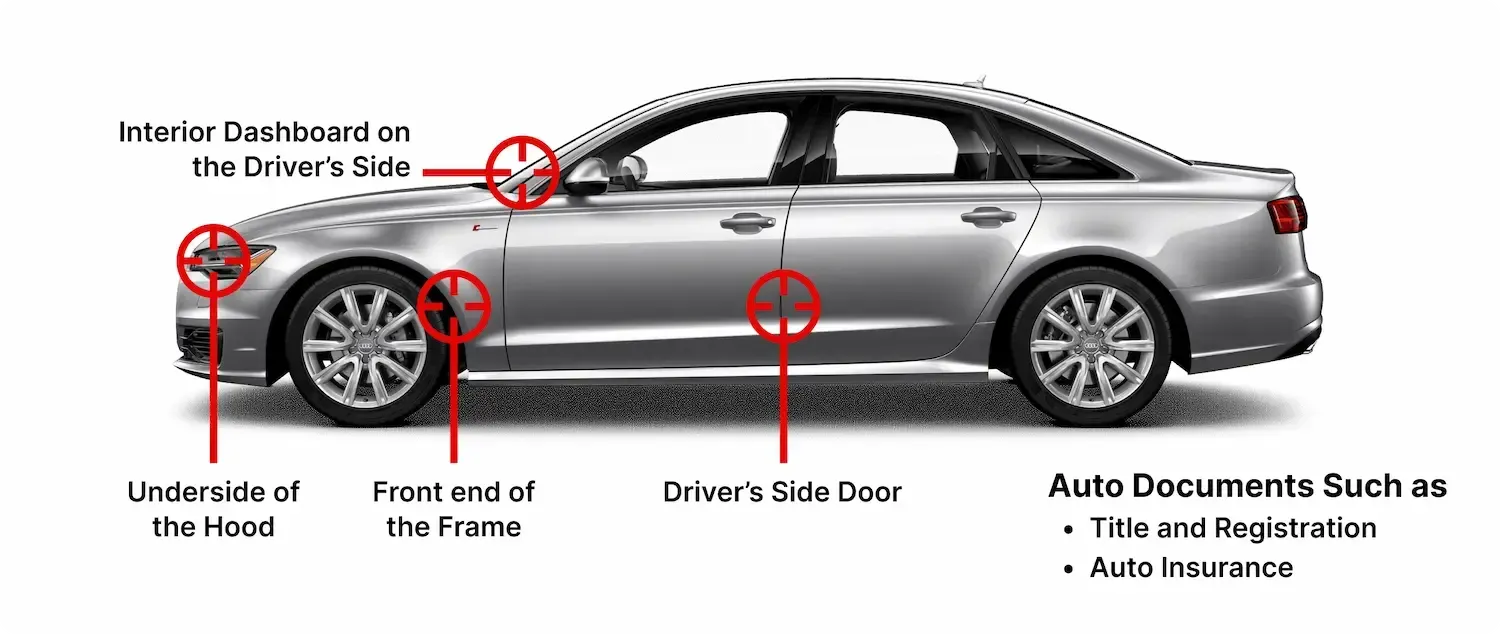
Audi VIN Location
The VIN is placed in several areas on the vehicle as well as in its paperwork. Check the following locations to identify it.
Driver’s Side Dashboard
Look through the windshield at the lower corner of the dashboard on the driver’s side to find the VIN plate.
Driver’s Side Door Jamb
Open the driver’s door and check the door frame or pillar for a sticker or metal plate near the latch area.
Engine Bay
Inspect the engine compartment for a stamped VIN, usually located along the bulkhead or near structural components.
Documents
The VIN is also listed on official documents such as the registration, insurance card, and vehicle title.
Classic Audi VIN Location
Older Audi models may follow familiar VIN placements, but some vehicles include less obvious or model-specific spots depending on the production year and design approach.
Under the Floor Mat
On select classic models, the VIN may be stamped directly onto the floor pan beneath the carpet, often positioned on the passenger side.
Body Panels
Some older Audi vehicles feature VIN tags on parts like the hood, trunk lid, or fenders, typically displayed on small plates or adhesive labels.
Who Should Use an Audi VIN Decoder
An Audi VIN decoder is useful for anyone dealing with a used or modern vehicle. With multiple trims, engine options, and technology packages, checking the VIN helps confirm details and avoid misunderstandings.
Buyers
Audi buyers often deal with varying trims, optional packages, and drivetrain setups like quattro. A VIN check helps confirm the exact configuration, ownership history, and records so the vehicle matches what is being advertised.
Sellers
Sellers can use VIN data to present accurate vehicle details in their listings. This helps reduce confusion around trims and options, supports fair pricing, and makes it easier for buyers to understand exactly what is being offered.
Dealers
Dealers can use our Audi VIN decoder to help verify configurations, reduce listing errors, and keep information consistent across platforms, especially when handling multiple trims and model variations.
Collectors
Collectors can use VIN data to confirm specifications and production details, particularly for older or limited Audi models. This helps ensure accuracy when evaluating vehicles where documentation may be incomplete or unclear.
Audi VINs Explained: Classic Simplicity vs Modern Standard
Audi VIN formats have evolved alongside the brand’s growth and engineering standards. Modern models follow a consistent global system, while older Audi vehicles often use shorter or less uniform identifiers, which can affect how much detail you can retrieve.
VIN Length and Format
Modern Audi vehicles use the standardized 17-character VIN introduced in 1981. Earlier Audi models may have shorter VINs, often between 5 and 14 characters, reflecting pre-standard production practices and simpler identification systems.
Data Availability
Modern Audi VINs provide detailed digital records, including specifications, engine data, and production details. Our classic Audi VIN decoder service can help you get the necessary data for the car.
Decoding Accuracy
Decoding modern Audi VINs is generally consistent due to standardized formatting and complete databases. Classic VIN decoding can be less precise, as formats vary and some historical records may be incomplete or not fully digitized.
How to Breakdown Audi VIN?
The Vehicle Identification Number is not a random sequence of digits, as it is used as a vehicle identifier. The VIN is classified into three different categories: WMI, VDS, and VIS–check the section below to see how an Audi VIN is deciphered.
World Manufacturer Identifier (WMI)
Digit 1 to 3: WAU
- W = Country of origin (Germany)
- AU = Audi
Vehicle Descriptor Section (VDS)
Digit 4 to 9: ENCF53
- E: Model line = Audi A5
- N: Body type = Sedan
- C: Engine type = 2.0L TFSI (Turbocharged Fuel Stratified Injection)
- F: Safety restraint system = Front and side airbags
- 5: Transmission = Automatic
- 3 = Check digit
Vehicle Identifier Section (VIS)
Digit 10 to 17: KA095546
- K = Model year (2019)
- A = Assembly plant in Ingolstadt, Germany
095546 = Production sequence number
Why Decoding an Audi VIN Matters
An Audi VIN is more than just an identifier. It reveals key details about the vehicle’s specifications, configuration, and history, helping you understand exactly what you are dealing with before making a decision.
Before Buying a Car
Audi models often come with different trims, engine options, and packages. Checking the VIN helps confirm the exact configuration, ownership history, and condition, reducing the risk of buying a car that does not match the listing.
Before Selling a Car
For sellers, accurate details matter by verifying specifications and history, making listings clearer and more reliable. It also helps address buyer concerns about past issues such as accidents, liens, or ownership records.
Verify Vehicle Identity
Decoding the VIN ensures the vehicle matches its make, model, trim, and drivetrain, such as quattro systems. This helps detect mismatches, incorrect listings, or potential fraud, especially when details are unclear.
Check History and Records
Review the car records such as ownership history, accident report, and title check. Checking the VIN helps to understand how a vehicle has been used in the past and whether there are issues that could affect performance, safety, and value.
Want More Info About Your Audi? Get A Vehicle History Report
The Audi history report gives you detailed information about the car. In the report, you will find detailed information about the vehicle, like the specifications, MSRP, and records.
Vehicle Specification
Access factory details such as engine type, transmission, drivetrain (quattro or FWD), trim level, and original MSRP. This helps confirm the vehicle matches the listing and ensures it fits your needs, driving style, and budget.
Title Records
Check the title status for issues like salvage, rebuilt, lemon, or theft records. These can affect registration, safety, and resale value, making it important to verify before buying or selling an Audi.
Odometer Reading
Review mileage records across different dates to confirm consistency. This helps detect unusual changes, gaps, or possible rollback cases, which is important when evaluating used Audi vehicles with varying usage patterns.
Accident and Damage History
Check for reported accidents, structural damage, or environmental exposure such as flooding. This helps assess repair quality and determine whether the vehicle maintains the performance and safety expected from an Audi.
Auction History
See if the vehicle was sold at auction, including dates, locations, and final prices. Some entries may include images, giving insight into the vehicle’s condition at the time it was listed or sold.
Ownership History
View the number of previous owners, general locations, and ownership duration. This helps you understand how the vehicle was used and whether frequent ownership changes may impact reliability or long-term value.
Recalls Check
Identify any safety or performance recalls issued for the Audi. The report may include recall details and whether repairs were completed, helping you avoid unresolved issues that could affect performance or safety.
Engine Information
Confirm engine type, configuration, and key performance details. This helps ensure the vehicle matches its original build and supports accurate comparisons when reviewing listings or checking for modifications.
Get More Information About Any Audi Using Our Tools
Use our service to get more information about the Audi before you decide to take it home. Check its recall history and get the window sticker easily.
Check the Audi recall history by using the VIN. Make sure all issues are resolved before you buy.
Check any Audi’s factory information by getting the window sticker by VIN.
Decode Modern and Classic Audi Models by VIN
Use our Audi VIN decoder tool to decode the VIN for any Audi models and trims–including its classic models.
Supported Modern Audi Models
We support all modern Audi models. Check which one is yours.
Supported Classic Audi Models
Aside from the modern VIN, we also support classic Audi models.
Check All Vehicles’ VIN
Use our VIN decoder to get the vehicle history report to make sure that the vehicle has no bad history.
Update on Audi EV
Audi began testing the EV market with the e-tron SUV in 2019. Later, the manufacturer began to expand and enhance their electric vehicle. In addition to that, Audi also collaborated with SAIC from China to expand its new EV subsidiary brand.
Audi EV Journey
Audi’s electric vehicle journey began with the e-tron SUV in 2019, followed by the performance-focused e-tron GT in 2021. The introduction of the Q6 e-tron and A6 e-tron in 2024 marked a significant step forward in Audi’s next-generation EV development.
Expanded EV Lineups
Audi continues to grow its electric portfolio across multiple segments, offering a broad range of models from compact crossovers to high-performance GT vehicles. Key examples include the Q4 e-tron, Q6 e-tron, A6 e-tron, and the e-tron GT, covering both everyday usability and premium performance.
EV Partnership
In China, Audi has partnered with SAIC to develop a new EV-focused sub-brand called “AUDI.” This initiative will introduce a range of China-exclusive electric models over the coming years, with multiple vehicles planned through the mid-2020s to support local market demand.
FAQs About Audi VIN Decoder
How do I decode an Audi VIN number?
To decode a 17-character Audi VIN, use a reliable online VIN decoder. Key indicators include the first character for country of origin (for example, “W” for Germany), the 10th character for model year, and the first three characters (such as WAU or WUA) for the manufacturer.
What do the 35 and 40 mean on Audi?
Audi’s 35 and 40 badges do not refer to engine size. Instead, they represent a standardized power output range introduced in 2017, making it easier to compare performance across petrol, diesel, and hybrid models.
What is the difference between Audi Q4 35 and 40?
The Audi Q4 35 e-tron and 40 e-tron differ mainly in battery size, range, and power. The 40 variant has a larger battery and more power, offering a longer range, while the 35 version uses a smaller battery with lower output.
Can an Audi VIN tell me the model year?
Yes, an Audi VIN can reveal the model year. The 10th character in the 17-character VIN corresponds to the vehicle’s model year.
Can an Audi VIN reveal the car's origin?
Yes, an Audi VIN can show where the vehicle was built. It identifies the country of origin, manufacturer, and sometimes the specific assembly plant through its structured 17-character format.
How to read a VIN number on a classic car?
Decoding a classic Audi VIN requires manufacturer-specific references, as pre-1981 VINs are often shorter and less standardized. These numbers can usually be found on the dashboard, door pillar, firewall, or engine block.
How many digits is a 1980 VIN number?
A 1980 vehicle may or may not have a 17-character VIN. While some adopted the format early, full standardization began in 1981, so many 1980 models still use shorter VINs with fewer characters.