
VIN Check - Get an Instant Vehicle History Report
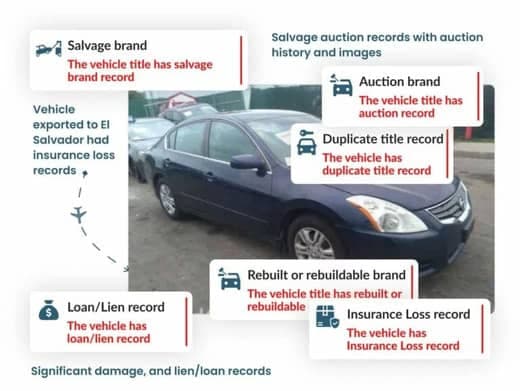
Are you buying or selling a used vehicle? Don’t forget to run the VIN Check and get the vehicle history report to examine the vehicle’s complete specifications and its record, like auction, accident, damage, title, and sales records.



What is a VIN Check
A VIN check is the process of using a vehicle's unique 17-character Vehicle Identification Number (VIN) to access detailed information about that vehicle. It helps verify that a vehicle's identity matches the information provided by the seller and can uncover issues that may not be visible during a physical inspection.
When you run a VIN check, you get a comprehensive vehicle history report that reveals:
- Vehicle specifications (make, model, year, engine, transmission, and more)
- Title status and any branded titles (salvage, rebuilt, junk, flood, lemon)
- Accident history with severity levels
- Mileage records and potential rollback detection
- Theft records and stolen vehicle alerts
- Open and completed recalls
- Auction history with condition photos
- Service and maintenance records
- Ownership history with duration and locations
- Lien and loan records
- Sales history and market valuation
A VIN check gives you the full picture so you can buy with confidence and avoid costly mistakes.
VIN Check vs VIN Decoder: What's the Difference?
Many people confuse a VIN check with a VIN decoder, but they serve completely different purposes.
Feature | VIN Decoder | VIN Check |
|---|---|---|
What it provides | Basic vehicle specifications | Complete vehicle history report |
Information included | Make, model, year, engine, transmission, trim, country of origin | Specifications + title status, accidents, mileage, theft, recalls, auctions, liens, ownership, service records, and more |
Best for | Identifying what a vehicle is | Understanding what a vehicle has been through |
Risk detection | None | Identifies salvage titles, flood damage, odometer rollback, theft records |
Cost | Usually free | Paid for comprehensive reports |
Think of it this way: A VIN decoder tells you the vehicle's identity. A VIN check tells you its life story including the hidden chapters the seller might not mention.
If you just need basic vehicle specifications, use our Free VIN Decoder tool. If you're buying a used car and need to know its full history, run a VIN check and get the complete report.
What Information is Included in the VIN Check?
Once you’ve successfully checked the VIN number with our VIN check service, you will get a vehicle report that shows the detailed specifications and the records, like accident, auction, and recall history.
Here’s what you will be getting through the vehicle history report by VIN check.
Vehicle Specifications
Get the detailed vehicle specifications information through a VIN check. In this section, you will get the detailed information about the drive type, engine capacity, country of origin, fuel type, transmission, MSRP, vehicle type, trims, and doors.
Odometer Reading
Check how the mileage has changed over time. See the recorded mileage along with the date and the last known mileage of the vehicle before it was put on sale.
Title Check
Confirm the title status of the vehicle before buying. The report shows whether the title is clean, rebuilt, salvaged, or junked. Knowing this early can help you avoid costly repairs and legal problems.
Damage Verification
Find out if the car has ever been damaged by an accident, flood, fire, or other events. The report lists different types of damage so you can better understand the car’s true condition.
Accident Records
See if the vehicle has ever been involved in an accident. Details may include how many times it happened, the date and place, and the extent of the damage.
Recalls Check
Check if the vehicle was recalled by the manufacturer. In this section, you can get the detailed information on the recall dates, what causes the recall, and the recall status, whether it's fixed or still open.
Stolen Vehicle Records
Check if the car was ever reported stolen. The report shows when and where the theft occurred and the source of the record, helping you avoid buying a stolen or smuggled car.
Auction Records
Review past auction data to see the vehicle’s real condition. The report may include up to 10 photos, showing where and when it was auctioned, its damage status, and the final sale price to help you know the vehicle’s market value.
Service and Repair History
In this section, you’ll get to see the history of service and repair that was done to the vehicle. Get the full information on the date, location, and the kind of service or repair performed.
Sales History and Market Valuation
Check how many times the vehicle has been sold. In this section, you will also see the price of the vehicle that was sold in a few different conditions: outstanding, clean, and rough.
Service and Maintenance Records
Check the scheduled maintenance for the vehicle that is due when a vehicle reaches a certain mileage to keep the vehicle running smoothly.
Inspection Records
This section displays whether the vehicle has passed its required inspections and includes details such as inspection dates and recorded results. Regular inspection records also help confirm that the car has been properly maintained and meets safety standards.
Warranty Records
Check if the vehicle is still covered by warranty. Our vehicle report shows you the limits, like the mileage and months of each warranty, like roadside assistance, bumper-to-bumper, corrosion perforation, and more.
How to Run a VIN Number Lookup?
To run our VIN check service, you will need to have the VIN of the vehicle you want to check. After that, follow these simple steps to successfully check VIN number.
Step 1: Find the VIN
You will need to find the VIN of the vehicle you want to check. Refer to the section above to see where you can get the VIN.
Step 2: Fill in the Form
Click on the form above, then write down the VIN. After that, click on the button to begin the process.
Step 3: Get Full Vehicle History Report
Examine the preview page, then proceed to payment to get the full vehicle history report.
How Do I Find the VIN for My Vehicle?
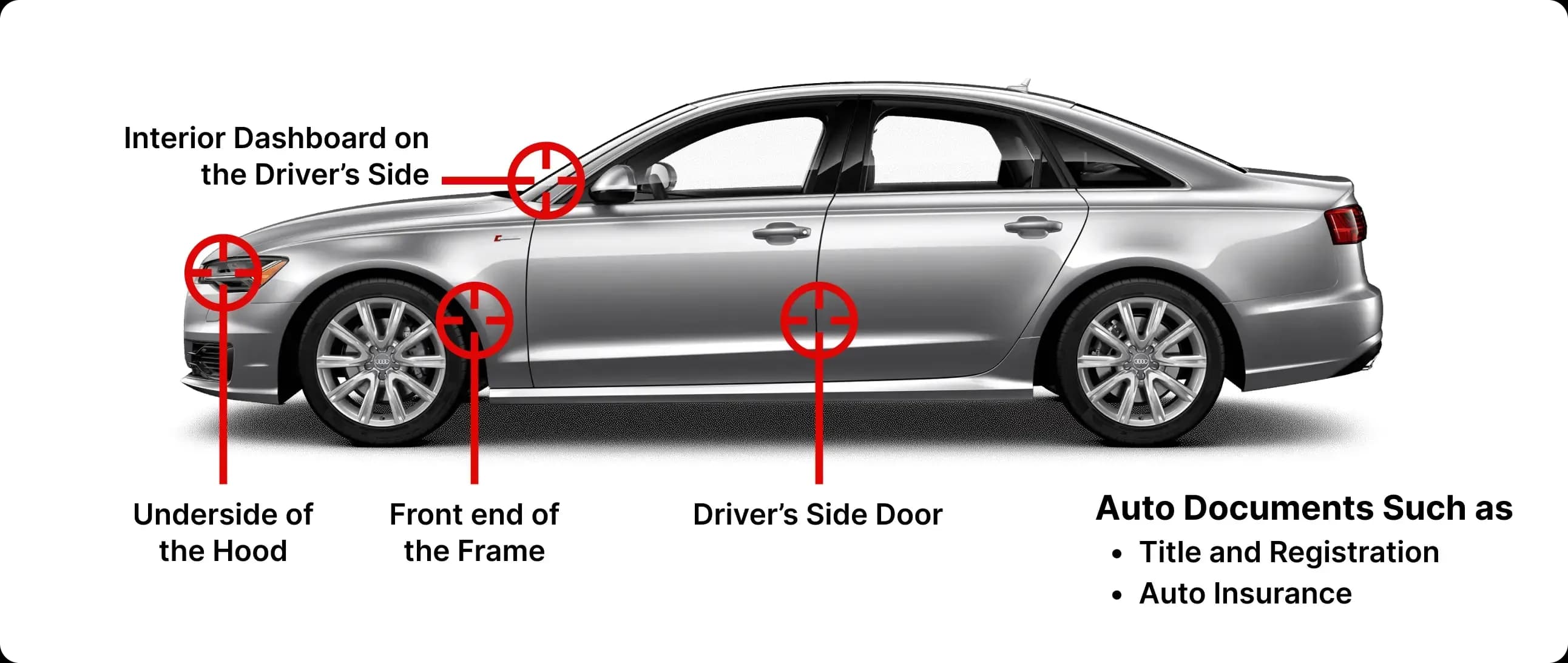
To find the vehicle, you can examine these locations, as well as the vehicle’s documentation, to get the VIN.
On the vehicle’s body
- Dashboard: The most common location. You can see it through the windshield on the driver’s side.
- Driver’s Side Door: Look inside the door post or door jamb. It’s usually printed on the Federal Safety Certification Label.
- Under the Spare Tire: Sometimes the VIN is in the trunk area, under the spare tire. You may need to lift the tire to find it.
- Front of the Vehicle Frame: The VIN may also be stamped under the hood, near the windshield washer container, or on the frame, often on the driver’s side.
On the vehicle’s paperwork
Check on the vehicle’s paperwork, like the insurance or the registration paper, to get the VIN. Aside from that, here’s the list of paperwork where the VIN can be found:
- Title Document: The Vehicle Identification Number (VIN) is printed on the first page of the title, along with details like the vehicle’s make, model, and body type at the top of the page.
- Registration Card: The VIN also appears on the front of your registration card. If you don’t have it, you can contact your local Department of Motor Vehicles (DMV) to ask for a replacement.
- Owner’s Manual: The VIN is usually printed in the owner’s manual, especially for brand-new cars. However, used cars may not always include the original manual.
- Body Repair Records: Auto repair shops record the VIN when doing maintenance or repairs. It helps them order the correct parts and keep accurate records of the work done.
- Police Reports: After an accident or theft, the police use the VIN to identify the vehicle and create official reports related to the case.
- Insurance Documents: When you insure your vehicle, the insurance company uses the VIN to confirm the car’s identity. After verification, it will appear on your insurance card or policy papers.
Why You Should Perform a VIN Check Before Buying a Vehicle?
Checking the VIN number through a VIN check service is important, as it helps you be informed about the vehicle’s full information, including the specifications and the records.
Here’s the importance of a vehicle VIN check that you should know about.
Check the Vehicle History
A VIN check provides a full picture of a car’s past. It can show ownership changes, accident reports, insurance, and whether the vehicle was used for commercial purposes, such as a taxi or fleet service.
Detecting Fraud
A VIN check provides a full picture of a car’s past. It can show ownership changes, accident reports, insurance claims, and whether the vehicle was used for commercial purposes, such as a taxi or fleet service.
Check the Safety Aspects
A vehicle VIN check helps you uncover the recalls and damage history of the vehicle, so you can be aware of its safety beforehand.
Legal Compliance
Checking the VIN number also confirms if the car is legally clear for sale. It helps verify that the vehicle is not stolen and follows local registration laws.
Insurance Valuation
The information from a VIN check can affect both insurance rates and market value. Insurers use these records to assess risk, while buyers can use them to negotiate a fair price and avoid vehicles that might be expensive to insure.
Get the Best Deal
With a VIN check, you can be informed about the vehicle’s MSRP; this information is crucial to make a good point when negotiating with the seller.
Who Uses a VIN?
The Vehicle Identification Number (VIN) is important for many people during a car’s life. It is not only used by the owner but also by professionals and authorities who deal with vehicles every day.
- Mechanics: Since each vehicle has its own unique code, the VIN helps them identify the exact model, engine type, and production year.
- Insurance Companies: The VIN is used to check the car’s history before giving coverage. They use it to see if the car has been in accidents, stolen, or rebuilt, which helps them decide the insurance cost.
- Manufacturers: Checking the VIN helps them track recalls, production details, and warranty information throughout the car’s life.
- Police and Law Enforcement: The VIN is used to identify stolen vehicles or cars involved in crimes. It allows them to match records and confirm if the vehicle’s identity has been changed illegally.
- DMV or BMV offices rely on the VIN for registration, title transfer, and legal documents. It ensures that every vehicle is correctly recorded under the right owner.
In addition to that, buyers should run a vehicle VIN check on a vehicle’s background before purchasing. It helps them learn about past accidents, ownership, and title status to make a safer buying decision.
How Our VIN Check Data Stays Fresh and Accurate
Your VIN check is only as good as the data behind it. That's why we maintain a rigorous data refresh schedule:
Data Source | Update Frequency |
|---|---|
DMV title and odometer records | Synced every 24 hours |
Auction records | Synced in real time |
Auction records | Synced in real time |
Theft records (NICB) | Updated daily |
Recall information (NHTSA) | Updated daily |
Service and maintenance records | Updated daily |
This continuous update process ensures every report reflects the most current and verified information available. When you run a VIN check, you're getting the latest data, not outdated records.
VIN Check for All Vehicle Types
We offer VIN checks for a wide range of vehicle types, not just cars. Here's what we cover.
Cars
Get complete history for passenger vehicles, including accidents, title status, mileage verification, recalls, and more. Works for all makes and models built after 1981.
Trucks and Heavy-Duty Vehicles
Check the history of pickup trucks, commercial trucks, and heavy-duty vehicles. Find accident records, title issues, and recall information specific to trucks with Truck VIN lookup tool.
Motorcycles
Run a VIN check on motorcycles to uncover accident history, title brands, theft records, and lien information. Learn more about our motorcycle VIN check.
RVs and Motorhomes
Get a complete history report for recreational vehicles, including ownership history, accident records, and recalls. Learn more about our RV VIN check.
Trailers
Check the history of trailers, including title status, lien records, and damage history.
Classic and Pre-1981 Vehicles
We support VIN checks for classic and vintage vehicles. Learn more about our classic VIN lookup service for older vehicles with different VIN formats.
Our VIN Check Service vs. Competitors
See how our VIN check service is better than the other competitors, including Carfax! Check the table below to see what made us better in the vehicle VIN check industry.
Comparison | Detailed Vehicle History | Carfax | EPICVIN | Auto Check |
|---|---|---|---|---|
Sales listing with photos | ||||
Market value data | ||||
Detailed vehicle specifications | ||||
Auction records with photos | ||||
Offline VIN Decoding | ||||
Support for classic vehicles | ||||
Maintenance recommendation | ||||
Ownership History | ||||
Accident history | ||||
Damage check | ||||
Branded title check | ||||
Salvage title check | ||||
Ownership history map | ||||
Recalls | ||||
Support for heavy duty trucks, trailers & motorcycles | ||||
Mobile & desktop application |
Case Study: The $6,000 Mistake a VIN Check Would Have Prevented
Same listing. Same seller. The only difference was whether the buyer ran a VIN check before handing over their money.
Scenario: Buying a used 2017 Ford Fusion 2.0L from a private seller in California.
Without a VIN Check
The seller says it's a one-owner car in good condition. You take their word for it.
Rear-end accident, never mentioned
Police report filed July 2022 in Upland, CA. The vehicle was towed from the scene.
Salvage title – not clean
Transferred to an insurance company after the accident, then sold at salvage auction for $5,250.
Two active liens on the vehicle
Someone else has a legal claim. You could buy the car and still lose it.
10 recalls – transmission, steering, seats
With a VIN Check
Before you reply to the listing, you run the VIN. It takes seconds.
Full accident record surfaced instantly
Police report number, date, location, and tow are all documented.
Salvage title flagged, with auction photos
You see the real damage condition before speaking to the seller.
Both liens visible, with dates and sources
You know to demand a lien release before any money changes hands.
All 10 recalls listed with components and status
You overpay by up to $6000
This car last sold at salvage auction for $5,250
You walk away or negotiate hard
Either way, you're in control
What Our Customers Are Saying
Window Sticker and Vehicle History report
I had ordered a window sticker and vehicle history reports for my car
Detailed Vehicle History company helped me to get the report very detailed and accurate at very low price if you compare with carfax, and the window sticker report was very accurately and fast
I am highly recommend this Detailed Vehicle History company for your vehicle history report at very price
Thank you
I had a great experience. They were quick to respond to my questions and provided the information I needed with a strong sense of urgency. The data was clear, accurate, and delivered efficiently, making the entire process smooth and hassle-free. Highly recommend them if you’re looking for a fast and trustworthy vehicle history report!
Excellent service
Very thorough report. Live chat was superb and knowledgeable. It was extremely helpful to see all the DMV, recall and general history of my vehicle. I recommend using this service. THANK YOU!
Check VINs From Other Countries
Run VIN Check in Other States
VIN Check FAQs
Is it Safe to Give Out My VIN?
You can safely share your Vehicle Identification Number (VIN) in most normal cases, like when selling or insuring your car. Still, it’s best not to share it everywhere. The VIN itself doesn’t show who you are, but if someone dishonest gets it, they could use it for crimes such as VIN cloning.
Do you cover all vehicle makes?
Yes, our VIN check tool covers all major makes worldwide. Thus, if you have a classic car, you can also run a classic VIN decoder with our service.
How long can I access my reports?
Our VIN lookup reports are accessible to you forever, with no expiry date. You may also buy additional VIN Check packages in the future.
Can a VIN tell you who owns a car?
You cannot find a car’s current owner using only the VIN because privacy laws like the DPPA (Driver’s Privacy Protection Act) keep that information confidential.
How to Check if a Car is Stolen by VIN?
You can use our VIN Check and get a vehicle history report. On the vehicle report, you will see a “Theft Record” section where you can examine the date, location, and the stolen vehicle data source.
How to check VIN Number for Free?
If you want to check the VIN number for free, you can use our free VIN Decoder tool. However, note that you will only get the basic information of the vehicle, like the trim, country of origin, transmission, and drive type.
What information will a VIN lookup show me?
A VIN lookup gives you two main types of essential information. First, it’s the vehicle’s core details, such as its manufacturer, model year, country of origin, and where it was assembled.
Second, it provides a comprehensive history report, which details everything from past owners and service records to accident history, open recalls, theft alerts, and any major title issues like salvage or flood branding. Check a sample record to see what you will get through a VIN lookup.
Which documents usually have the VIN number?
You can find a vehicle’s VIN on essential paperwork like the title, registration, and insurance card. The VIN also usually appears on other important vehicle records, such as service and repair invoices.
Can a vehicle’s VIN ever be changed?
The VIN (Vehicle Identification Number) is a unique code that lasts forever. It’s illegal to change it.The only time a new VIN is allowed is in rare, special cases like:
- Major rebuilds after huge damage.
- Restoring a classic car.
- Police recovered it after it was used in a crime.
In these rare cases, the DMV must inspect the car thoroughly and issue a brand-new, unique VIN. Trying to hide or change a VIN is a felony
Are VIN numbers unique for every vehicle?
Yes, the VIN number is unique for every vehicle. Every vehicle has a unique 17-character VIN (Vehicle Identification Number). This code is the primary identifier and stays with that specific vehicle for its entire lifespan. Every vehicle manufactured since 1981 has a unique 17-character VIN. This system ensures no two cars share the same number.
Because each VIN is permanent and unique, it can be used to monitor a car’s accidents, recalls, and theft reports, making it an essential tool for both owners and law enforcement.
How Often do We Update our Database?
Our database is regularly updated, with most of the sources automatically refreshing the data every 24 hours. For example, our title and odometer reading records are in sync with the DMV across the state.
We’ve updated our insurance and loss report within 48 hours to a maximum of 72 hours after the events happened, after being processed by the authorities. In addition to that, our auction records are synced in real time, so if a vehicle was sold at an auction yesterday, our database is automatically updated with the latest information.
This continuous update process ensures that every report reflects the most current and verified information available.
Can a VIN check detect odometer fraud in used cars?
Yes, a vehicle history report is one of the best ways to spot odometer tampering. The report tracks the mileage every time the car gets serviced, inspected, or switches owners. If the current number on the dashboard is lower than a past recording, the report will flag it as a mileage rollback.
Can a VIN check detect stolen vehicles?
Yes, The report pulls data from police databases and the National Insurance Crime Bureau. If a car was reported stolen and never recovered, the VIN lookup will immediately alert you. Buying a stolen car means you could lose both the vehicle and your money, so this lookup keeps you safe.
What does a clean VIN mean?
A clean VIN means the vehicle does not have any severe red flags on its record. It shows the car has a clean title, meaning it was never totaled in a major wreck, flooded, or sent to a junk yard. It also implies the car has no active theft reports or financial liens against it.
Note: A "clean" VIN does not mean the car is in perfect mechanical condition. It only means the car hasn’t gone through major paperwork issues or big disasters.
What problems can a VIN check reveal?
A VIN lookup uncovers hidden issues that a seller might try to hide. It shows:
- Past accidents and title brands (such as Salvage or Rebuilt)
- Mileage records and potential rollbacks
- Auction history with images
- Service and maintenance records
- Number of previous owners
- Whether the car was used as a taxi, rental, or fleet vehicle
This transparency helps buyers make smarter decisions when purchasing used cars.
Can a VIN check show manufacturer recalls and safety issues?
Yes. A VIN report includes safety recalls issued by the manufacturer or the National Highway Traffic Safety Administration (NHTSA). If an auto manufacturer or NHTSA finds a dangerous defect such as faulty airbags or software glitches, they issue a recall to fix it free of charge. The report also shows whether the previous owner took the car to a dealership to complete the recall repair, giving buyers peace of mind about safety.
Is there a mobile app for VIN checks?
Yes. You can use the VIN Check App to perform VIN checks using your smartphone. Simply enter or scan a VIN to access available accident history, title records, mileage, recalls, ownership history, auction records, and other vehicle history information. Download the VIN Check App for Android on Google Play or the VIN Check App for iPhone & iPad on the App Store.