
Free VIN Decoder for Vehicle Lookup
Not sure what a vehicle really is? Enter the VIN to find out instantly. This free VIN decoder shows the year, make, model, engine, transmission, and essential specifications so you can verify listings and avoid costly mistakes.



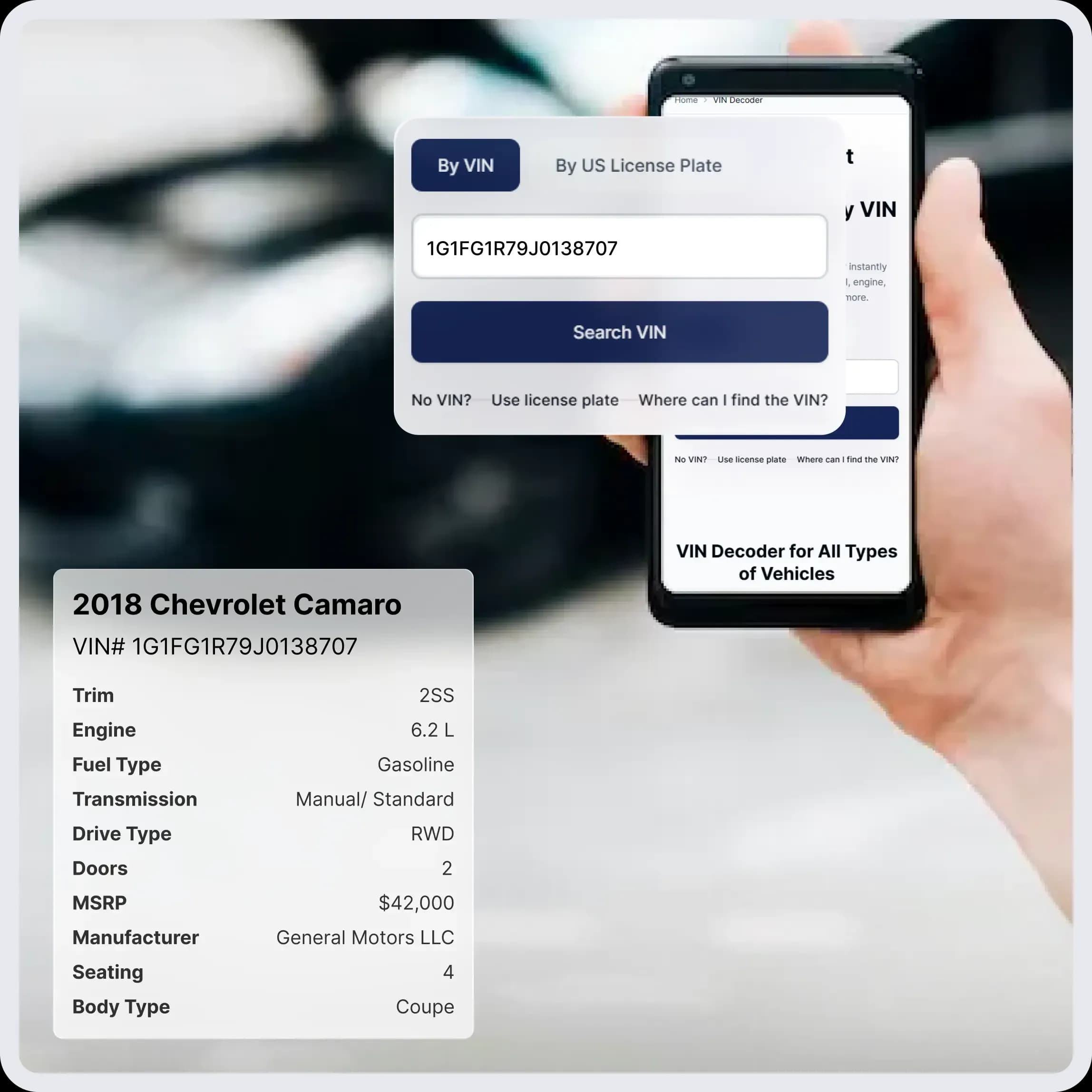
What is a VIN Decoder?
A VIN decoder is a tool that translates the 17-character Vehicle Identification Number (VIN) into information about a vehicle’s original factory specifications. By entering a VIN, a decoder can identify key details such as the manufacturer, model, model year, engine type, transmission, body style, drivetrain, assembly plant, and other vehicle attributes encoded by the manufacturer.
What Information You Can Decode From a VIN Lookup Tool?
A VIN Lookup Tool shows how a vehicle was originally built, based on the VIN assigned at the factory. The details come from the VIN itself, not from listings or assumptions.
When you decode a VIN, you are looking at the vehicle’s actual specifications, not generic model information. These specs help confirm what the vehicle really is, which is especially useful when details matter or something feels off.
Basic Vehicle Identification
These details confirm the vehicle’s core identity and help verify that listings and documents match the actual car. They are often the first things buyers check when comparing vehicles.
Year
Make
Model
Trim
Body type
Country of manufacture
Engine and Powertrain Details
This section explains how the vehicle is powered and how that power is delivered to the wheels. It is especially useful for confirming engine options, drivetrain setups, and hybrid or electric components.
Engine size and specifications
Engine configuration
Engine model and description
Displacement
Valve train design
Transmission style
Drive type
Fuel type
Electrical powertrain
Electrical specifications
Traction battery
Range extender
Dimensions, Weight, and Capacity
These specifications describe the vehicle’s physical size and how much it can safely carry or tow. They help determine usability, garage fit, and load limits.
Exterior dimensions
Interior dimensions
Cargo dimensions
Ground clearance
Weight
Number of doors
Seating capacity
Standard seating
Tank capacity
Safety, Emissions, and Compliance
This information highlights safety equipment and regulatory classifications tied to the vehicle. It is useful for understanding compliance, inspection requirements, and environmental standards.
Front airbag information
Seat belt type
Tire pressure and size
Braking system
Emissions data
EPA class
Chassis, Suspension, and Handling
These details relate to how the vehicle rides, steers, and performs in different driving conditions. They are especially helpful for towing, off-road use, or performance-focused vehicles.
Suspension
Steering
Wheels
Trailering capability
Off-road attributes
Pricing and Factory Data
This section reflects original factory pricing and cost-related information when available. It helps buyers and sellers understand how the vehicle was priced when new.
MSRP
Delivery charges
How to Run a Free VIN Decoder?
After you get the VIN, enter it into the VIN decoder. You’ll instantly see key details like the year, make, model, engine, trim, and other vehicle specs.
Step 1: Find the VIN
You will need to find the VIN of the vehicle you want to check. Refer to the section above to see where you can get the VIN.
Step 2: Fill in the Form
Click on the form above, then write down the VIN. After that, click on the button to begin the process.
Step 3: Get the Report
Wait for a few seconds to get the report generated by our system. Then, download the vehicle history report in PDF format.
How Do I Find the VIN Number for My Vehicle?
You can easily find the VIN for any vehicle on the driver’s side dashboard. Look through the windshield on the driver’s side. The VIN is often visible from outside the vehicle on a metal plate at the bottom of the windshield.
You can also find the VIN on the:
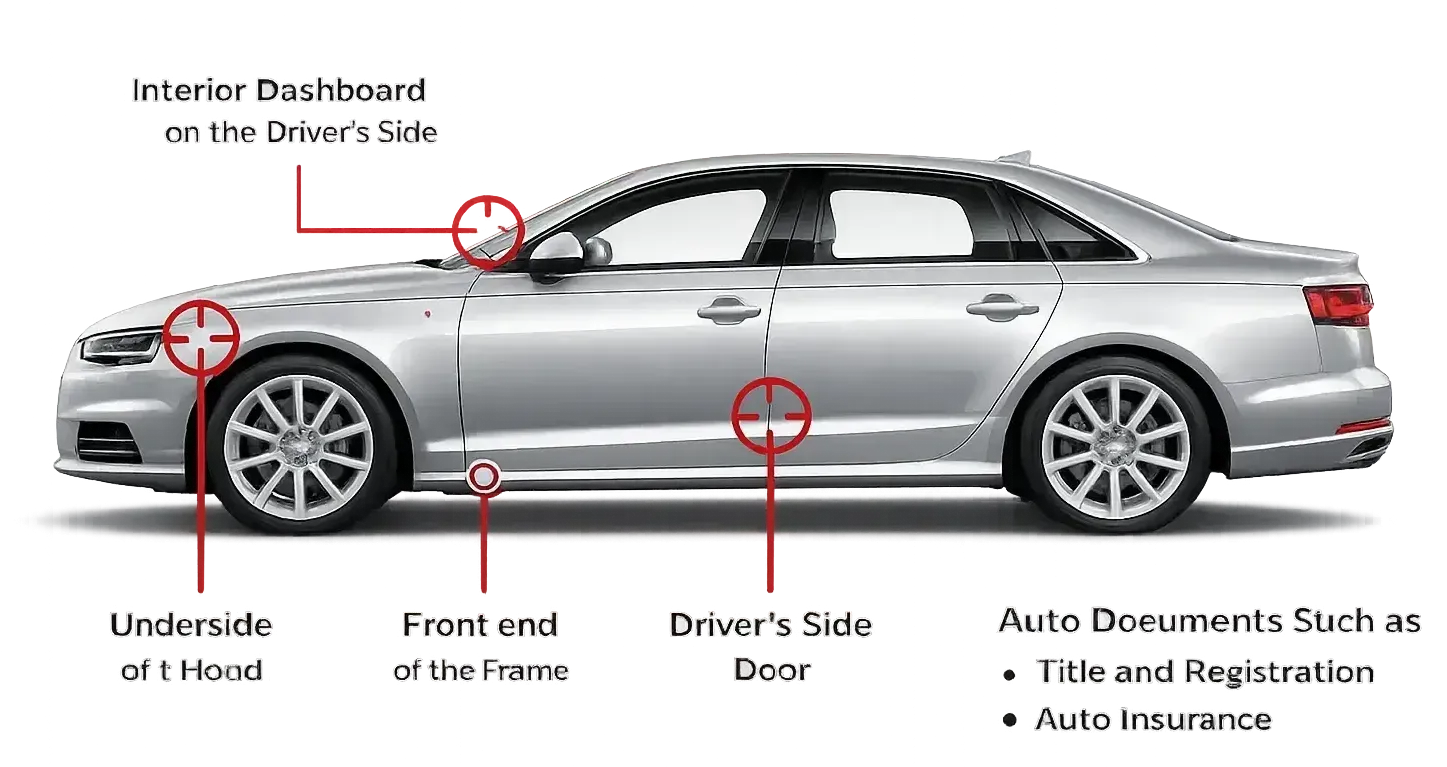
Driver’s Side Door Jamb
Open the driver’s door and look for a sticker or metal plate near the latch area that lists the VIN and other vehicle details.
Engine Block
Some manufacturers stamp the VIN directly onto the engine block, which is more common on older vehicles or performance models.
Under the Hood
Check the firewall, radiator support, or strut towers for a stamped VIN or manufacturer label.
Vehicle Trunk
In some cars, the VIN may appear under the trunk lid, near the spare tire well, or on a body panel inside the trunk.
Vehicle Registration Documents
Your registration card or certificate always lists the VIN exactly as recorded by the DMV.
Insurance Documents
Insurance policies and proof-of-insurance cards include the VIN used to identify the covered vehicle.
Free VIN Decoding Examples
Our free VIN decoding service can help you get a few important pieces of information about the vehicle. It shows the vehicle’s specifications, auction/sales record, and market value. These are the examples showing how you can do a free VIN decoding service.
Here’s what you will be getting on the free VIN check:
VIN | Year | Manufacturer | Model | Engine Capacity | Engine Type | Auction History | Market Value | Fuel Type |
|---|---|---|---|---|---|---|---|---|
WBXPC93489WJ29870 | 2009 | BMW | X3 | 3.0L | L6 DOHC 24V | 0 | $6,498 | Gasoline |
1FUGGLDV6DLFA2220 | 2013 | Freightliner | Cascadia | 12.8 L | Detroit DD13 | 4 | $20,000 | Diesel |
478TE230744409755 | 2004 | HONDA | SPORTRAX | 0.4 L | Single-cylinder SOHC* | 0 | $6,000 | Gasoline |
ZARFAEBN3J7582817 | 2018 | ALFA ROMEO | GIULIA | 2 L | Turbocharged inline-four, DOHC, 16-valve | 5 | $14,390 | Gasoline |
5YJXCAE44GF006807 | 2016 | Tesla | Model X | Electric | Electric Motor | 3 | $30,000 | Electric |
SMTD54HFXNTBA4357 | 2022 | Triumph | Speed | 1.2 L | Three-cylinder DOHC* | 1 | $3,100 | Gasoline |
5VBABX5A2MA121581 | 2021 | Tiffin Motorhomes | INC Allegro Red | 6.7 L | ISB | 0 | $320,000 | Diesel |
4YDF26R278V505914 | 2008 | Keystone | Keystone | No engine | Trailer | 1 | $15,000 | Gasoline/Diesel |
252677X172255 | 1967 | Pontiac | Convertible | Not verified from this VIN alone | OHV | 2 | $15,000 | Gasoline |
How to Read Your Vehicle's VIN
VIN number breakdown
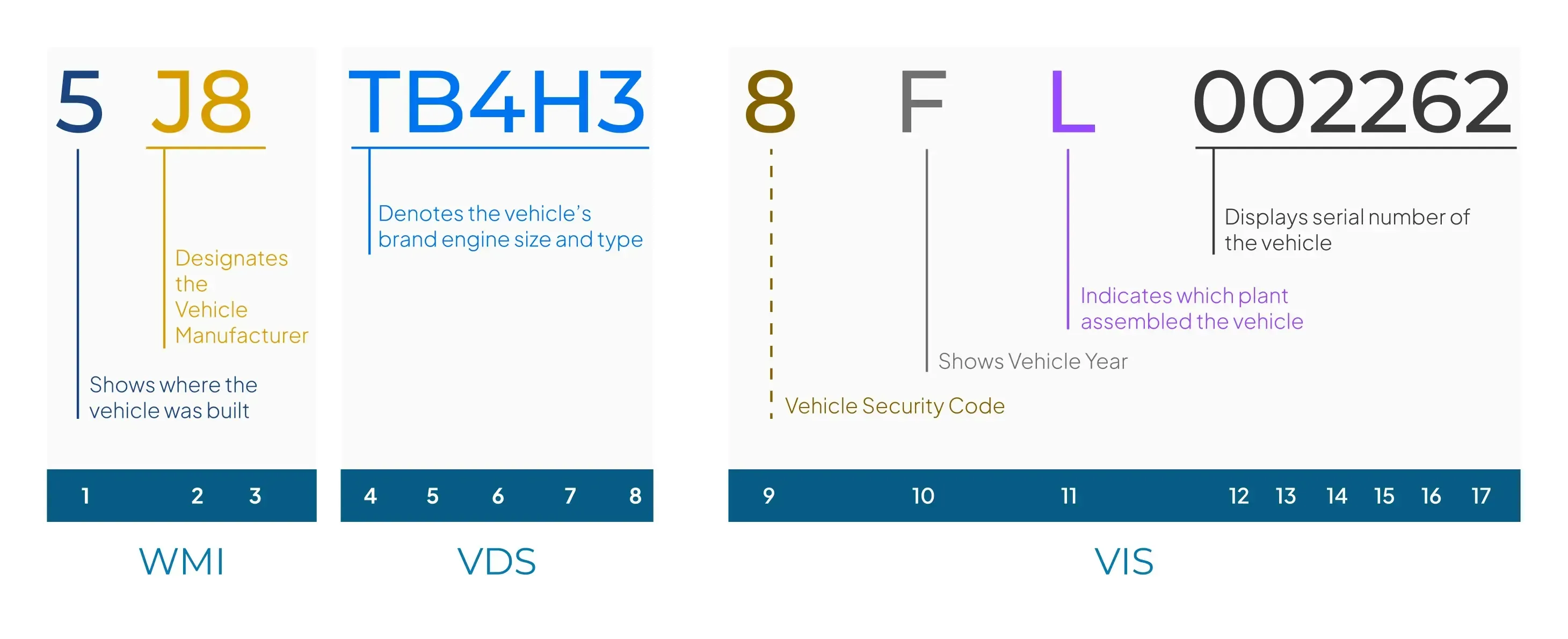
Have you been wondering what the numbers and letters in a VIN mean? Well, let's break it down for you. Each character in the VIN represents specific information about the vehicle. Before we go into the details, the table below lists what each character represents:
| VIN Digit | Meaning |
|---|---|
| 1st digit | Country |
| 2nd digit | Manufacturer |
| 3rd digit | Vehicle type |
| 4th - 8th digit | Vehicle Features |
| 9th digit | Check digit |
| 10th digit | Model year |
| 11th digit | Assembly Plant |
| 12th - 17th digits | Serial Number |
The VIN is divided into three sections: WMI, VDS, and VIS. Understanding these sections helps access important information about any car.
The 3 Main VIN Sections
The World Manufacturer Identifier (WMI)
The first three characters of the VIN number represent the WMI. They uniquely identify the Country of origin, vehicle manufacturer, and vehicle type.
For example, cars with VINs beginning with 1, 4, and 5 are manufactured in the United States. If you find the WMI to be “1G2”, 1G represents General Motors in the United States, and 1G2 stands for Pontiac passenger cars.
The table below shows some WMI Codes:
| Character | Region | Country |
|---|---|---|
| A-H | Africa | AA-AH = South Africa |
| J-R | Asia | J = Japan/ KL-KR = South Korea L = China MA-ME = India MF-MK = Indonesia ML-MR = Thailand MS = Myanmar PA-PE = Philippines PL-PR = Malaysia RF-RG = Taiwan |
| S-Z | Europe | SA-SM = United Kingdom SN-ST, W = Germany SU-SZ = Poland TA-TH = Switzerland TJ-TP = Czech Republic TR-TV = Hungary TW = Portugal VA-VE = Austria VF-VR = France VS-VW = Spain VX-V2 = Yugoslavia XL-XM = The Netherlands XS-XW = USSR X3-X0 = Russia YA-YE = Belgium YF-YK = Finland YS-YW = Sweden ZA-ZR = Italy |
| 1-5 | North America | 1, 4, 5 = United States 2 = Canada 3 = Mexico |
| 6-7 | Oceania | 6A-6W = Australia 7A-7E = New Zealand |
| 8-0 | South America | 8A-8E = Argentina 8F-8J = Chile 8X-82 = Venezuela 9A-9E, 93-99 = Brazil 9F-9J = Colombia |
Learn more about the country of origin of your vehicle through our VIN country codes.
VIN Number to Year Chart Code
Each VIN includes a character that identifies the vehicle’s model year. A VIN year chart helps translate that code into the correct production year.
How VIN Year Codes Work
For standard 17-character VINs, the model year is shown in the 10th character. The table below shows how each letter or number corresponds to a specific year.
| A 1980 | B 1981 | C 1982 | D 1983 | E 1984 | F 1985 | G 1986 | H 1987 | J 1988 | K 1989 |
| L 1990 | M 1991 | N 1992 | P 1993 | R 1994 | S 1995 | T 1996 | V 1997 | W 1998 | X 1999 |
| Y 2000 | 1 2001 | 2 2002 | 3 2003 | 4 2004 | 5 2005 | 6 2006 | 7 2007 | 8 2008 | 9 2009 |
| A 2010 | B 2011 | C 2012 | D 2013 | E 2014 | F 2015 | G 2016 | H 2017 | J 2018 | K 2019 |
| L 2020 | M 2021 | N 2022 | P 2023 | R 2024 | S 2025 | T 2026 | V 2027 | W 2028 | X 2029 |
| Y 2030 | 1 2031 | 2 2032 | 3 2033 | 4 2034 | 5 2035 | 6 2036 | 7 2037 | 8 2038 | 9 2039 |
Learn more about the model year in your VIN through our VIN to year chart.
Vehicle Identifier Section (VIS)
The Vehicle identifier section covers the rest of the VIN characters from the 10th to 17th characters. The 10th digit represents the model year and can be used to tell when a vehicle rolled off the assembly plant.
The 11th digit identifies the manufacturing plant where the vehicle was assembled, and the 12th to 17th digits are the vehicle’s serial number.
This Bentley Looks Like Luxury, But it’s Carrying 9 Liens!
Buyers can sometimes end up paying full price for vehicles with hidden problems. Here’s a side-by-side look at two Bentleys – one clean, and one with a troubled history. The difference is tens of thousands of dollars:
This car: VIN SCBDR33WX7C043412
2007 Bentley Continental GTC. Originally $189,990 new. Listed as a luxury private sale.
Salvage title
Titled to an insurance company in 2019, then sold at auction with a California Salvage Certificate.
Collision and vandalism damage
Both flagged across two separate auction listings.
7 owners, 3 held it for under 6 months
liens across California
Buy without lien release and you could lose the car entirely.
A clean Bentley
2007 Bentley Continental GTC, similar mileage, clean title, personal use.
Clean title, no salvage or insurance loss
No collision or vandalism on record
2 owners, consistent long-term ownership
No open liens, free and clear to buy
Real value: ~$8,000 to $12,000
Salvage title, collision, vandalism, 9 liens
Fair value: ~$25,000 to $35,000
Either way, you're in control
~$25,000
Priced to look like a clean luxury deal
~$10,000
Salvage, collision, vandalism, 9 liens
Potential overpayment without a VIN check
Up to $15,000
Before Bentley repair costs, which average 2 to 3x a standard vehicle
Why Our VIN Decoder Stands Out
Not all VIN decoders show the same level of detail. Ours is built to give clear, VIN-specific information that helps people verify vehicles quickly and accurately.
Some reasons why we stand out are:
Accurate VIN-Based Results
Every result is matched to the exact VIN entered, helping reduce errors caused by generic data
Works With More VIN Types
Supports standard VINs and older or non-standard formats across different vehicle types.
Trusted and Update Data Source
Get up-to-date vehicle data from DMV, auctions, police, insurance, and proprietary online sales sources.
Clean, Readable Output
Information is shown in a structured format that is easy to scan. This makes it useful on both desktop and mobile.
Built for Everyday Use
Useful for buyers, sellers, and dealers who need reliable vehicle details.
24/7 Customer Support
If something looks unclear or you need help, customer support is available to assist with your VIN lookup.
Looking for More Than Specifications?
A VIN decoder shows how a vehicle was built, but it does not show what happened after it left the factory. A full vehicle history report adds context by showing records tied to the vehicle’s real-world use.
With a full report, you can see details such as:
Reported accident and damage records.
Title history and title brand information.
Theft and recovery records.
Mileage readings over time.
Ownership and registration events.
Salvage, rebuilt, or write-off records.
Lien or loan records.
Open recalls and safety issues.
Free VIN Decoder vs. Vehicle History Report by VIN
Looking to take it a step further? You can use our paid VIN check service for a detailed vehicle history report. A vehicle history report gives access to records of vehicles, including accident records, damages, title brand records, theft records, and more.
| Free VIN Decoder | Vehicle History Report |
|---|---|---|
Free VIN decoding for all vehicle types | ||
Year, make, model, trim | ||
Full vehicle specifications | ||
Sales listings | ||
Auction records | ||
Mileage during auction/sales | ||
History Records | ||
Theft records | ||
Owner records | ||
Salvage records | ||
Title brand records | ||
Odometer rollback | ||
Lien and loan records | ||
Vehicle usage | ||
Service history | ||
Open recalls |
Why Use a VIN Decoder Before Buying or Selling a Vehicle?
For Buyer
See what the car really is
Listings do not always show everything, especially when features, trims, or engines are described loosely or incorrectly. Decoding the VIN fills in those gaps by showing the vehicle’s original configuration.
Pick up on warning signs
When specifications do not match what the seller is claiming, it is usually worth slowing down and taking a closer look. That pause gives you time to ask better questions.
Avoid buying blind
Knowing the real details helps you feel more confident about what you are buying and why it is priced the way it is. It also removes a lot of doubt that often comes from incomplete or unclear listings.
For Sellers
Double-check before posting
Running the VIN helps confirm important details before publishing a listing and responding to early buyer inquiries. This simple step can prevent corrections and confusion later.
Make buyers more comfortable
Clear and accurate specifications help buyers trust what they are seeing instead of second-guessing the information provided. When trust is higher, conversations tend to move faster.
Keep things simple
Accurate information from the start means fewer changes are needed once the listing is live. This makes the entire process easier and avoids confusion as the sale progresses.
For Dealers
Speed up daily tasks
VIN decoding reduces the need to manually verify specifications across multiple systems or documents. Over time, that saved effort adds up and improves efficiency.
Clean up listings
Correct specifications prevent confusion when vehicles are advertised across different platforms or channels. Confusion slows deals down and creates avoidable friction with buyers.
Stay consistent
Verified VIN data helps maintain consistency across sales, appraisals, trade-ins, and internal records. That consistency supports smoother workflows and fewer errors overall.
Real Customer Feedback
Window Sticker and Vehicle History report
I had ordered a window sticker and vehicle history reports for my car
Detailed Vehicle History company helped me to get the report very detailed and accurate at very low price if you compare with carfax, and the window sticker report was very accurately and fast
I am highly recommend this Detailed Vehicle History company for your vehicle history report at very price
Thank you
I had a great experience. They were quick to respond to my questions and provided the information I needed with a strong sense of urgency. The data was clear, accurate, and delivered efficiently, making the entire process smooth and hassle-free. Highly recommend them if you’re looking for a fast and trustworthy vehicle history report!
Excellent service
Very thorough report. Live chat was superb and knowledgeable. It was extremely helpful to see all the DMV, recall and general history of my vehicle. I recommend using this service. THANK YOU!
VIN Decoder for All Types of Vehicles
A VIN decoder can save the day if you’re in the market to buy or sell a vehicle and can’t seem to get enough information. With our VIN number lookup, anyone can gain full access to the specifications and features of any used or new vehicle.
What makes it better than others? Our VIN decoder offers access to all sorts of vehicles that others can’t:
- Classic vehicles
- Motorcycle
- Trucks
- Trailers
- Motorhomes
- ATV
Our VIN Lookup Tool not only decode standard 17-character VINs, but also classic VINs with 5 – 14 characters. We decode data to the exact trim, providing a plethora of unique information about that specific vehicle.
Not only that, you also get access to detailed specifications, including but not limited to year, make, model, engine, transmission, braking suspensions, wheels, fuel type, and more.
VIN Decoder by Manufacturer List
FAQ About VIN Number Lookup
Can I check a VIN for free?
There is no service online offering free to get the original window sticker lookup by VIN. Detailed window sticker information requires premium services, so it’s advisable to check these service providers to compare their prices.
What is a VIN decoder?
A VIN decoder is a tool that you can use to decode a 17-digits character of a Vehicle Identification Number into specific details of the vehicle like its manufacturer, country of origin, and engine type. By writing down the VIN on the form above, a VIN decoder tool can provide you with a vehicle history report; the report will details abo the vehicle’s specifications and past records like accident, auction, sales history, and more.
How do I find my VIN number without my car?
The VIN number can be found in various documents, including:
Vehicle registration documents
Bill of sale
Insurance documents
Certificate of title
Can a VIN tell you who owns a car?
No, the VIN number cannot tell who owns a car or vehicle. However, a paid tool can help you view past owner records, such as the date of purchase, locations of the previous owner(s), and duration of ownership.
Is there an app to lookup the VIN number?
Yes, we offer a mobile app for both iOS and Android devices that allows users to scan VINs using OCR technology. This tool can decode VINs from various documents instantly and for free.
How to decode a 13 digit vin?
To decode a 13-digit VIN, analyze each character position to uncover details about the vehicle, such as its country of origin, manufacturer, vehicle type, model year, and unique serial number. Alternatively, you can use our online Classic VIN decoder.
What information does a VIN decoder provide?
A VIN decoder provides vehicle specifications tied to the VIN, including year, make, model, trim, engine, drivetrain, body type, and technical details. It helps confirm how the vehicle was originally built.
What if my VIN is less than 17 characters?
If your VIN is less than 17 characters, it usually means the vehicle was built before 1981 and uses a non-standard VIN format. In that case, you can use our classic VIN decoder to view specifications and history correctly.
Is the VIN check really free?
Yes, the VIN check is free for decoding vehicle specifications and basic VIN details. Paid reports are only needed if you want full vehicle history records.
Can I decode a pre-1981 VIN?
Yes, you can decode a pre-1981 VIN, but it requires a classic VIN decoder designed for shorter or non-standard formats. Modern VIN decoders often cannot read those VINs properly.
What if my VIN shows an O or I?
If a VIN appears to show an O or I, it is usually a misread character. VINs never include the letters I, O, or Q to avoid confusion with numbers.
Is personal data in a VIN report legal to show?
Personal data is not included in VIN decoding results or vehicle history reports, and it is not legal for such reports to display private owner information. VIN-based reports only show vehicle-related data, such as specifications, title events, accidents, recalls, or usage records.
Are free VIN decoders reliable?
Personal data is not included in VIN decoding results or vehicle history reports. Vehicle history reports only show vehicle-related information, which is legal to access.
Is there a mobile app to decode a VIN?
Yes. If you prefer using your smartphone instead of the website, you can use the VIN Decoder App to decode VINs, scan VIN barcodes, view vehicle specifications, and save vehicles to your Garage. You can download the VIN Decoder App for Android on Google Play or the VIN Decoder App for iPhone & iPad on the App Store.