
Modern and Classic Aston Martin VIN Decoder
Purchasing a branded car like Aston Martin requires extra attention. Use our Aston Martin VIN decoder to check specs and records such as the accident history, auction records, warranty records, and more!
|No VIN?Use License Plate
Table of Contents:
What Will You Get From an Aston Martin VIN Decoder
With our Aston Martin VIN Decoder, you can get the full vehicle specification and its updated market value. Always run a quick VIN decoder to recheck everything before any transaction happens to avoid costly mistakes.
- Manufacturer and origin
- Model, trim, and package details
- Engine specifications
- Transmission setup
- Body style
- Model year
- Production plant
- Manufacturer Suggested Retail Price (MSRP)
- Market Value
How to Use the Aston Martin VIN Decoder
To use the Aston Martin VIN decoder, follow these simple steps and get it done in less than a minute. Follow these simple steps to get it done in seconds.
1
Step 1: Find the VIN
2
Step 2: Fill Out the Form
3
Step 3: Check the Vehicle Specs
Decode Aston Martin Pre-1981 VIN
In the market to purchase a classic Aston Martin? Use our classic Aston Martin VIN decoder and get the classic history report to check the car's condition. Always thoroughly check the past events and make sure the car wasn't stolen, involved in an accident, or sold at an auction.
Where to Find the VIN on an Aston Martin
Finding the VIN on both classic and modern Aston Martin models is a key first step before decoding it. Locations can vary by model and production year, so knowing where to look helps you save time.
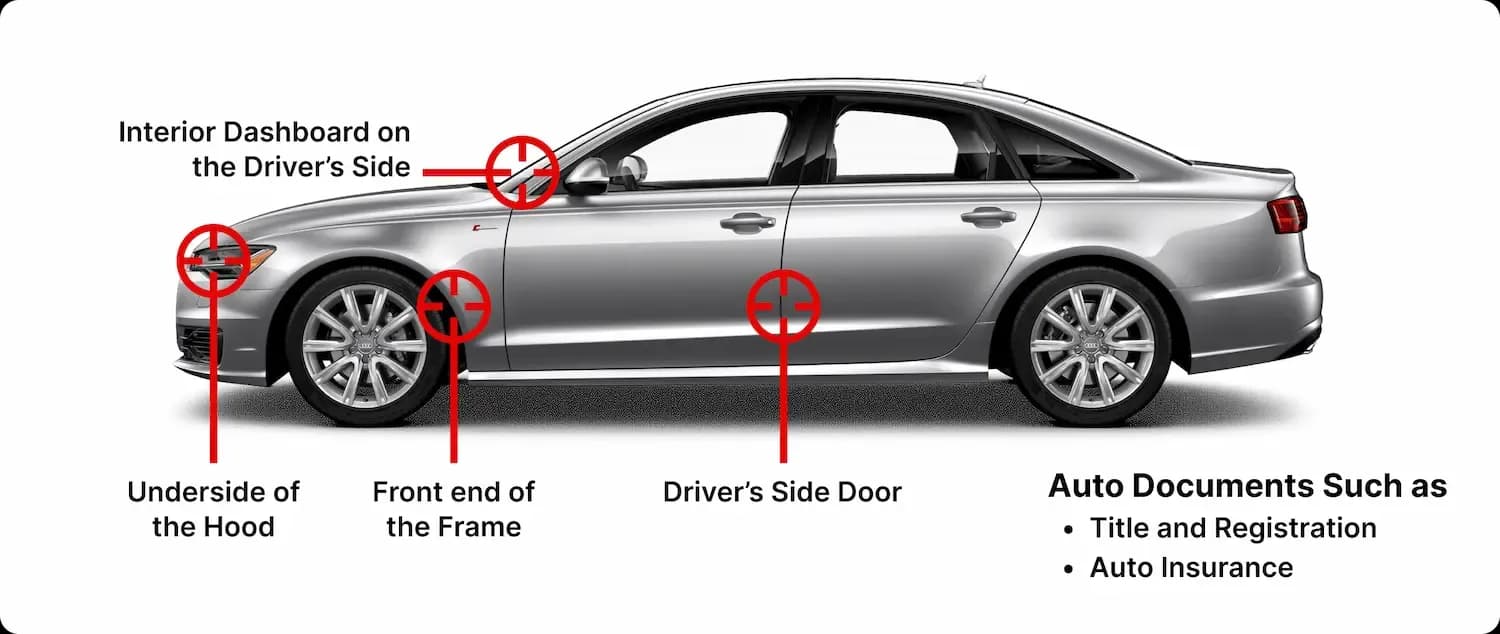
Aston Martin VIN Location
The VIN is placed in several locations on the vehicle and within its documents. Check the following areas to locate it accurately.
Driver’s Side Dashboard
Look through the windshield at the lower corner of the dashboard on the driver’s side to spot the VIN plate.
Driver’s Side Door Jamb
Open the driver’s door and check the door frame or pillar for a label or metal plate near the latch area.
Engine Bay
Inspect the engine compartment for a stamped VIN, often located along the bulkhead or near key structural components.
Documents
You can also find the VIN on official paperwork such as the registration, insurance card, or vehicle title.
Classic Aston Martin VIN Location
Classic Aston Martin models may share similar VIN placements, but some vehicles include less common or model-specific locations depending on the era and build.
Under the Floor Mat
On certain classic models, the VIN may be stamped on the floor pan beneath the carpet, typically on the passenger side.
Body Panels
Older Aston Martin vehicles may have VIN tags on panels like the hood, trunk lid, or fenders, usually shown on small plates or adhesive labels.
Who Should Use an Aston Martin VIN Decoder?
An Aston Martin VIN decoder is essential for anyone dealing with a premium or collectible vehicle. With high values, bespoke builds, and frequent spec variations, verifying details through a report helps avoid costly mistakes and supports confident decisions.
Buyers
Aston Martin buyers face risks like undisclosed damage, incorrect specs, or missing factory options. Our vehicle history report confirms build details, ownership history, and past records, helping you avoid overpaying and ensuring the car matches what is being advertised.
Sellers
For sellers, proving originality and condition is key to securing strong offers. Decode the VIN to see verified specs and history, set the right selling price, reduce buyer doubts, and position the vehicle as a well-documented, trustworthy listing.
Dealers
Dealers handling Aston Martin inventory need accuracy and speed. VIN decoding helps verify configurations, avoid listing errors, and present transparent information, which is critical when dealing with high-value vehicles and well-informed buyers.
Collectors
Collectors rely on precise details when evaluating Aston Martin models. A vehicle report helps confirm authenticity, factory configuration, and production data, which is essential for rare or limited builds where originality directly impacts long-term value.
Aston Martin VINs: From Hand-Built Heritage to Modern Precision
Aston Martin VIN formats have evolved alongside the brand itself. Modern models follow a standardized system, while older, hand-built cars often use shorter or less uniform identifiers, which can affect how much information you can retrieve.
VIN Length and Format
Modern Aston Martin vehicles use the standard 17-character VIN with a fixed structure. Classic models, especially pre-1980s builds, may use shorter or unique chassis numbers that vary by era and production method.
Data Availability
Modern VINs provide detailed digital records, including specifications and build data. For classic Aston Martins, information can be limited, depending on how well factory records were preserved or later digitized.
Decoding Accuracy
Modern VIN decoding is consistent due to standardized formats and complete databases. Classic Aston Martin VINs can be harder to interpret, as formats differ and records may be incomplete, making verification more dependent on available documentation.
Aston Martin VIN Breakdown
A VIN or Vehicle Identification Number is a 17-digit alphanumeric code used as a vehicle identifier. The VIN is divided into three main categories: WMI, VDS, and VIS. Check the section below to see how the VIN is deciphered.
Sample VIN: SCFSMGAW9LGN04181
WMI (World Manufacturer Identifier)
Digit 1 to 3: SCF
- S = Country of origin (United Kingdom)
- CF = Aston Martin
VDS (Vehicle Descriptor Section)
Digit 4 to 9: SMGAW9
- S = Model line (Vantage series)
- M = Engine type (4.0L twin-turbo V8)
- G = Body style (2-door coupe)
- A = Trim level (standard/base Vantage configuration)
- W = Series or performance package within the model range
- 9 = Check digit
VIS (Vehicle Identifier Section):
Digit 10 to 17: LGN04181
- L = Model year (2020)
- G = Assembly plant: Gaydon Plant, Warwickshire, United Kingdom
- N04181 = Serial Number
Why Do You Need to Decode an Aston Martin VIN
An Aston Martin is not just a car; it is a hand-built machine with bespoke details. The VIN unlocks its true identity, from original configuration to ownership history, helping you verify exactly what you are paying for.
Before Buying a Car
Every Aston Martin is built with unique options and finishes. Check the VIN to confirm the exact spec, ownership history, and condition, helping you avoid misrepresented listings or cars that no longer match their original factory configuration.
Before Selling a Car
In the Aston Martin market, documentation drives value. As a seller, it is crucial to make sure that the car has proven originality, verify the specs, and make sure it does not carry bad history like being stolen or still held as a lien.
Verify Vehicle Identity
Aston Martin models often feature bespoke builds and rare configurations. Decoding the VIN ensures the car matches its original identity, helping detect altered specs, incorrect listings, or vehicles that have been pieced together over time.
Check History and Records
High-value cars attract high-risk issues. Check the vehicle report thoroughly to see the ownership history, accident records, and title data. Confirm the vehicle’s background and avoid costly surprises that can impact both value and long-term ownership.
Decode Any Aston Martin Model’s VIN
Our Aston Martin VIN decoder service can help you get the complete information of the car, and this service can be done for classic Aston Martin too!
Supported Models of Modern Aston Martin
Check which Aston Martin models you want to check.
DB7 VantageVanquishDB9V8 VantageDBSRapideV12 VantageV8 Vantage SVirageRapide SV12 Vantage SVantage GTDb11VantageDBX
Supported Classic Aston Martin Models
Not only modern Aston Martin, but we also cover classic Aston Martin models.
Aston Martin DB5Aston Martin V8 VantageAston Martin LagondaAston Martin VolanteAston Martin DBSAston Martin V8Aston Martin VirageAston Martin DB7
Want More Info About Your Aston Martin? Get a Vehicle History Report
After decoding the VIN, the report outlines details about the vehicle’s build and background. It helps buyers spot potential risks early and gives sellers reliable information to present accurate and transparent listings.
Vehicle Specification
Access factory-issued details such as engine configuration, transmission type, fuel system, production origin, and original MSRP. This section helps confirm the vehicle matches its listing and ensures it aligns with your expectations, intended use, and overall budget.
Title Records
Review the title status to identify issues such as salvage, rebuilt, lemon, or theft records. These factors can affect legality, safety, and resale value, making it important to verify before completing any transaction involving the vehicle.
Odometer Reading
Track mileage records across different dates to ensure consistency over time. This helps identify unusual changes, gaps, or possible rollback cases, giving you a clearer understanding of how the vehicle has been used and maintained.
Accident and Damage History
Check for reported accidents, structural damage, or environmental exposure such as flooding. These records help assess repair quality, current condition, and whether the vehicle is suitable for long-term ownership or further investment.
Auction History
Find out if the vehicle has been sold through auctions, including details such as sale dates, locations, and final prices. Some entries may also include images that show the vehicle’s condition at the time of sale.
Ownership History
View the number of previous owners, general locations, and ownership duration. This helps you understand how the vehicle was used over time and whether frequent ownership changes may have affected its overall condition.
Recalls Check
Identify any safety or performance recalls issued for the Aston Martin. The report may include recall dates, causes, and whether corrective actions were completed, helping you avoid potential risks and unresolved issues.
Engine Information
Confirm the engine type, configuration, and key performance details. This helps ensure the vehicle still matches its original factory build and supports accurate comparisons when reviewing listings or checking for modifications.
Get More Information About the Aston Martin Using Our Tools
Need to get more information about the Aston Martin? Use our service to get the most out of it!
Aston Martin Recall Check by VIN
Examine the causes, dates, and fixes of Aston Martin recall history with our service.
Aston Martin Window Sticker by VIN
Check the original factory information of the car with our window sticker by VIN.
Any Car. Any VIN. One Check
Use our tool to access vehicle details across all makes and models. A quick VIN check helps you avoid risks and make a smarter decision.
Acura
Alfa Romeo
AM General
Aston Martin
Audi
Bentley
BMW
Buick
Cadillac
Chevrolet
Chrysler
Daewoo
Dodge
Ferrari
Fiat
Fisker
Ford
Genesis
GMC
Honda
Hummer
Hyundai
Infiniti
Isuzu
Jaguar
Jeep
KIA
Lamborghini
Land Rover
Lexus
Lincoln
Lotus
Maserati
Maybach
Mazda
Mclaren
Mercedes Benz
Mercury
Mini
Mitsubishi
Nissan
Oldsmobile
Panoz
Plymouth
Polestar
Pontiac
Porsche
RAM
Rolls Royce
Saab
Saturn
Scion
Smart
Subaru
Suzuki
Tesla
Toyota
Volkswagen
Volvo
Aston Martin Electric Vehicles: Lineup and Future Plans
Aston Martin’s first fully electric vehicle (BEV) is expected before 2030, following a shift to focus on plug-in hybrid electric vehicles (PHEVs). Until then, the brand’s electrified offerings showcase advanced performance and hybrid technology.
Electrified Models (PHEVs)
The Aston Martin Valhalla marked the limited-production PHEV hypercar, combining a twin-turbo V8 with three electric motors. This vehicle delivers remarkable performance and advanced hybrid performance.
Upcoming Electric Vehicle (BEV) Plans
Aston Martin’s first fully electric vehicle is expected later this decade, with development timelines adjusted as the brand prioritises plug-in hybrid technology and cost efficiency.
- Development Delays: The release of Aston Martin’s first pure EV has been postponed to ensure peak performance and refinement while trimming development costs.
- Simulated Driving Thrills: To replicate the signature feel of V12 and V8 engines, the company is testing technologies like simulated gear shifts and vibrating panels.
- Technology Partnerships: The upcoming EV platform benefits from technical collaborations, including powertrain support from Lucid Group and electrical architecture expertise from Mercedes-Benz.
FAQs About Aston Martin VIN Decoder
To check a classic Aston Martin VIN, use a reliable VIN decoder to access available records. You can review key details such as original specifications, past ownership, auction history, and reported incidents in one report.
Yes, classic Aston Martins built before 1981 often use shorter, non-standard chassis numbers, usually between 4 and 10 digits. These numbers were tied to internal identification, such as chassis or engine references.
To look up VIN details online, enter the 17-character VIN into a trusted decoder like our VIN Decoder service. This allows you to access key information such as vehicle specifications, build data, and estimated market value.
Yes, a 17-character VIN can be used to check a vehicle’s history, specifications, and authenticity. Free tools provide basic manufacturing details, while paid reports offer deeper insights like accidents, title records, and ownership history.
No, accessing a vehicle owner’s personal information through a VIN or license plate is generally restricted. Privacy laws limit this data to authorized parties such as law enforcement, insurers, or approved businesses with valid reasons.
Yes, a VIN can be used to trace a vehicle’s history, including manufacturer details, accident records, and title issues. While it cannot track real-time location, it serves as an identifier for accessing vehicle records.
Yes, you can check if a vehicle is reported stolen using its 17-digit VIN. Use the stolen check by VIN tool to help identify theft records and avoid purchasing a high-risk vehicle.
Quick VIN Decoder
Get comprehensive vehicle history reports
Quick VIN Decoder
Get comprehensive vehicle history reports