
Decode Any Classic and Modern Nissan VIN
Before buying or selling a used Nissan, it’s important to know exactly what you’re getting. Decode Nissan VIN to get model year, trim, engine specifications, transmission setup, body style, production details and many more.
Table of Contents:
What Will You Get from the Nissan VIN Decoder
From original factory specifications to available history records, this tool helps you verify the vehicle’s true identity. It’s especially useful for Nissan models, where engine options (like VQ V6 or turbocharged units), trims (S, SV, SL, SR, Platinum), and drivetrain setups (FWD, AWD, 4WD) can vary and directly impact performance, reliability, and overall value.
- Manufacturer and origin
- Model, trim, and package details
- Engine specifications
- Transmission setup
- Body style
- Model year
- Production plant
- Manufacturer Suggested Retail Price (MSRP)
- Market Value
How to Use the Nissan VIN Decoder
The Nissan VIN decoder is designed to work with both modern 17-digit VINs and older formats. Whether you’re checking a newer Nissan or a classic model, the process is quick and straightforward. Follow these steps to get accurate results in seconds.
Step 1: Enter the VIN
Locate the VIN on the driver’s side dashboard (visible through the windshield), door jamb, engine bay, or on documents such as the registration or bill of sale.
Step 2: Fill Out the Form
Enter the Nissan VIN into the decoder form. Double-check the characters for accuracy, then submit it to begin the decoding process.
Step 3: Check the Specifications
Once processed, you’ll get full vehicle details, including engine type, transmission, fuel type, factory specs, country of origin, MSRP, and estimated market value.
Where to Find the VIN on a Classic and Modern Nissan
Before decoding, you’ll need to locate the VIN on your Nissan. Most modern models follow standard placement, but older or classic vehicles can vary slightly depending on the model, market, and production year.
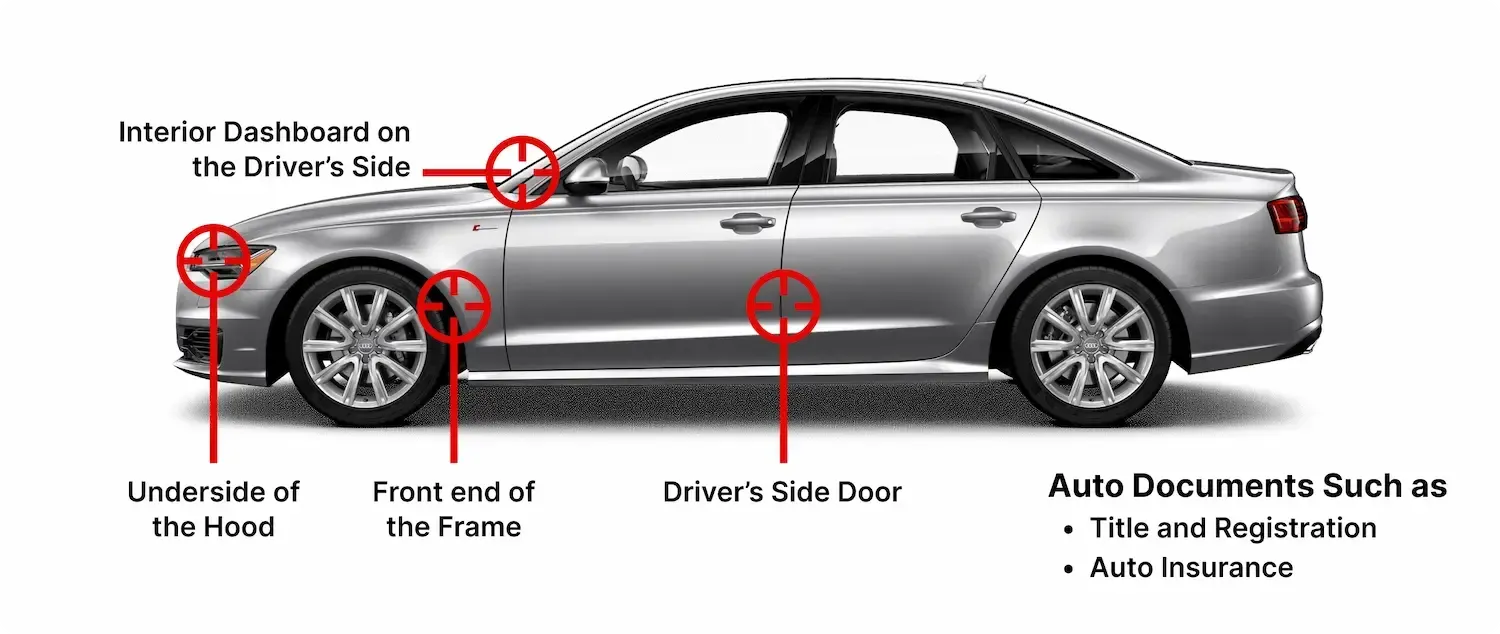
Nissan VIN Location
The VIN appears in several key areas on the vehicle and in official records. Check these common spots to make sure you’re using the correct number:
Driver’s Side Dashboard
Look through the windshield at the lower corner of the dashboard on the driver’s side. This is the most common VIN location on modern Nissan vehicles.
Driver’s Side Door Jamb
Open the driver’s door and inspect the door frame or pillar near the latch. You’ll usually find a sticker or plate displaying the VIN along with manufacturing details.
Engine Bay
Check inside the engine compartment, typically near the firewall or chassis frame. Some Nissan models may also have the VIN stamped on structural components.
Documents
The VIN is also listed on official paperwork such as registration documents, insurance cards, and the vehicle title. Always cross-check these with the VIN on the vehicle for accuracy.
Classic Nissan VIN Location
Older Nissan models, especially those built before VIN standardisation, may not follow modern placement rules. Identification numbers can sometimes appear in less obvious areas.
Under the Hood
On many classic Nissan vehicles, the VIN or chassis number is often found on a plate mounted inside the engine bay, usually on the firewall or inner fender.
Body Panels
Some older models may include identification tags on panels such as the hood, trunk lid, or body structure. These were commonly used for factory tracking and assembly reference.
Who Should Use the Nissan VIN Decoder
A Nissan VIN decoder is useful for anyone buying, selling, or evaluating a vehicle. Whether it’s a reliable daily driver, a performance model like the GT-R, or a classic project, decoding the VIN and checking its full specifications to make sure the vehicle is what you need.
Buyers
Check the Nissan’s factory specifications, ownership history, and overall condition before purchasing. A VIN lookup helps confirm the vehicle matches the listing and reveals details that may not be obvious at first glance.
Sellers
Provide accurate, verified information in your listing. Decoding the VIN confirms original specs and available records, making your listing more trustworthy and appealing to potential buyers.
Dealers
Dealers can use VIN decoding to maintain accurate listing claims. This is especially important for Nissan vehicles, where trims, engines, and drivetrain options can vary across markets and model years.
Enthusiasts
Nissan enthusiasts can use VIN decoding to understand their car’s original configuration, including engine type, trim level, and factory features. This is particularly helpful for restoration projects, modifications, or verifying rare models.
What is the Difference Between Modern and Classic VIN
Modern and classic VINs differ mainly in structure and the level of detail they provide. Newer vehicles follow a fixed system, while older models use less consistent formats, which can affect how much information you can get.
VIN Length and Format
Modern vehicles use a standardized 17-digit VIN introduced in 1981. Classic vehicles often have shorter VINs, usually between 5 and 14 characters, depending on the manufacturer and year.
Data Availability
Modern VINs can reveal detailed specifications such as engine type, trim, and production data. Classic VINs may only provide limited information due to incomplete or inconsistent records.
Decoding Accuracy
Decoding modern VINs is generally reliable and consistent. Classic VINs can be harder to interpret, but you can use our service to decode any classic car VIN.
Nissan 17-digit VIN Breakdown
A modern Nissan VIN consists of a 17-digit alphanumeric code. Globally, the VIN is classified into three different categories: WMI, VDS, and VIS—each of the digit convey different information about the vehicle. Check this section below to see how a Nissan VIN is broken down.
World Manufacturer Identifier (WMI)
Digit 1 to 3: JN1
- J = Country of origin (Japan)
- N1 = Nissan
Vehicle Descriptor Section (VDS)
Digit 4 to 9: AZ4EH5
- A = Model line (370Z platform)
- Z = Engine type (3.7L V6 engine)
- 4 = Body style (2-door coupe)
- E = Drivetrain (Rear-Wheel Drive)
- H = Trim level (Touring / higher specification variant)
- 5 = Check digit
Vehicle Identifier Section (VIS)
Digit 10 to 17: KM421002
- K = Model year (2019)
- M = Assembly plant in Tochigi Plant, Japan
- 421002 = Production sequence number
Need More Information? Get a Nissan Vehicle History Report
A VIN decoder gives you a solid overview, but a full history report fills in the gaps. Get the full vehcile history report to understand how the vehicle has been used, maintained, and whether the unit has been recalled in the past.
Vehicle Specification
See how the Nissan was originally built at the factory. This includes engine type (such as naturally aspirated or turbocharged inline-4, V6, or hybrid setups), transmission, trim level, drivetrain (FWD, AWD, or 4WD), production plant, and original MSRP.
Title Records
Review the title history to catch any issues that could affect value or legality. Red flags like salvage status, rebuilt titles, theft records, or mileage discrepancies are essential checks when evaluating a used Nissan.
Odometer Reading
Mileage gives insight into how the vehicle has been used over time. This section shows recorded readings with corresponding dates, helping you identify rollbacks or irregular patterns that may signal potential concerns.
Accident and Damage History
Check for reported accidents, structural damage, or environmental exposure such as flooding. Even well-built Nissan vehicles can be affected by past damage, so having this visibility helps you avoid unexpected repairs.
Auction History
If the Nissan has passed through an auction, you’ll find those records here. This include sale dates, locations, prices, and photos, giving you a clearer picture of its past condition and presentation.
Ownership Information
Understand how the vehicle has changed hands over time. You’ll see the number of owners, general locations, and ownership duration, helping you assess how consistently the car has been cared for.
Recalls Check
Stay informed about any recalls linked to the vehicle. This section outlines the issue, when it was issued, and whether it has been resolved—helping ensure the Nissan remains safe and road-ready.
Engine Information
Review the engine configuration linked to the VIN in one report. Modern Nissan models commonly feature efficient inline-4 engines, turbocharged options, or V6 units, while older models often use durable, naturally aspirated engines built for long-term reliability.
Get More Nissan Information With Our Tools
Need to get more information before you purchase a used Nissan? Use our dedicated tool and make sure to get all the needed information!
Nissan Recall Check by VIN
Use the Nissan recall check by VIN service to reveal all the recall information–make sure the status is closed.
Nissan Window Sticker by VIN
Get the Nissan window sticker—see all complete information on features, options, and more.
Decode Any Modern and Classic Nissan VIN
Thinking about a used Nissan? Don’t rely on listings or a quick test drive alone. Decode the VIN first to verify specifications, uncover key records, and make sure everything matches what’s being advertised.
Supported Modern Nissan Models
Decode VINs for a wide range of modern Nissan vehicles, including popular models like the Altima, Rogue, Sentra, Pathfinder, and more.
Supported Classic Nissan Models
Working with an older Nissan? Our VIN decoder also supports classic VIN formats, including shorter or non-standard identifiers, helping you confirm originality, specs, and estimated value.
Decode Any Vehicle’s VIN
Looking at more than one car? You’re not limited to Nissan. Our VIN decoder works across multiple brands, so you can compare vehicles, verify specifications, and review history records—all in one place.
Nissan Information on EV
The Nissan electrification strategy focuses on expanding its battery-electric vehicle lineup while continuing to support hybrid and e-Power technologies in global markets. Nissan remains one of the earliest mass-market EV manufacturers, with the LEAF helping establish the modern EV segment.
EV Lineup
Nissan offers multiple battery-electric vehicles, led by the LEAF and Ariya. These models serve different customer segments, from compact hatchbacks to crossover SUVs.
These are the key models included:
LEAF electric hatchback.
Ariya electric crossover SUV.
Multiple battery and range configurations.
Continued expansion of EV technology and charging capabilities.
Nissan EV Development
Nissan has played a significant role in the growth of modern electric vehicles. The LEAF became one of the world's first mass-market EVs and remains an important part of the company's electrification history.
Launch of the LEAF in 2010.
Early leadership in mass-market EV adoption.
Ongoing battery and charging technology development.
Continued investment in electric mobility.
FAQs About Nissan VIN Decoder
Can a VIN decoder show Nissan's original color?
A VIN decoder can sometimes reveal the original factory color of a Nissan, but it’s not guaranteed for every model or year. In most cases, it will at least provide the paint code, which you can use to identify the exact colour. We recommend that you get the window sticker by VIN to check the vehicle’s complete information, including paint colors.
What can a Classic Nissan VIN Decoder reveal about limited-edition or imported models?
A classic Nissan VIN decoder—especially for models built after 1981—can uncover detailed information about the car’s identity, including trim, special editions, and origin. For enthusiasts, this is key to confirming authenticity and identifying imported or JDM models.
Why do some classic Nissan VINs not match modern decoding formats?
Classic Nissan VINs don’t follow modern decoding formats because the 17-digit standard wasn’t introduced until 1981. Earlier vehicles used shorter, manufacturer-specific codes, which is why decoding them often requires a different approach.
Can I use a Classic Nissan VIN Decoder for vehicles made before 1980?
Standard VIN decoders typically don’t work for pre-1981 Nissan models. Older Datsun and Nissan vehicles used shorter chassis or serial numbers, so decoding them usually involves specialised databases, marque experts, or physical identification plates.
How do I find out what options my Nissan has?
To check your Nissan’s factory options, the most reliable method is to decode the VIN or access the original window sticker. You can also review official documents or use connected services like the MyNISSAN app, where available.
Why is decoding a classic VIN important?
Decoding a classic VIN is one of the best ways to confirm a vehicle’s authenticity, original specs, and history. It helps prevent issues like misrepresented trims or engine swaps, while ensuring you get accurate details for maintenance or parts sourcing.