
Mercedes-Benz Modern and Classic VIN Decoder
Thinking about a Mercedes-Benz? Don’t just rely on listings and test drives. Use our Mercedes-Benz VIN decoder to get model year, trim, engine specifications, transmission setup, body style production details and many more.
Table of Contents:
What Will You Get from the Mercedes-Benz VIN Decoder?
Our Mercedes-Benz VIN decoder provides an in-depth look into the vehicle's true identity. From its original factory configuration to valuable history records, this tool ensures that you can verify exactly what you’re buying. Here’s a breakdown of the information you’ll get from the Mercedes-Benz VIN Decoder.
- Manufacturer and origin
- Model, trim, and package details
- Engine specifications
- Transmission setup
- Body style
- Model year
- Production plant
- Manufacturer Suggested Retail Price (MSRP)
- Market Value
How to Decode the Mercedes-Benz VIN?
Decoding a Mercedes-Benz VIN, whether from a modern luxury sedan or a classic model, is quick and easy with our service. Just follow these simple steps to get it done in seconds.
Step 1: Find the VIN
Look for the VIN in common locations, such as the dashboard (visible through the windshield), the driver ’s-side doorjamb, or in official documents like the vehicle registration or bill of sale.
Step 2: Fill out the Form
Enter the Mercedes-Benz modern or classic VIN on the form. Then, enter the button to submit the VIN.
Step 3: Check the Vehicle Specs
Once processed, you’ll get access to detailed specifications such as engine type (often V6 or V8 configurations), transmission type, production details, and the vehicle’s estimated market value.
Where to Find the VIN on a Classic and Modern Mercedes-Benz?
Before decoding, you’ll need to locate the VIN on your Mercedes-Benz. While modern Mercedes-Benz models follow standard VIN placement, earlier or limited-production vehicles may have slight variations depending on the specific model and production year.
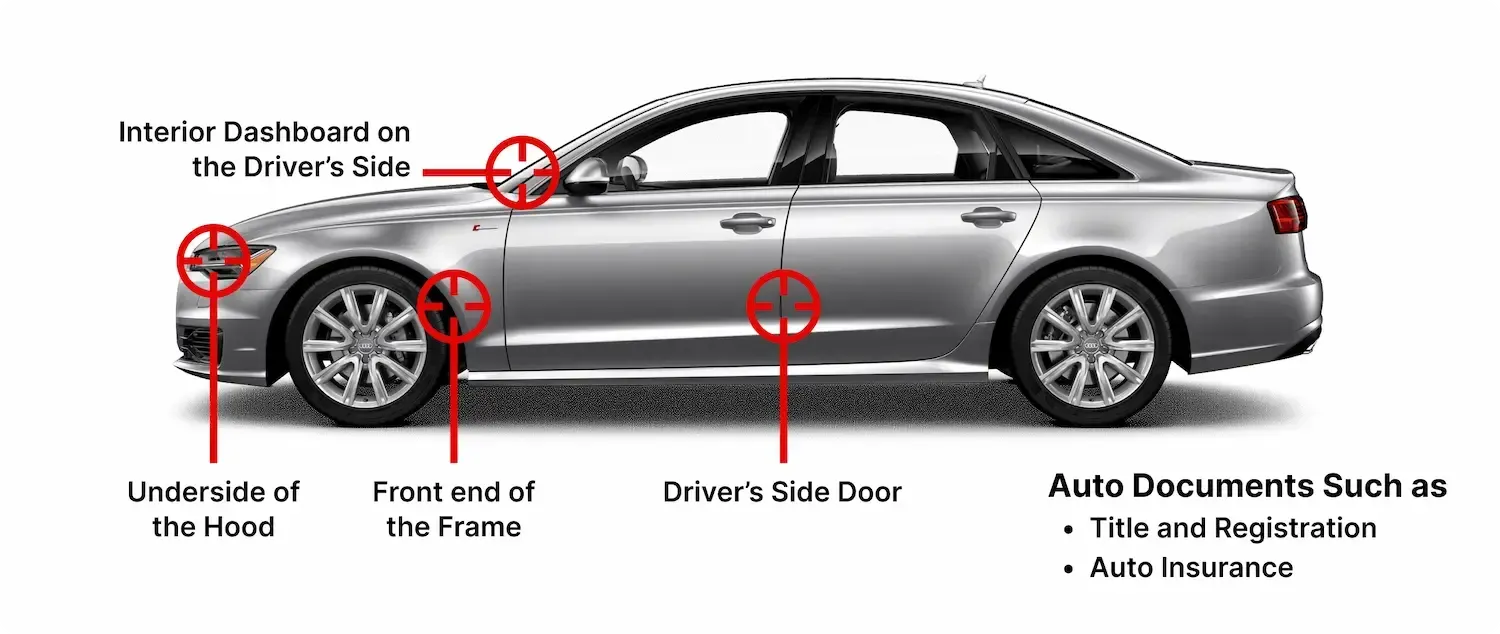
Mercedes-Benz VIN Location
The VIN can be found in several key areas on the vehicle and within official documents. Check these locations to ensure accurate identification:
Driver’s Side Dashboard
Look through the windshield at the lower corner of the dashboard on the driver’s side. Most modern Mercedes-Benz models display the VIN clearly in this position.
Driver’s Side Door Jamb
Open the driver’s door and inspect the door frame or pillar near the latch. You will typically find a label or plate showing the VIN, along with manufacturing details.
Engine Bay
Check the engine compartment or chassis area for a stamped VIN. In many Mercedes-Benz vehicles, this may be located on structural components, particularly in models with unique build options.
Documents
The VIN is also listed on official paperwork such as the registration, insurance card, and vehicle title.
Classic Mercedes-Benz VIN Location
Classic or early Mercedes-Benz models, particularly limited-production cars, may not always follow modern VIN placement standards. Some identifiers may be placed in less obvious areas.
Under the Floor Mat
On some older models, the VIN may be stamped on the floor structure beneath the carpet, often near the passenger side or under the driver’s seat.
Body Panels
Certain Mercedes-Benz vehicles may have identification labels on removable panels or structural parts. These labels are typically used for factory tracking and verification, especially on rare, custom, or limited-edition models.
Who Should Use the Mercedes-Benz VIN Decoder?
A Mercedes-Benz VIN decoder is essential for anyone purchasing, selling, or evaluating a high-performance vehicle. Whether you're dealing with a modern luxury sedan, a sports car, or a classic model, decoding the VIN ensures authenticity and helps avoid costly mistakes.
Buyers
Check the Mercedes-Benz’s factory specifications, ownership history, and overall condition before purchasing. Decoding the VIN helps to oversee the vehicle’s performance based on the engine or fuel capacity.
Sellers
Provide accurate, verified details to support your listing. A VIN check confirms original specifications and available records, helping to build trust with potential buyers. For Mercedes-Benz vehicles, transparency can significantly impact buyer confidence and the final sale price.
Dealers
Dealers can use VIN decoding to quickly verify inventory and maintain accurate listings. This is especially important for Mercedes-Benz models, where various trims, special editions, and production years can greatly affect value.
Collectors
Collectors and enthusiasts can use VIN decoding to confirm originality, production details, and rare specifications. This is especially valuable when dealing with limited-edition or historically significant Mercedes-Benz models, ensuring the car’s authenticity and preserving its value.
What is the Difference Between a Modern and Classic Mercedes-Benz VIN?
The primary difference between modern and classic Mercedes-Benz VINs lies in the structure, consistency, and level of detail they provide. While modern models follow the standardized 17-digit global format, earlier Mercedes-Benz vehicles may have varying VIN formats, often consisting of 5 to 14 digits depending on the year of production.
VIN Length and Format
Modern Mercedes-Benz vehicles use the standardized 17-digit VIN system, introduced in 1981, which follows a global format that is consistent across all makes. Classic or vintage Mercedes-Benz models, on the other hand, may have shorter or less standardized VINs, reflecting the different production methods and record-keeping practices used at the time.
Data Availability
Modern Mercedes-Benz VINs provide extensive data, including detailed engine specifications (often 4-cylinder, V6, or V8), model designations, production year, and factory configuration. In contrast, classic Mercedes-Benz VINs may yield more limited information, especially for older models, due to less comprehensive historical records and variations in build details.
Decoding Accuracy
Decoding modern Mercedes-Benz VINs is generally straightforward and reliable due to standardized formatting and well-maintained databases. For the classic Benz VIN, you can use our VIN decoder to get the full report.
Decoding Mercedes-Benz’s VIN
A 17-digit Mercedes-Benz VIN follows a structured format that provides key details about the vehicle. The VIN is divided into three main sections: WMI (World Manufacturer Identifier), VDS (Vehicle Descriptor Section), and VIS (Vehicle Identifier Section). Take a look at the section below to see how a VIN is broken down.
World Manufacturer Identifier (WMI)
Digit 1 to 3: 4JG
- 4 = Country of origin (United States)
- JG = Mercedes-Benz (Manufactured in the U.S. for the North American market)
Vehicle Descriptor Section (VDS)
Digit 4 to 9: DA7EB6
- D = Model line (GLE platform)
- A = Engine type (3.5L V6 engine, likely in GLE 350)
- 7 = Body style (5-door SUV / GLE Coupe or GLE)
- E = Drivetrain (All-Wheel Drive / 4MATIC)
- B = Trim level (base / standard configuration)
- 6 = Check digit
Vehicle Identifier Section (VIS)
Digit 10 to 17: FA568107
- F = Model year (2015)
- A = Assembly plant (Tuscaloosa, Alabama, USA)
- 568107 = Production sequence number
Why Do You Need to Decode the Mercedes-Benz VIN?
Decoding a Mercedes-Benz VIN transforms a simple string of characters into verified, real-world vehicle data. For luxury cars, this step is crucial to confirm factory specifications and ensure the car is exactly as presented.
Before Buying a Car
Before purchasing a luxury car, it is better to check everything thoroughly—from the specifications, MSRP, and market value. Use our VIN decoder tool to see the car’s complete information on engine, trims, transmission, and more.
Before Selling a Car
Transparency is key in building trust with potential buyers. Decoding thr VIN and finding the correct specification to write on the listing description is crucial to enhance buyers’ trust and maintain a good reputation.
Verify Vehicle Identity
Confirm that the VIN matches the Mercedes-Benz model, engine type, trim, and other critical details. This step is vital to avoid mismatches, fraud, or potential cloning. In the luxury car market, where high-end vehicles often have unique configurations.
Check History and Records
By accessing the complete vehicle history, including past ownership, accident reports, auction activity, and recall data, you get a clearer picture of the car’s background. Checking a car’s specs, history, and records is crucial.
Need More Information? Get a Mercedes-Benz History Report
A VIN decoder provides the basics, but a full history report offers a complete picture. For a Mercedes-Benz, that extra layer of detail is essential. It helps you see beyond the specifications and understand how the car has been used, maintained, and cared for over time.
Vehicle Specification
Get an in-depth look at the car’s original build. This includes key details like engine type (often a refined turbocharged 6-cylinder or V8), transmission, MSRP, and country of origin. It’s the best way to ensure the car still meets its original specifications, offering you peace of mind before making your decision.
Title Records
Review the title history to identify any potential issues that could affect the car’s value or legal standing. Red flags like salvage status, rebuilt history, theft records, or mileage discrepancies are crucial to know, particularly when dealing with a premium brand like Mercedes-Benz.
Odometer Reading
The mileage on a Mercedes-Benz isn’t just a number—it plays a significant role in both maintenance and resale value. This section shows recorded mileage over time, including the most recent reading and the date it was recorded. It helps ensure you’re buying a car that hasn’t been misrepresented.
Accident and Damage History
While a luxury vehicle like a Mercedes-Benz is built to last, even minor accidents or structural damage can affect its performance and value. This section shows any reported accidents, structural issues, or environmental damage, such as flooding, giving you critical insight into how the car has been treated.
Auction History
If the Mercedes-Benz has passed through an auction, you’ll find detailed records here. This includes sale dates, locations, hammer prices, and sometimes photos, so you can see how the car was presented and valued in the past.
Ownership History
Track the car’s ownership history to get an idea of how it’s been cared for. You’ll see the number of previous owners, where the car was registered, and how long each owner held onto it. While personal details are excluded, this information helps you understand the car’s usage and care history.
Recalls Check
Stay informed about any recalls issued for the vehicle. This section provides details about the recall, the issue, and whether it has been resolved, ensuring the car remains safe, roadworthy, and up to Mercedes-Benz’s high standards.
Engine Information
Check the complete engine information on classic and modern Mercedes-Benz. Modern Benz models typically feature turbocharged inline-4s, V6s, or V8s—classics often have naturally aspirated inline-6s, V8s, or durable diesel engines, each offering distinct performance characteristics.
Get More Information on the Benz with Our Tools Before You Buy
Purchasing a Mercedes-Benz can be a hurdle if you do not check everything thoroughly. Use our tool to check everything and get the window sticker as well.
Mercedes Recall Check by VIN
Check the recall status by VIN, get the recall information, and see if solved already.
Mercedes Window Sticker by VIN
Secure the window sticker by VIN and get the window sticker in less than a minute.
Decode Any Mercedes-Benz Model by VIN
Considering purchasing a used Mercedes-Benz? Remember, decode the VIN to make sure that the vehicle matches everything that was shown on the ads.
Supported Modern Mercedes-Benz Models
Decode VINs for a wide range of modern Mercedes-Benz vehicles, including the Mercedes-Benz S-Class, E-Class, GLC, and A-Class, to ensure you’re getting the luxury and performance you expect.
Supported Classic Mercedes-Benz Models
Need to decode the classic Mercedes-Benz model? Use our service to check the car’s full specifications and current market value.
Decode Any Vehicle’s VIN
Need to check another vehicle? Our VIN decoder works across multiple brands, helping you access specs, history, and key details all in one place.
Update on the Mercedes-Benz EV Car
The strategy for Mercedes-Benz's electrification strategy focuses on expanding its EV models, while adopting a more flexible approach that combines different methods such as electric, hybrid, and combustion-powered vehicles. In addition, Mercedes-Benz also plans to integrate electrification into its main models.
EV Lineup Expansion
Mercedes maintains one of the broadest luxury EV portfolios in the industry, covering sedans, SUVs, and performance-oriented models.
These are the core models of Mercedes-Benz EV:
EQS Sedan and EQS SUV
EQE Sedan and EQE SUV
EQB compact electric SUV
G 580 with EQ Technology electric G-Class
FAQs About Mercedes-Benz VIN Decoder
How do I find out the specs of my Mercedes?
To discover the exact specifications of your Mercedes-Benz, including engine, transmission, paint code, and factory-installed options, use a free online VIN decoder. Simply enter your 17-digit VIN to access the original build sheet, detailing how your vehicle was configured at the factory.
Can I look up a vehicle's specs with a VIN number?
Yes, you can look up a vehicle's specifications using the 17-character VIN, revealing key details such as engine size, trim level, transmission, and country of origin. Use services like Detailed Vehicle History to decode the VIN and get comprehensive vehicle specs.
How do I check the options my Mercedes has?
To check the factory options and specifications of your Mercedes-Benz, use a free VIN decoder to generate a detailed "datacard." Enter your 17-character VIN, found on the dashboard, driver’s side door jamb, or registration document, into a service like Detailed Vehicle History’s Mercedes VIN decoder.
Can a Classic Mercedes-Benz VIN Decoder help confirm if a car still has its original engine?
Yes, a classic Mercedes-Benz VIN decoder can help confirm whether the car retains its original engine, but for older models, it’s often necessary to refer to the Mercedes-Benz Data Card to compare engine numbers, not just the VIN. The decoder provides the engine type, but the Data Card verifies the exact engine installed at the factory.
Does the VIN decoder show production details like factory location or trim package?
Yes, a 17-character VIN decoder typically reveals production details, including the factory location (usually the 11th character) and often the trim package, model, engine type, and body style. The first character shows the country of origin, while digits 4-8 specify vehicle characteristics.
What is the importance of decoding a Classic Mercedes-Benz VIN number?
Decoding a classic Mercedes-Benz VIN (Vehicle Identification Number) or chassis number is essential for verifying the vehicle’s authenticity. It ensures compatibility when sourcing rare parts and restoring the car to its original factory specifications. For models produced before 1980, which often use a 14-character system instead of the modern 17-character VIN, decoding provides a unique "fingerprint" that reveals manufacturing details, engine/transmission variants, and original options.