
Decode Classic and Modern Dodge VIN
Use our Dodge VIN decoder to check both modern and classic Dodge VINs. Start with the form to access vehicle details, including model year, trim, engine specifications, transmission setup, body style production details and many more.
Table of Contents:
What Will You Get From the Dodge VIN Decoder
Mismatched listings and unclear specs can lead to costly mistakes. Use the Dodge VIN Decoder to solve the issues confirming the vehicle’s true configuration and helping you price it correctly using its original MSRP.
- Manufacturer and origin
- Model, trim, and package details
- Engine specifications
- Transmission setup
- Body style
- Model year
- Production plant
- Manufacturer Suggested Retail Price (MSRP)
- Market Value
How to Decode the Dodge VIN
Decoding a Dodge VIN is easy. Follow these simple steps to check both modern 17-digit VINs and older 5 to 14-digit VINs across different Dodge models and trims.
Step 1: Find the VIN
Locate the VIN on the driver’s side door jamb, inside the engine bay, or on documents such as the registration or bill of sale.
Step 2: Enter the VIN
Use the form above and input the correct VIN. Double-check for accuracy, then submit it to begin the decoding process.
Step 3: Check the Specifications
Check the full vehicle information like the engine, transmission, country of origin, MSRP, and its market value.
Where to Find the VIN on a Dodge
Before decoding, you need to locate the VIN on your Dodge. While most models follow a standard layout, the exact position can differ slightly depending on the model, trim, and production year.
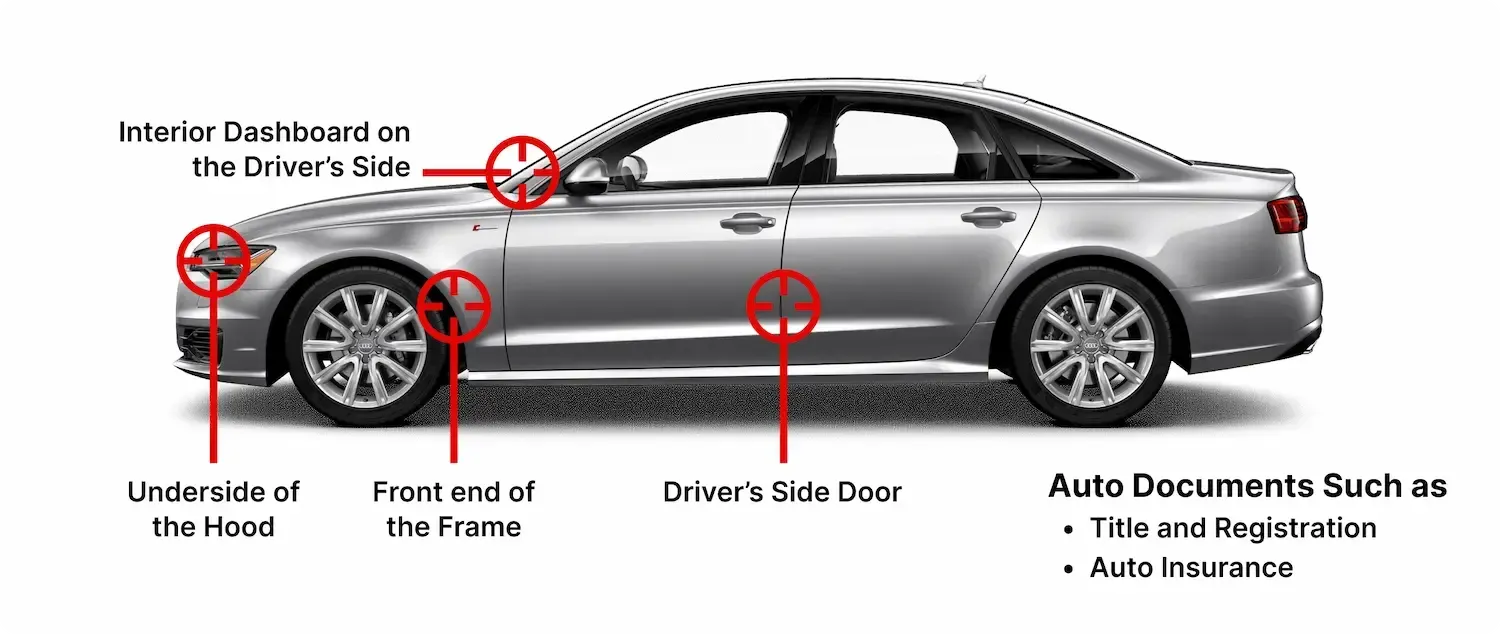
Dodge VIN Location
The VIN is placed in several key spots on the vehicle and across official documents. Check the following areas to find it quickly and accurately.
Driver’s Side Dashboard
Look through the windshield at the lower corner of the dashboard on the driver’s side to spot the VIN plate.
Driver’s Side Door Jamb
Open the driver’s door and check the door frame or pillar for a label or metal plate near the latch area.
Engine Bay
Inspect the engine compartment for a stamped VIN, often located along the firewall or near key structural components.
Documents
You can also find the VIN on official paperwork such as the registration, insurance card, or vehicle title.
Classic Dodge VIN Location
Classic Dodge vehicles may follow similar VIN placements, but some models include additional or less obvious locations depending on the era and how the vehicle was built.
Under the Floor Mat
On certain older models, the VIN may be stamped directly into the floor pan beneath the carpet, usually on the passenger side.
Body Panels
Some classic Dodge vehicles may carry VIN tags on panels like the hood, trunk lid, or fenders, typically shown on small metal plates or factory-applied labels.
Who Should Use a Dodge VIN Decoder
A Dodge VIN decoder is useful for anyone dealing with a used or classic Dodge. Whether you are buying, selling, managing inventory, or collecting, decoding the VIN helps confirm details and avoid costly surprises.
Buyers
Check the vehicle’s specifications, ownership history, and records before committing. This helps ensure the Dodge matches its listing and reduces the risk of hidden issues, especially with performance models or older units.
Sellers
Provide accurate and verified information in your listing to build trust. A VIN check helps confirm specs and history, making it easier to justify pricing and answer buyer questions with confidence.
Dealers
Use VIN decoding to quickly verify inventory details and maintain accurate listings. It helps reduce errors, improve transparency, and manage multiple trims, engines, and model variations more efficiently.
Collectors
Confirm authenticity, production details, and key specifications before acquiring a vehicle. For classic Dodge models, this is especially useful when identifying rare builds or verifying originality.
Modern vs Classic Dodge VIN: What Sets Them Apart
VIN formats have evolved, which affects how much information you can retrieve. Modern Dodge vehicles follow a standardized system, while older models use shorter and less consistent formats.
VIN Length and Format
Modern Dodge vehicles use a standardized 17-character VIN introduced in 1981. Older models may have shorter VINs, typically between 5 and 14 characters, depending on the production year and factory system used at the time.
Data Availability
Modern VINs are backed by detailed digital records, including specifications, engine data, and production details. Classic Dodge VINs may return limited information, depending on how well historical records were preserved.
Decoding Accuracy
Decoding modern VINs is generally reliable due to standardized formatting and complete databases. Classic VIN decoding can vary, as formats differ and some records may be different. However, you can trust our service and get the classic VIN decoding done correctly.
Understanding the Dodge VIN Structure
A Dodge VIN is a 17-character alphanumeric code that acts as the vehicle’s unique identifier. It is divided into three main sections: WMI, VDS, and VIS, each providing specific information about the vehicle. Take a look at the example below to see how a VIN is decoded.
World Manufacturer Identifier (WMI)
Digit 1 to 3: 2C3
- 2 = Country of origin (Canada)
- C3 = Dodge
Vehicle Descriptor Section (VDS)
Digit 4 to 9: CDXJG4
- C = Car line: Dodge Charger
- D = Series: SXT
- X = Body type: 4-door sedan
- J = Engine: 3.6L V6
- G = Safety features: Active belts, front airbags
- 4 = Check digit (to validate the VIN)
Vehicle Identifier Section (VIS)
Digit 10 to 17: KH547765
- K = Model year (2019)
- H = Assembly plant in Brampton, Ontario, Canada
- 547765 = Production sequence number
Why Decoding a Dodge VIN Actually Matters
Decoding a Dodge VIN gives you a much clearer picture of what you are dealing with, especially with performance-focused models, trim variations, and heavily modified units in the market. It helps you verify details that are not always obvious at first glance.
Before Buying a Dodge
Dodge vehicles, from daily drivers to muscle cars like the Charger or Challenger, often come with multiple trims and performance packages. A VIN check helps confirm the exact setup, ownership history, and condition, so you are not buying something misrepresented.
Before Selling a Dodge
If you are selling, accuracy builds trust. Decoding the VIN lets you present verified specs and history, making your listing easier to understand and helping buyers feel more confident about mileage, condition, and records.
Verify Dodge Vehicle Identity
A VIN ensures the vehicle matches its original model, trim, engine, and factory configuration. This is especially important with Dodge, where engine swaps, badge changes, or clone builds can happen more often than expected.
Check History and Records
Review ownership timelines, accident reports, and title status to understand how the vehicle has been used. This helps you avoid hidden issues that could affect performance, safety, or long-term reliability.
Decode Dodge Model by VIN Easily
Use our Dodge VIN decoder tool to be able to decode its classic and modern VINs easily.
Modern Dodge Models
We cover all the Chrysler models and trims.
Supported Classic Dodge Models
We also support the VIN decoding process for all models and trims of classic Dodge.
Want More Info About Your Dodge? Get a Vehicle History Report
Once you decode a Dodge VIN, the report brings together key details about the vehicle’s build and records in one place. It helps buyers avoid risks and allows sellers to present accurate, verified information.
Vehicle Specification
Access detailed factory information for both classic and modern Dodge models, including engine type, transmission, drivetrain, production origin, and original MSRP. This helps confirm the vehicle matches the listing and fits your expectations.
Title Records
Review the title status to check for issues such as salvage, rebuilt, lemon, theft, or odometer discrepancies. These records can affect safety, legality, and resale value, making them essential to verify before any transaction.
Odometer Reading
Track mileage history with recorded dates to ensure consistency. This helps identify unusual changes or possible rollback cases, giving you a clearer understanding of the vehicle’s actual usage over time.
Accident and Damage History
Check for reported accidents, structural damage, or environmental exposure such as flooding. These details help you assess repair quality and determine whether the vehicle is still reliable and safe to drive.
Auction History
Find out if the vehicle has been sold through auctions, including sale dates, locations, and final prices. Some reports may also include images showing the vehicle’s condition at the time of listing.
Ownership Information
View the number of previous owners, general locations, and ownership duration. This helps you understand how the vehicle has been used and whether frequent ownership changes may impact its condition.
Recalls Check
Identify any safety or performance recalls issued for the Dodge. The report may include recall details and whether repairs were completed, helping you avoid unresolved issues that could affect reliability.
Engine Information
Confirm engine type, configuration, and key performance details. This is especially useful for Dodge models with performance-focused engines, helping you verify the vehicle still matches its original factory build.
Get More Details Before You Decide with Our Tools
Need a deeper insight before you decide to purchase a used Dodge? Use our other tool and get it done in less than a minute.
Dodge Recall Check by VIN
Use our Dodge recall by VIN and make sure that the car’s recall issues are fixed.
Dodge Window Sticker by VIN
Get the original Dodge window sticker by VIN to check its options, features, safety, and more.
Check All Vehicles’ VINs in Seconds
Need to check another vehicle, but not a Dodge? Don’t worry, our service can be used to decode all vehicle makes. See the list below.
Dodge Update on EV Market
The Dodge strategy is centered on its iconic model, the Daytona. It marks the brand's initial step into electrified muscle cars under the Dodge brand. This step highlights Dodge’s crucial improvement by combining traditional muscle cars with a fully electric powertrain.
Dodge EV Launch
The Dodge Charger Daytona EV serves as the brand’s first battery-electric performance vehicle, built on Stellantis’ STLA Large platform. Starting the new era of electrified muscle cars that aims to keep its identity while transitioning into modern technology.
Software and Powertrain Updates
Recent software updates for the Charger Daytona have focused on improving vehicle stability, energy management, and powertrain calibration. These addresses aim to fix issues such as low-voltage system behaviour, drive mode consistency, and performance optimization.
EV Features and Ecosystem
The Charger Daytona EV introduces simulated performance elements such as the Fratzonic Chambered Exhaust system, designed to recreate the acoustic and vibration feel of a traditional V8 muscle car experience.
The features include:
Fratzonic Chambered Exhaust system: simulates the sound and vibration of a traditional V8 engine.
Performance-oriented powertrain: high-output electric motors delivering muscle-car acceleration.
Battery and software management: optimized for range, power delivery, and responsiveness.
Integrated driver-assist and infotainment systems: ensuring a modern, connected driving experience.
Charging infrastructure support: includes Level 2 home charging and public network access via Dodge-supported apps.
FAQs About Dodge VIN Decoder
How can I verify the originality of a classic Dodge using its VIN?
To confirm the originality of a classic Dodge (pre-1981), the VIN must be decoded and compared against factory specifications such as engine type, body style, and assembly plant. On models from 1966 to 1974, the VIN is commonly located on the driver-side dashboard, radiator support, or door jamb.
Can a classic Dodge VIN report reveal hidden accident or damage history?
Yes, a classic Dodge VIN report can uncover past accidents or damage, but the depth of information depends on factors like the vehicle’s age, registration history, and whether incidents were officially reported. Unlike modern 17-digit VINs, older Dodge records may require specialised databases or historical DMV sources.
Can I check if my classic Dodge was ever stolen or recalled?
Decoding a Dodge VIN (17 characters for models from 1981 onward) involves reading specific positions within the code. The first three digits identify the manufacturer, digits four to eight outline vehicle attributes like engine and body style, while the tenth and eleventh digits indicate the model year and assembly plant.
How do I decode a Dodge VIN number?
Decoding a Dodge VIN (17 characters for models from 1981 onward) involves reading specific positions within the code. The first three digits identify the manufacturer, digits four to eight outline vehicle attributes like engine and body style, while the tenth and eleventh digits indicate the model year and assembly plant.
Can a VIN decoder reveal the production date of a Dodge?
Yes, a VIN decoder can determine a Dodge vehicle’s model year. For more precise production details, such as the build month, you will typically need to check the label located on the driver-side door jamb.
What does the 8th digit of a VIN tell you?
The eighth digit in a 17-character VIN represents the engine type and size. This is especially important for distinguishing between different engine options within the same model year and is often used when sourcing compatible parts or verifying specifications.