
Decode Jeep Classic and Modern VINs
Need a hand to decode classic or modern VINs for Jeep? Use our Jeep VIN decoder service to see its complete specifications and market value. Check everything thoroughly to make sure that the car fits your needs and budget.
Table of Contents:
What Will You Get From the Jeep VIN Decoder
A Jeep VIN decoder brings transparency to the vehicle. It confirms the exact configuration, reduces the chance of listing errors, and helps keep pricing aligned with its original MSRP and the updated market value.
- Manufacturer and origin
- Model, trim, and package details
- Engine specifications
- Transmission setup
- Body style
- Model year
- Production plant
- Manufacturer Suggested Retail Price (MSRP)
- Market Value
How to Decode Jeep Window Sticker?
To easily decode the Jeep window sticker, you can use our service and get it done in less than a minute. Follow the instructions below to decode VIN and get the full vehicle history report.
Step 1: Find the VIN
Check the driver’s side doorjamb or vehicle documentation, like registration paper and bill of sale.
Step 2: Fill in the Form
Click on the form above, then write the VIN. After that, click on the button to submit the form.
Step 3: Check the Vehicle Specs
Check the preview page to see the complete specifications and market value. Then, proceed to payment and secure the full vehicle history report.
Where to Find the VIN on a Jeep
Before decoding, it’s important to locate the VIN on your Jeep. While most Jeep models follow standard VIN placement, variations can occur depending on the model, generation, and whether the vehicle has been modified for off-road use.
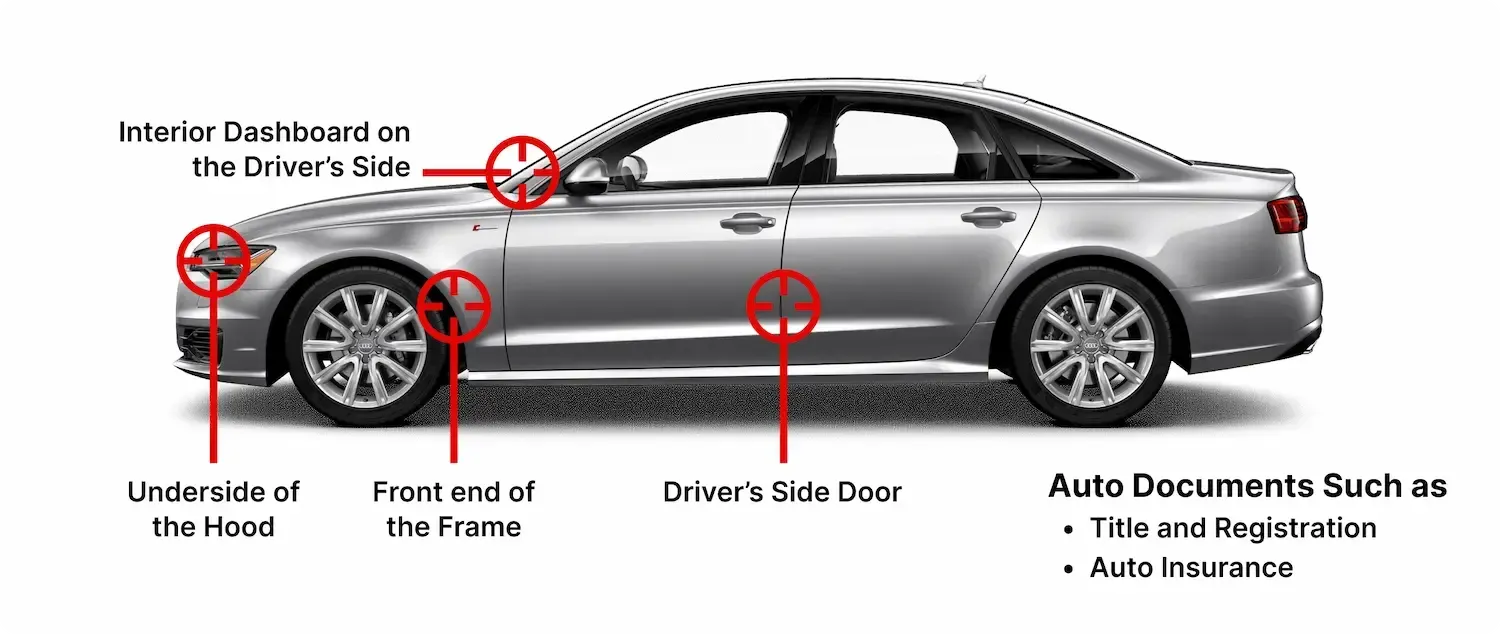
Jeep VIN Location
The VIN is typically found in several common areas on the vehicle and within official documents. Check the following locations to identify it accurately:
Driver’s Side Dashboard
Look through the windshield at the lower corner of the dashboard on the driver’s side to find the VIN plate.
Driver’s Side Door Jamb
Open the door and inspect the frame or pillar near the latch area for a sticker or metal plate displaying the VIN.
Engine Bay
Check the engine compartment for a stamped VIN, usually located on the firewall, inner fender, or chassis frame, especially relevant for rugged Jeep builds.
Documents
The VIN is also listed on official paperwork such as registration documents, insurance papers, or the vehicle title.
Classic Jeep VIN Location
Classic Jeep models, particularly older CJ and early Wrangler units, may have less standardized VIN placement depending on the production year and configuration.
Frame Stamp
Look along the frame rail, often near the rear axle or under the body, where the VIN may be stamped directly onto the metal.
Wiper Motor Cover
On some mid-1980s Jeep models, a VIN plate may be located on or near the wiper motor cover inside the vehicle.
Who Should Use the Jeep VIN Decoder
A Jeep VIN decoder is useful for anyone buying, selling, or evaluating a vehicle built for both daily driving and off-road use. With different trims, 4x4 systems, and frequent modifications, decoding the VIN helps confirm accuracy and avoid costly surprises.
Buyers
Check the Jeep’s specifications, ownership history, and condition before making a purchase. A VIN lookup helps confirm the vehicle matches its listing and reveals hidden issues, especially important for lifted, modified, or heavily used off-road units.
Sellers
Provide clear and verified details to strengthen your listing. A VIN check confirms specifications and history, helping build trust with buyers. For older or modified Jeeps, it also helps present accurate information and avoid disputes.
Dealers
Dealers can use VIN decoding to quickly verify inventory and maintain accurate listings. This reduces errors and improves transparency, especially when dealing with multiple trims, drivetrain options, and custom builds.
Off-Road Enthusiasts
Jeep owners and enthusiasts can decode the Jeep’s VIN to understand their vehicle’s original configuration. This is useful for planning upgrades, confirming factory specs, or checking whether components still match the original build.
What is the Difference Between Modern and Classic VIN
The differences between modern and classic VINs come down to structure, consistency, and how much information they provide. Newer Jeep models follow a standardized format, while older models often use shorter and less uniform VINs, which can affect decoding accuracy.
VIN Length and Format
Modern Jeep vehicles use a 17-digit VIN with a fixed global structure. Older Jeep models, especially pre-1981 units, may have VINs ranging from 5 to 14 characters due to the lack of a universal standard at the time.
Data Availability
Modern VINs provide detailed information, including engine specs, drivetrain configuration, and production data. Classic Jeep VINs may return limited results, particularly for older off-road models where records are less complete.
Decoding Accuracy
Decoding modern Jeep VINs is generally consistent due to standardized formatting and complete databases. Classic VINs can be more difficult to interpret because of inconsistent formats and limited records, but reliable tools can still provide useful insights.
Breaking Down a Jeep VIN
A 17-digit Jeep VIN follows a structured format that reveals key vehicle details. It is divided into three main sections: WMI, VDS, and VIS. Each section provides specific information, helping identify the manufacturer, vehicle attributes, and unique production data.
World Manufacturer Identifier (WMI)
Digit 1 to 3: 3C4
- 3 = Country of origin (Mexico)
- C4 = Jeep
Vehicle Descriptor Section (VDS)
Digit 4 to 9: NJDBB9
- N = Model line (Compass platform)
- J = Engine type (2.4L inline-4 Tigershark engine)
- D = Drivetrain (4x4 / AWD system)
- B = Body style (4-door SUV)
- B = Trim level (Latitude / mid-level configuration)
- 9 = Check digit
Vehicle Identifier Section (VIS)
Digit 10 to 17: MT534924
- M = Model year (2021)
- T = Toluca Assembly Plant, Mexico
- 534924 = Production sequence number
Why Checking a Jeep VIN Matters Before You Buy or Sell
A Jeep might look clean on the outside, but that does not always tell the full story. From hard off-road use to heavy modifications, a VIN check turns guesswork into clear facts, so you know exactly what you are dealing with before it costs you.
Before Buying a Car
That lifted Wrangler or modified Cherokee might look perfect, but what has it been through? A VIN check confirms specs, past ownership, and usage history, helping you spot flood damage, rebuilds, or rough off-road abuse before you commit.
Before Selling a Car
Buyers ask questions, especially with Jeeps. Use our tool to verify specs and history upfront–reducing back-and-forth, and helping justify your price with real data.
Verify Vehicle Identity
With so many modified Jeeps on the road, mismatches happen. Ensure the engine, trim, and model all align with factory records, helping you avoid cloned vehicles or builds that are not what they claim to be.
Check History and Records
Some Jeeps live easy lives. Others spend years on trails, in mud, or even underwater. Check the vehicle history report that shows accident records, title issues, and past usage so you can understand what the vehicle has really been through.
Need More Information? Get a Jeep Vehicle History Report
Once the VIN is decoded, you’ll see the complete information about the vehicle’s specifications and market value. Don’t forget to get the full vehicle history report so you can get more crucial information about the vehicle. Here’s a snippet of what you’ll get on the full report.
Vehicle Specification
Access full specifications for both classic and modern Jeep models in one report. This includes engine type, drivetrain (4x4 systems), transmission, assembly plant, MSRP, and trim details, helping confirm if the Jeep matches its intended build and capability.
Title Records
Check for title issues that may impact safety, legality, or resale. This includes salvage, rebuilt, theft records, or inconsistencies. Clean title status is crucial, especially for Jeeps that may have been heavily used or modified.
Odometer Reading
Review mileage records over time to ensure consistency. This is important for Jeeps, as usage can range from daily driving to heavy off-road activity, which can affect wear and long-term reliability.
Accident and Damage History
Identify past accidents, including dates, locations, and severity. The report may also show damage from flooding, trail use, or structural impacts, all of which can affect the vehicle’s safety and performance.
Auction History
See if the Jeep has been sold through auctions. The report may include sale dates, locations, prices, and sometimes photos, giving insight into the vehicle’s previous condition and presentation.
Ownership Information
Track ownership history, including the number of owners, regions, and duration. While personal details are not included, this timeline helps assess how the Jeep has been used and maintained.
Recalls Check
Check for any safety recalls issued for the Jeep. Newer models typically include detailed recall data, while older ones may have limited records. Addressing recalls helps maintain safety and proper function.
Engine Information
Confirm engine specifications, configuration, and key features. Jeep vehicles often include a range of engines, from efficient inline-4 units to larger V6 options, making this section essential for verifying performance and maintenance needs.
Get More Jeep Information With Our Tool
Want everything in one place? Use the VIN tool to check recalls, factory specs, and history records quickly, so you can move forward with clarity instead of risk.
Jeep Recall Check by VIN
Use the Jeep recall check by VIN to see the car’s recall history, causes, and how the issues were handled by the manufacturer.
Jeep Window Sticker by VIN
Use our Jeep window sticker to secure the window sticker to see original features, options, and more.
Decode Your Jeep Models by VIN in Seconds
Looking to check a Jeep before you commit? Whether it’s a daily driver or a trail-ready build, use the VIN decoder to see the complete information on the vehicle’s specifications and more!
Supported Modern Jeep Models
From Wranglers and Grand Cherokees to Gladiators and Renegades, the tool supports a wide range of modern Jeep models.
Supported Classic Jeep Models
Working with an older Jeep? The decoder also supports many classic models, including older CJ and early Wrangler generations. Access available records and verify details before you move forward.
Decode Any Vehicle’s VIN, Not Just Jeep
Don’t stop at one check. Use the VIN decoder for any car, truck, or SUV and get the details you need in less than a minute.
Jeep EV Update
The Jeep EV strategy is to focus on introducing dedicated battery-electric SUVs while still relying on plug-in hybrid models as a transition phase. Under the brand, Jeep prepares to gradually expands its EVs.
Jeep EV Lineup
Jeep’s EV direction is built around two main battery-electric models: the Jeep Recon and the Wagoneer S. These represent the brand’s first step into full electrification, combining traditional Jeep identity with modern EV architecture.
Recon and Wagoneer S Focus
The Jeep Recon is designed as an all-electric adventure SUV with Trail Rated capability and rugged off-road features. The Wagoneer S, on the other hand, targets the premium segment with a performance-oriented electric setup and advanced interior technology.
Recon: off-road focused EV with estimated mid-200 mile range.
Wagoneer S: premium EV SUV with ~300-mile class range.
Both models emphasize Jeep’s core identity in electric form.
Positioned for different segments: adventure vs luxury.
Hybrid Transition Strategy
Jeep continues to use plug-in hybrid models, especially the Wrangler 4xe, as a bridge toward full electrification. This allows the brand to maintain flexibility while expanding its battery-electric lineup.
Strong reliance on Wrangler 4xe and other plug-in hybrids.
Hybrids act as transition technology to full EV adoption.
Gradual shift rather than immediate full electrification.
Balanced ICE, hybrid, and EV lineup strategy.
FAQs About Jeep VIN Decoder
How do I find out what kind of Jeep I have?
To identify your Jeep’s exact model, year, and trim, start by locating the 17-digit VIN on the driver’s side dashboard, door jamb, or registration documents. Enter the VIN into a decoder to access the build sheet, which lists factory specifications, drivetrain details, and installed features.
Is there a free Jeep VIN decoder?
Yes, there are several free Jeep VIN decoders available. Official tools can provide build sheet data, while other online decoders can quickly reveal key specifications and basic vehicle details at no cost.
How do you decode a classic VIN older than 1980?
Decoding a pre-1980 Jeep VIN, often referred to as a serial number, requires using manufacturer-specific references since the 17-digit standard only began in 1981. Check common locations like the door pillar, firewall, or engine bay, then use a classic VIN decoder to interpret the information.
What if my VIN is less than 17 digits?
If your VIN has fewer than 17 characters, the vehicle was likely built before 1981, prior to VIN standardization. Older VINs vary in length and format, and some modern systems may require adjustments or verification through local registration authorities.
Can I look up my vehicle specs by VIN number?
Yes, you can look up detailed vehicle specifications such as engine type, trim level, transmission, and production details by entering a 17-digit VIN into an online decoder, making it easier to confirm the vehicle’s original configuration.