
Decode Classic and Modern FIAT’s VIN
Need a hand to decode any classic and modern FIAT? Be sure to use our VIN decoder service to get model year, trim, engine specifications, transmission setup, body style production details and many more.
Table of Contents:
What Will You Get From the FIAT VIN Decoder?
A FIAT VIN Decoder reveals vehicle details straight from the source. This helps prevent listing discrepancies and ensures pricing reflects the car’s original MSRP, all while remaining completely free.
- Manufacturer and origin
- Model, trim, and package details
- Engine specifications
- Transmission setup
- Body style
- Model year
- Production plant
- Manufacturer Suggested Retail Price (MSRP)
- Market Value
How to Decode the Fiat VIN?
Decoding a Fiat VIN is quick and simple. With the Fiat VIN decoder, vehicle details can be accessed in under a minute without any complicated steps.
Step 1: Find the VIN
Locate the VIN on the dashboard, driver’s side door jamb, or within the vehicle’s paperwork.
Step 2: Fill out the Form
Enter any Fiat VIN, whether from a newer model or an older one, into the form and submit it.
Step 3: Check the Vehicle Specs
Review the preview page for specifications and value insights, then continue to access the complete vehicle history report.
Where to Find the VIN on a Fiat
Before running the FIAT VIN decoder tool, you’ll need to find the VIN first. Fiat models typically follow standard VIN placement, although older units may vary slightly depending on the year and production origin.
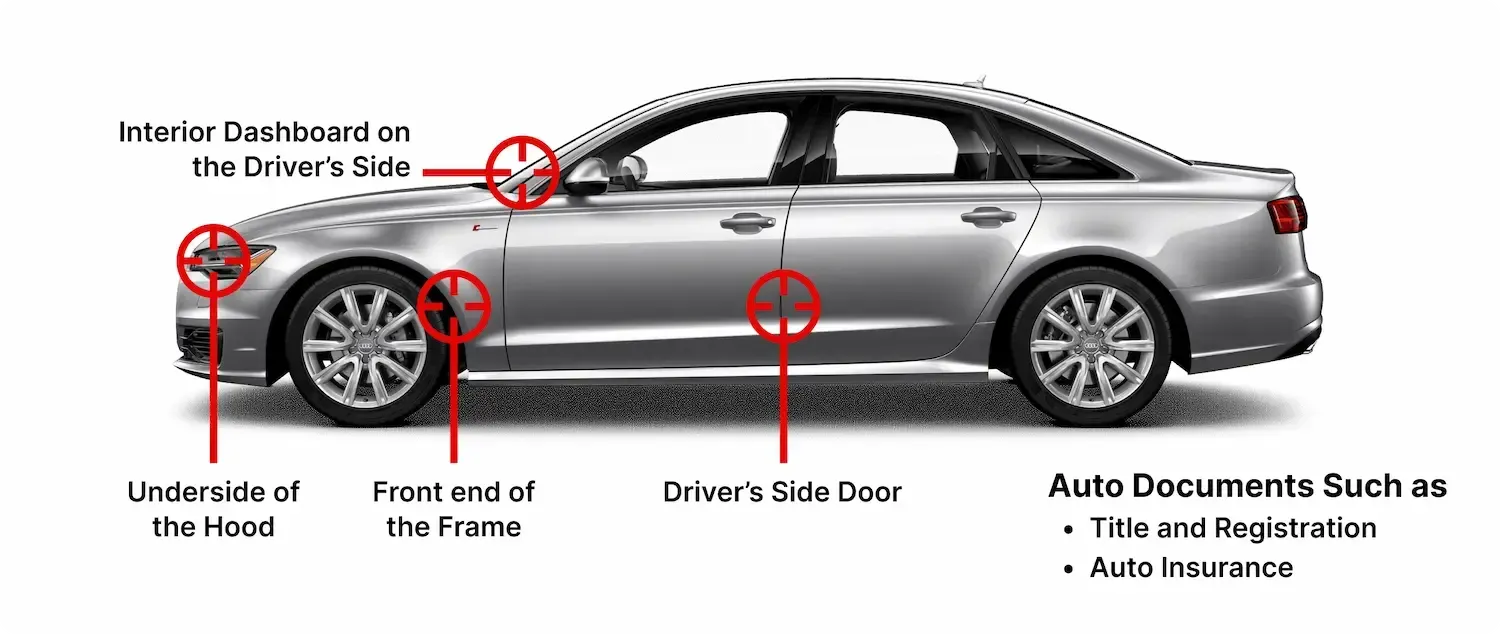
Fiat VIN Location
The VIN can be found in several common spots on the vehicle and in official documents. Check the following areas to locate it accurately.
Driver’s Side Dashboard
Look through the windshield at the lower corner of the dashboard on the driver’s side to spot the VIN plate.
Driver’s Side Door Jamb
Open the driver’s door and check for a sticker or plate near the latch or door frame.
Engine Bay
Check inside the engine compartment. The VIN may be stamped on structural parts such as the firewall or chassis.
Documents
The VIN is also listed on documents like the registration, insurance papers, and vehicle title.
Classic Fiat VIN Location
Older Fiat vehicles may still follow similar placement, but some can include less typical locations due to different manufacturing standards at the time.
Under the Floor Mat
On certain classic Fiat models, the VIN may be stamped into the floor beneath the carpet, often on the passenger side.
Body Panels
Some vintage Fiat models may have VIN plates attached to areas like the hood, trunk section, or inner panels, usually displayed on small factory-installed tags.
Who Should Use a Fiat VIN Decoder
A Fiat VIN decoder is useful for anyone dealing with a used or classic vehicle. Since Fiat models vary by market, trim, and production year, verifying details through the VIN helps ensure accuracy, transparency, and informed decisions.
Buyers
Fiat buyers benefit from more than a basic inspection. A VIN lookup confirms factory specifications, ownership records, and vehicle history, helping ensure the car matches its listing—especially important for imported models or trim-specific features.
Sellers
For Fiat sellers, clear and accurate information builds trust. A VIN check helps present verified specs and history, supports the asking price, and makes the listing more credible to potential buyers.
Dealers
Dealers handling Fiat vehicles need reliable data to avoid listing errors. VIN decoding helps confirm build details, streamline inventory checks, and provide accurate information in a competitive used car market.
Daily Drivers
Every day, Fiat owners can use a VIN decoder to understand their vehicle. It helps verify specifications, track history, and prepare for maintenance, resale, or ownership planning with more confidence.
Modern vs Classic VIN: What Sets Them Apart
VIN systems have evolved. While modern vehicles follow a standardized global format, older cars used shorter, manufacturer-specific codes. This directly affects how much detail can be extracted during decoding.
VIN Length and Format
Modern vehicles use a 17-character VIN with a consistent structure applied worldwide. Older models, including classic Fiat vehicles, often have shorter VINs ranging from 5 to 14 characters due to the lack of a universal system before 1981.
Data Availability
Modern VINs are supported by detailed digital databases that include specifications, engine data, and production records. Classic VINs rely more on archived or brand-specific information, so the level of detail may vary depending on the Fiat model and production year.
Decoding Accuracy
Thanks to standardized formatting, modern VIN decoding is generally accurate and consistent. Classic VINs can be harder to interpret due to inconsistent formats and limited records, but they can still be decoded with the right tools and references.
Fiat VIN Structure Breakdown
A VIN, or Vehicle Identification Number, is a 17-character alphanumeric code used to identify a vehicle. Each Fiat model and trim has a unique VIN. Typically, the VIN is divided into three main sections: WMI, VDS, and VIS.
World Manufacturer Identifier (WMI)
Digit 1 to 3: ZFB
- Z = Country of origin (Italy)
- FB = Fiat
Vehicle Descriptor Section (VDS)
Digit 4 to 9: NFADH2
- N = Model line (500L platform)
- F = Series: Ducato or similar Fiat Professional model
- A = Body type: Cargo van or chassis
- D = Engine: 3.0L I4 Diesel
- H = Safety features: Front airbags, active belts
- 2 = Check digit
Vehicle Identifier Section (VIS)
Digit 10 to 17: LZ042537
- L = Model year (2020)
- Z = Assembly plant
- 042537 = Production sequence number
Why Decoding a Fiat VIN is Non-Negotiable
Decoding a Fiat VIN goes beyond simple identification. It provides verified details about the vehicle’s specifications and background, helping confirm exactly what the car is and whether the information presented matches reality.
Before Buying a Fiat
Fiat models can vary in trims, engine options, and market-specific features. A VIN check confirms the exact configuration, past ownership, and condition, reducing the risk of relying only on listings or seller claims.
Before Selling a Fiat
Accurate details matter when listing a vehicle. Decoding the VIN allows sellers to present verified specifications and history, making the listing more trustworthy and helping support the asking price.
Verify Fiat Vehicle Identity
Vehicles may undergo modifications, part replacements, or restorations over time. A VIN check helps confirm that key details such as engine type, model, and production data align with factory records.
Check History and Records
Access ownership history, accident reports, and title data to understand the vehicle’s background. These records help identify potential issues that may affect value, safety, or resale.
Decode the FIAT Models by VIN Easily
Use our FIAT VIN decoder tool to be able to decode its classic and modern VINs easily.
Modern FIAT Models
We cover all the Ferrari models and trims.
Supported Classic FIAT Models
We also support the VIN decoding process for all models and trims of classic Ferrari.
Want More Info About Your Fiat? Get a Vehicle History Report
After decoding a Fiat VIN, the report brings together detailed information about the vehicle’s specifications and background. This is useful for both buyers and sellers, as condition, history, and originality can influence value and long-term reliability.
Vehicle Specification
Access manufacturer-provided details such as engine type, transmission, production plant, and original MSRP. For Fiat models, this helps confirm whether the vehicle still matches its factory configuration, which can impact resale value and accuracy when listing.
Title Records
Check the title status for issues like salvage, rebuilt, theft records, or inconsistencies. These details can affect the car’s market value, registration process, and whether it can be legally resold or exported.
Odometer Readings
Review recorded mileage over time to ensure consistency. Any irregularities may indicate tampering or reporting errors, which can affect the vehicle’s credibility and overall condition assessment.
Accident and Damage History
Look for reported accidents, repairs, or environmental damage. This helps determine whether the Fiat maintains its structural condition and is safe for everyday use.
Auction History
Find out if the vehicle has appeared in auctions, including dates, locations, and final sale prices. Some records may include photos, giving additional insight into past condition and presentation.
Ownership Information
See previous ownership records, including number of owners, locations, and duration. A clear ownership timeline can support transparency and make the vehicle more appealing to potential buyers.
Recall Check
Identify any recalls issued for the Fiat related to safety or performance. The report may also show whether the necessary fixes have been completed.
Engine Information
Verify engine specifications, configuration, and performance details. This helps ensure the engine aligns with factory records, which is important for accurate valuation and maintenance planning.
Get More Fiat Information With Our Tool
Before you purchase a used FIAT, you need to make sure the vehicle has no recall history, and ensure you check everything thoroughly before proceeding to buy the unit.
FIAT Recall Check by VIN
Check the FIAT recall by VIN and secure the vehicle history report to see how the recall issues were handled.
FIAT Window Sticker
Get the FIAT window sticker and get the window sticker to examine the car’s initial feature, options, MSRP, safety ratings, and more!
Check All Vehicles’ VINs in Seconds
Need to check another vehicle, but not a FIAT? Don’t worry, our service can be used to decode all vehicle makes. See the list below.
FIAT EV Expansion Strategy
FIAT continues to position itself as a leader in small urban electric vehicles, focusing on affordability and practicality rather than high-performance EV development. The company’s electrification roadmap aligns with Stellantis’ multi-energy strategy to compete in the global market.
Grande Panda Introduction
The FIAT Grande Panda represents the brand’s next-generation affordable EV direction, combining retro-inspired styling with modern electric style. The EV is positioned as a practical city-car crossover and is expected to play a major role in the EV market segment, especially in Europe.
FIAT 500e Evolution
The FIAT 500e remains one of the brand’s most recognisable electric models, although Fiat is reportedly preparing cost-focused updates to improve competitiveness in the compact EV market
Future Product and Mobility Plans
FIAT’s long-term strategy includes expanding beyond traditional hatchbacks with additional compact crossovers, mobility-focused vehicles, and next-generation urban transportation. Stellantis has signalled broader Fiat product expansion in the future.
FAQs About FIAT VIN Decoder
Can I decode an old 13-digit FIAT VIN?
Yes, an older 13-digit Fiat VIN can still be decoded, but it requires dedicated tools rather than standard 17-digit decoders. These pre-1981 VINs usually reveal basic details like manufacturer, model, and serial number. Using a classic VIN decoder is the most effective way to access available history records.
Is the reliability of Serbian-built Fiats a concern?
The reliability of Fiat vehicles produced in Serbia has been mixed, particularly in earlier models like the Yugo, which had well-known quality concerns. More recent models tend to perform better with proper maintenance, though high production demand can sometimes put pressure on consistency.
What’s typical mileage when the Fiat oil cooler fails?
Owner reports and maintenance data suggest that the oil cooler on certain Fiat engines, especially the 1.4L MultiAir and Abarth variants, commonly develops issues between 70,000 and 110,000 miles.
Is the Fiat theft rate low in the US?
Available data indicate that Fiat vehicles are not commonly targeted for theft in the United States. Most theft cases typically involve other segments, such as full-size trucks, older Honda models, and certain Hyundai or Kia vehicles.
What’s typical mileage when the Fiat oil cooler fails?
Based on common repair trends, the oil cooler in some Fiat models, including the Fiat 500 and Abarth versions, often shows signs of failure between 80,000 and 120,000 miles.