
Decode Any Modern and Classic Alfa Romeo VIN
If you are in the market for a used modern or classic Alfa Romeo, be sure to check it before you buy. Enter the VIN on the form below to decode the VIN and get model year, trim, engine specifications, transmission setup, production details and more.
Table of Contents:
What Information is Available on an Alfa Romeo VIN Decoder?
With our Alfa Romeo VIN decoder, you can get this crucial information to help you spot a mismatch listing or see if the car matches your needs. A VIN decoder brings clarity to every detail. It ensures the vehicle matches its listing and minimizes costly mistakes.
- Manufacturer and origin
- Model, trim, and package details
- Engine specifications
- Transmission setup
- Body style
- Model year
- Production plant
- Manufacturer Suggested Retail Price (MSRP)
- Market Value
How to Use the Alfa Romeo VIN Decoder
To use our Alfa Romeo VIN decoder, you just need to follow these simple steps and get it done in less than a minute.
Step 1: Enter the VIN
Locate the VIN on the driver’s side door jamb or check documents like the registration or bill of sale, then enter it into the form.
Step 2: Submit the Form
After entering the VIN, click the button to run the check and start the lookup process.
Step 3: Check Vehicle’s Specifications
Check the full vehicle’s specifications, like engine, transmission, country of origin, and the car’s market value.
Where to Find the VIN on an Alfa Romeo
Locating the VIN on both classic and modern Alfa Romeo models is essential before decoding it. VIN placement can vary by model and year, so knowing where to check will save time.
Alfa Romeo VIN Location
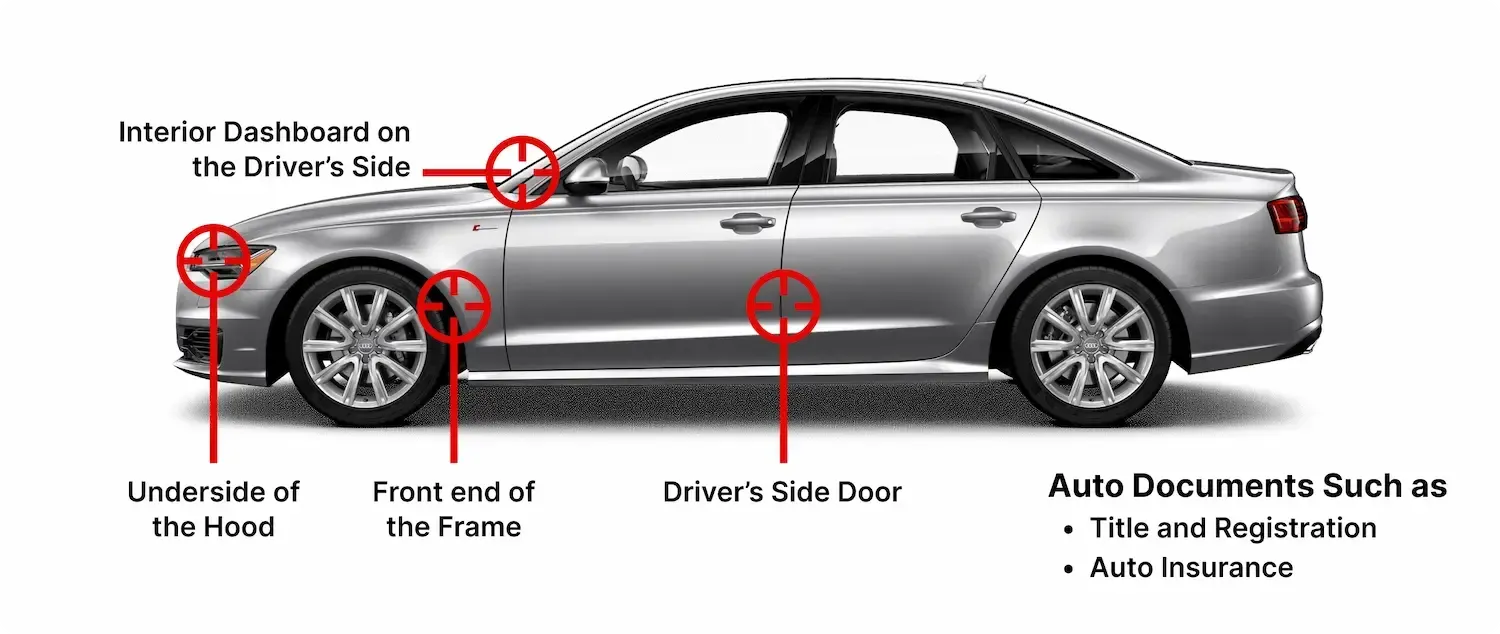
The VIN can be found in several locations on the vehicle and its documents. Check the following areas to locate it.
Driver’s Side Dashboard
Check the lower-left corner of the dashboard by looking through the windshield from outside the vehicle.
Driver’s Side Door Jamb
Open the driver’s door and look for a sticker or plate near the latch or door frame.
Engine Bay
Look for a stamped VIN on the engine block or along the bulkhead inside the engine compartment.
Documents
The VIN is also listed on official documents such as the registration, insurance card, and vehicle title
Classic Alfa Romeo VIN Location
Classic Alfa Romeo models share common VIN locations, but some have additional or less standard placements depending on the model and production year.
Under the Floor Mat
On certain models, the VIN may be stamped on the floor pan under the carpet, often on the passenger side.
Body Panels
Older models may have VIN tags on components like the hood, trunk lid, or fenders, typically shown on small stickers or plates.
Who Benefits from Using an Alfa Romeo VIN Decoder
An Alfa Romeo VIN decoder is useful for anyone dealing with a used or classic model. Whether buying, selling, managing inventory, or collecting, decoding the VIN helps confirm details and avoid costly mistakes.
Buyers
Check specifications, ownership records, and past history before committing. This helps confirm the vehicle matches the listing and reduces the risk of hidden issues, especially when dealing with older Alfa Romeo models.
Sellers
Provide accurate details to support your listing and build trust. A VIN check helps confirm specs and history, making it easier to answer buyer questions and justify your asking price.
Dealers
Verify inventory quickly and keep listings accurate across platforms. VIN decoding helps reduce errors, supports transparency, and makes it easier to manage both modern and classic Alfa Romeo vehicles.
Collectors
Confirm authenticity, production details, and key specifications before acquiring a vehicle. This is especially useful for identifying rare Alfa Romeo models and verifying originality when documentation is limited.
Modern vs Classic Alfa Romeo VIN: What Sets Them Apart
VIN formats have changed over time. Modern Alfa Romeo vehicles follow a fixed structure, while older models use shorter and less consistent formats, which affects how much information can be retrieved.
VIN Length and Format
Modern Alfa Romeo vehicles use a standardized 17-digit VIN. Older models may use shorter VINs, typically between 5 and 14 characters, depending on the production year and manufacturing practices at the time.
Data Availability
Modern VINs provide detailed information, including specifications and production data. Classic VINs may return limited results, depending on available records and how well the manufacturer preserved historical data.
Decoding Accuracy
Modern VIN decoding is more consistent due to standardized formatting and complete databases. Classic VIN decoding can vary, as formats differ and some historical records may be incomplete or missing.
Alfa Romeo VIN Number Breakdown
The Alfa Romeo VIN is used as an identifier for a certain vehicle. Each VIN structure is different, and they convey different information about the vehicle. Here’s how an Alfa Romeo VIN is broken down.
Sample : ZARFAECN0J7583907
World Manufacturer Identification (WMI)
Digit 1 to 3: ZAR
- Z = Italy
- AR = Alfa Romeo
Vehicle Descriptor Section (VDS)
Digit 4 to 9: FAECN0
- F = Model line (Giulia platform)
- A = Engine type (2.0L turbocharged inline-4 engine)
- E = Body style (4-door sedan)
- C = Trim level (base / standard configuration)
- N = Series or equipment package within the model range
- 0 = Check digit
Vehicle Identifier Section (VIS)
Digit 10 to 17: J7583907
- J = Model year (2018)
- 7 = Cassino Assembly Plant, Italy
- 583907 = Production sequence number
Why Decoding an Alfa Romeo VIN Matters
An Alfa Romeo VIN is more than just a code. Decoding the Alfa Romeo helps you understand exactly what you are dealing with before making any decision.
Before Buying a Car
Check the VIN to confirm specifications, ownership history, and overall condition before purchase. This helps you catch hidden issues early and avoid costly mistakes, especially when dealing with older or less documented Alfa Romeo models.
Before Selling a Car
Use a VIN check to present accurate and verified details in your listing. This helps reduce buyer hesitation, supports your asking price, and makes the process smoother, particularly for classic Alfa Romeo vehicles.
To Verify Vehicle Identity
Confirm that the VIN matches the car’s make, model, and configuration. This step helps detect mismatches, cloning, or fraud, which is especially important when records are limited or inconsistent across older Alfa Romeo models.
To Check History and Records
Access records such as ownership history, title data, and reported events. This helps build a clearer picture of the vehicle’s background, even if available data is limited for some classic Alfa Romeo models.
Supported Alfa Romeo Models
Explore which Alfa Romeo models you can check with our service. It supports both modern and classic vehicles, helping you access key details and records across different model years.
Decode Modern Alfa Romeo
Use our tool to check the history of modern Alfa Romeo models across different trims and production years. Access everything in one report.
Classic Alfa Romeo VIN Decoder
Want to decode the classic Alfa Romeo? You can use our tool to check a Pre-1981 VIN that has a 5 to 14-digit VIN alphanumeric code.
Want More Info About Your Alfa Romeo? Get a Vehicle History Report
Get the full vehicle history report for Alfa Romeo to see more past details. It helps buyers spot risks and allows sellers to present accurate, verified information before listing an Alfa Romeo.
Vehicle Specification
Access detailed factory information, including engine type, transmission, fuel system, country of manufacture, and original MSRP. This section helps confirm the vehicle matches the listing and ensures it aligns with your expectations, needs, and overall budget before buying.
Title Records
Review the vehicle’s title status to identify issues such as salvage, rebuilt, lemon, or stolen records. These details can affect safety, ownership transfer, registration, and resale value, making it important to verify before completing any purchase or sale.
Odometer Reading
Track mileage records over time with corresponding dates to confirm consistency. This section helps detect irregular patterns, gaps, or possible rollback issues, giving you a clearer understanding of the vehicle’s actual usage and condition before making a decision.
Accident and Damage History
Check for reported accidents, structural damage, or environmental exposure such as flooding. Records may include dates and locations, helping you assess the vehicle’s condition, potential repair quality, and long-term reliability before committing to the purchase.
Auction History
Find out if the vehicle was previously sold at auction, including key details such as sale date, location, and final price. Some reports may include images that show the vehicle’s condition at the time it was listed or sold.
Ownership Information
View the number of previous owners, general locations, and how long each owner kept the vehicle. This helps you understand usage patterns and whether the vehicle changed hands frequently, which can influence condition and overall reliability.
Recalls Check
Identify any safety or performance recalls issued for the Alfa Romeo. This section helps you understand if the car was recalled by giving crucial information on the recall date, causes, and fixes done to the vehicle.
Engine Information
Confirm the engine type, configuration, and key performance details. This helps verify the vehicle still matches its original factory setup and supports accurate evaluation when comparing listings, checking modifications, or assessing overall performance expectations.
Get More Alfa Romeo Details with Our Tool
If you need more than basic VIN decoding, use our tool to check recalls and factory specifications through the window sticker. This helps you confirm original features and spot differences before making a decision.
Check Alfa Romeo Recalls by VIN
Use our Alfa Romeo recall check by VIN to check its recall history. Make sure all recalls are fixed.
Alfa Romeo Window Sticker
Get the Alfs Romeo window sticker by VIN to see the complete specifications and many more.
Check Any Vehicle With Our VIN Decoder Tool
You can decode VINs for a wide range of makes and models using our service. Run a VIN check before buying to confirm vehicle details and records.
Alfa Romeo Electric Vehicles Update: Models, Features & Future Plans
Alfa Romeo continues to expand its electrified lineup while adopting a multi-energy approach, including gasoline, hybrid, and electric vehicles. The brand's future models aim to combine modern EV technology with signature performance and driving dynamics.
The Alfa Romeo Junior Leads the EV Lineup
The Alfa Romeo Junior marks the brand’s first fully electric production vehicle with the Alfa Romeo Junior Elettrica. This compact crossover is ly rolling out across global markets and is available with two electric powertrain options:
- 156 HP electric version
- 280 HP Junior Veloce performance model
Next-Generation Giulia and Stelvio Updates
The upcoming Alfa Romeo Giulia and Stelvio were originally planned as fully electric models built on Stellantis’ STLA Large platform. However, Alfa Romeo later revised the project to support internal combustion engines and hybrid powertrains alongside EV options.
Both models are now expected to arrive around 2027 or 2028 as part of Alfa Romeo’s updated multi-powertrain strategy.
Performance and Future Models
Alfa Romeo has also confirmed the return of high-performance Quadrifoglio models. Future performance variants are expected to include both advanced electric powertrains and updated combustion-engine setups designed to preserve the brand’s sporty driving character.
In addition, Alfa Romeo continues exploring future lineup expansion with new crossover and compact vehicle projects ly under development.
FAQs About Alfa Romeo VIN Decoder
Can I decode a pre-1981 VIN?
Yes, pre-1981 VINs can be decoded, but they require specialized tools since formats were not standardized. You can use dedicated classic VIN decoders, manufacturer resources, or contact the DMV. These VINs typically range between 11 and 17 characters.
How does a Classic Alfa Romeo VIN decoder help with restoration?
A classic Alfa Romeo VIN decoder supports restoration by providing factory specifications. It helps verify authenticity, identify correct parts, and confirm original details such as paint, trim, engine, and transmission based on the vehicle’s build data.
Why are older Alfa Romeo VINs shorter than modern ones?
Older Alfa Romeo VINs are shorter because they were not standardized. Before 1981, they were simple chassis or serial numbers, often 5 to 7 digits or combined with model prefixes, rather than today’s structured 17-character format.
Can I get the original Alfa Romeo window sticker by VIN?
Yes, you can get a replica Alfa Romeo window sticker using the 17-digit VIN. A VIN-based lookup tool can generate a digital version showing original MSRP, factory options, paint codes, and key specifications.
Is chassis no 17 digits?
Yes, modern VINs are standardized to 17 characters. This format has been used for most vehicles built after 1981, providing consistent information about the car’s origin, specifications, and production details.
Is there a free VIN number check for old cars?
Yes, free VIN checks for older cars are available, but they usually provide limited details. A classic VIN decoder can offer more information, including specifications, usage records, and other available historical data.
How many digits is a 1980 VIN number?
A 1980 VIN is often shorter and not fully standardized, typically ranging from 5 to 13 characters. Although standardization began around that time, many vehicles still used manufacturer-specific formats.