Key Takeaways
- The used car vehicle sector consistently sells more than twice as many units as the new vehicle market each year.
- Supply chain disruptions between 2020 and 2022 reshaped pricing, inventory patterns, and buyer behavior in lasting ways.
- Light trucks and used electric vehicles are changing the structure of demand across the U.S. auto landscape.
If you walk into almost any neighborhood in America, chances are most of the cars parked in driveways are not brand new. They’re used vehicles, and they power the majority of households across the country.
The used vehicle market in the US is relatively massive. More than 43 million used light vehicles were sold in the United States in 2021, and even after prices cooled down and supply chains stabilized, annual used sales still hovered near 38 million units.
So here is the real question. How did used cars become the center of the American auto industry?
Let’s break it down carefully.
The Size of the United States Used Car Market
Before discussing disruption or pricing, we need to take a look at the, scale.
The United States used car market operates at enormous volume. Pre-pandemic annual sales averaged roughly 40 million units. During the supply shock period, used sales climbed even higher as buyers shifted away from unavailable new inventory.
Metric | Current Estimate |
|---|---|
Annual Used Sales | 36–40 million |
Total Market Value | $1.2–$1.5 trillion |
Projected CAGR (2024–2029) | ~4.3% |
Average Used Price | ~$27,000 |
Even at the lower end, $1.2 trillion annually places the used vehicle market among the largest retail sectors in the U.S. economy. It directly affects household debt levels, credit markets, dealership employment, and even insurance premiums.
Growth is projected to continue at a steady pace, not explosive, not collapsing. That stability is key.
How Many Used Cars Are Sold Yearly?
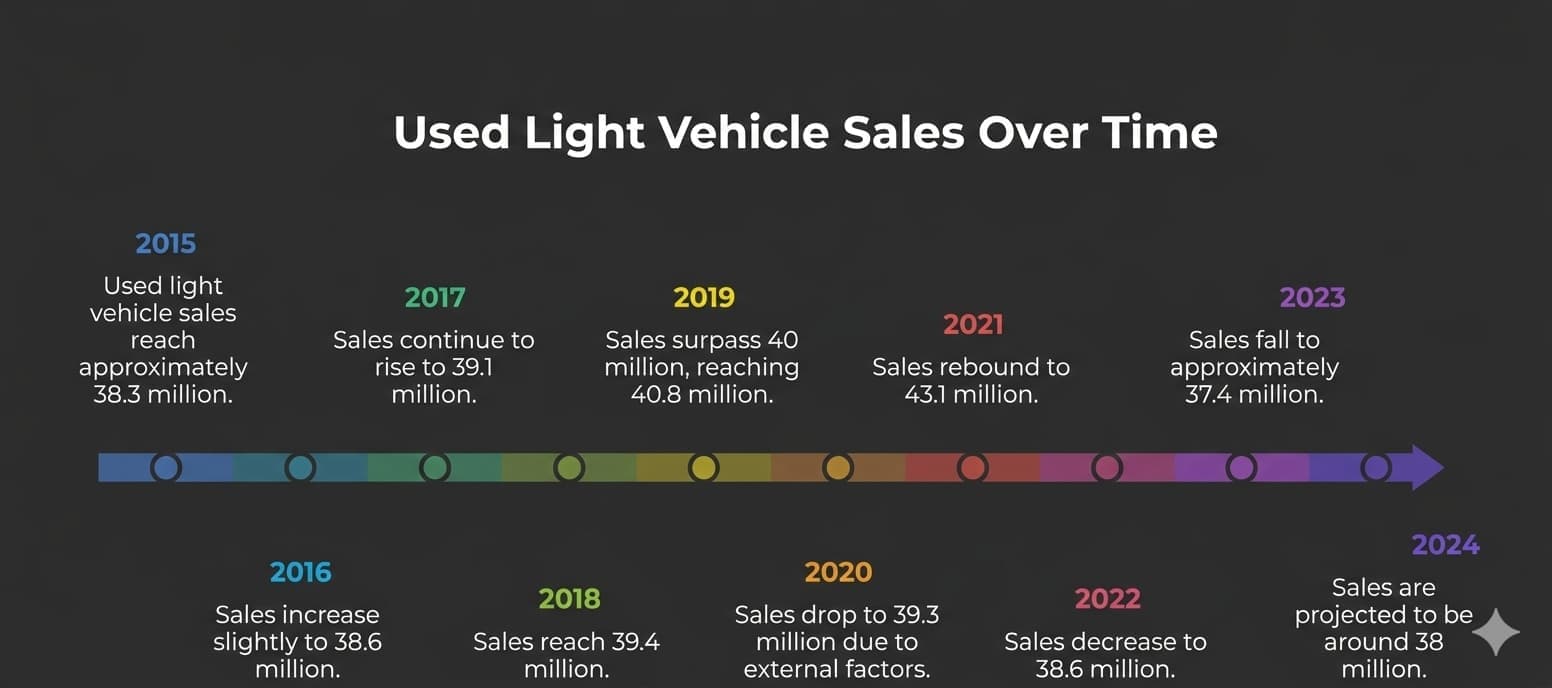
Let's take a walk down history lane here:
Year | Used Light Vehicle Sales (Millions) |
|---|---|
2015 | ~38.3 |
2016 | ~38.6 |
2017 | ~39.1 |
2018 | ~39.4 |
2019 | 40.8 |
2020 | 39.3 |
2021 | 43.1 |
2022 | 38.6 |
2023 | ~37.4 |
2024 | ~38 |
The 43.1 million peak in 2021 marked one of the strongest used sales years on record. Even with normalization, used sales remain near historic averages.
By comparison, new vehicle sales in recent years have ranged between 13 and 16 million units. That means the used-to-new sales ratio often exceeds 2.5 to 1.
That ratio is not new, but it became far more visible during supply disruptions.
Supply Disruptions and Their Role in the Used Vehicle Market
The period from 2020 through 2022 fundamentally reshaped the used vehicle market. Let’s see how.
Impact of the Semiconductor Shortage on Vehicle Availability
Global semiconductor shortages reduced new vehicle production significantly. Industry estimates suggest more than 11 million vehicles were removed from global production schedules in 2021.
When new vehicle output drops, trade-ins decline. Lease returns shrink. Fleet replacement cycles are slow. The ripple effect flows directly into used inventory.
According to the market summary, supply chain disruptions limited new car production and reduced trade-in volume, intensifying used vehicle competition .
Dealers faced sourcing challenges. Auction prices spiked. Consumers encountered limited availability and rising prices.
Inventory-to-Sales Ratio as a Market Signal
The inventory-to-sales ratio provides a clear indicator of market tightness.
In April 2020, the ratio initially surged as lockdowns halted retail activity. However, by June 2022, the ratio dropped to approximately 0.56, signaling extremely constrained supply relative to demand.
In simple terms, there were fewer cars available for each buyer.
By late 2024, inventory levels improved, though not excessively. Used days’ supply hovered near 45 to 50 days at franchised dealers. That suggests balance, not oversupply.
The shock period exposed just how dependent the market is on steady new vehicle production.
Average Used Vehicle Prices vs. New Vehicle Prices
Before 2020, average used vehicle prices were near 22,000 dollars. In 2021, that figure jumped to roughly 26,700 dollars. That represents a 4,000 dollar increase in one year.
Here is a simplified comparison:
Year | Average Used Price | Average New Price |
|---|---|---|
2019 | ~$21,900 | ~$36,700 |
2020 | ~$22,000 | ~$38,000 |
2021 | ~$26,700 | ~$45,000 |
2022 | ~$27,000+ | ~$48,000+ |
2023 | ~$27,000 | ~$48,000+ |
2024 | ~$26,000–27,500 | ~$48,500+ |
In 2021, used vehicles were roughly 37 percent cheaper than new vehicles on average. Even at elevated levels, that price gap preserved demand.
The average used car price in 2023 reached approximately 27,000 dollars, reflecting continued upward pressure.
How Is the Used Car Market Right Now?
The honest answer to this question is stabilization. Prices have cooled from peak volatility and inventory is improving gradually. However, used prices remain above 2019 levels.
Interest rates play a growing role. As financing costs rise, monthly payments increase even if vehicle prices decline slightly.
The market is no longer in crisis mode. It is recalibrating.
Want to Know What a Vehicle is Really Worth?
Get a free VIN check to view a vehicle’s actual market value and verify the history of that vehicle. View past sales data, accident history, theft records, and other records linked to the VIN.
Check before you buy. It only takes a few seconds.
Who Is Buying Used Cars in the U.S.?
If we want real insight into the market, we need to look beyond sales volume and pricing. The buyer profile explains why demand remains so durable.
The US used car market is not driven by one narrow income group. It spans multiple life stages, financial positions, and motivations.
Demographics of Used Car Buyers
Let’s break it down more carefully.
Income Distribution Patterns
In 2022, 55 percent of used vehicle buyers reported household incomes above 75,000 dollars .
That matters.
It shows used vehicles are not simply a fallback for constrained buyers. Many higher-income households intentionally choose used vehicles to avoid depreciation on new cars.
However, middle-income consumers play an increasingly important role. Surveys indicate that 81 percent of middle-income respondents are considering used vehicles due to rising new vehicle costs.
There is a practical logic here. When new vehicle prices approach 48,000 dollars on average, even financially stable households pause.
Age-Based Purchase Behavior
Age differences reveal another layer.
Buyers aged 18 to 29 lean more toward new vehicles. Roughly 56 percent in that group express intent to buy new, while only 28 percent prefer used.
Now compare that to buyers aged 45 to 64. Nearly 46 percent of that group prefer used vehicles, compared to 33 percent choosing new.
Age Group | Tendency |
|---|---|
18–29 | Lean toward new |
30–44 | Balanced |
45–64 | Strong used preference |
65+ | Even split |
Why the difference?
Younger buyers may prioritize newer technology and warranty coverage. Older buyers often prioritize reliability, depreciation value, and known brand reputation.
The pattern reflects life stage more than income alone.
Gender Distribution and Preferences
Gender distribution remains nearly balanced. Males account for 51 percent of used buyers; females, 49 percent.
However, female buyers show a stronger stated preference for used vehicles compared to male buyers in survey intent data.
That nuance is easy to miss if you only look at total percentages.
Education and Geographic Influence
Education level and location influence model preferences.
Buyers in metropolitan areas often have broader access to inventory and are more exposed to electric vehicles. Rural buyers often prioritize trucks and SUVs with higher utility value.
Local market conditions shape availability, pricing, and demand patterns in subtle but meaningful ways.
Demographics are not static. They move with economic pressure.
Financing Trends in the Used Car Market
Pricing only tells part of the story. Financing determines what buyers can realistically afford.
In 2023, roughly 55 percent of used vehicle transactions were financed.
Average Loan Amounts
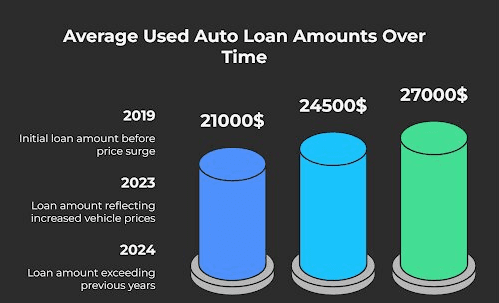
The average used auto loan hovered around 22,000 dollars. That number reflects higher vehicle prices compared to the previous decade. As prices increased, loan sizes increased accordingly.
Year | Avg Used Loan |
|---|---|
2019 | ~$21,000 |
2023 | ~$22,000–$27,000 |
2024 | ~$27,000+ |
Interest Rate Environment
Interest rates for used vehicles typically ranged between 4 and 6 percent depending on credit quality and vehicle age.
However, macroeconomic rate increases in 2023 and 2024 pushed some borrowers into higher monthly payment brackets.
Longer loan terms have become more common as lenders attempt to maintain affordability. While that lowers monthly payments, it extends total interest paid. That trade-off shapes buyer decisions more than headline pricing alone.
Credit Tier | Typical Rate |
|---|---|
Prime | 5–7% |
Near Prime | 7–9% |
Subprime | 9–14% |
Vehicle Mix and Body Type Dynamics in the Used Market
The shift toward trucks and SUVs continues.
Dominance of Light Trucks in Used Vehicle Sales
SUVs, crossovers, and pickups account for a majority of used transactions. Sedans remain relevant at lower price tiers, but resale strength is concentrated in truck-based segments.
Best-Selling Used Models and Price Implications
If you spend enough time looking at transaction data, you start to see a pattern. Some vehicles just refuse to fade.
Full-size pickups sit at the top of the used market year after year. The names do not change much. The Ford F-150. The Chevrolet Silverado 1500. The Ram 1500. These trucks move volume. But more importantly, they move money.
Ford F-150
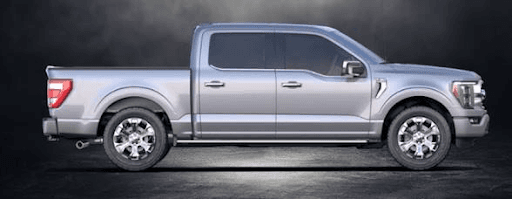
The F-150 has led U.S. sales for decades, and that reputation carries into the used market. Supply is high, but demand stays strong among contractors, rural drivers, and families.
- Avg used price: ~$41,000
- Strong resale performance
- Contractor and rural demand
Chevrolet Silverado 1500
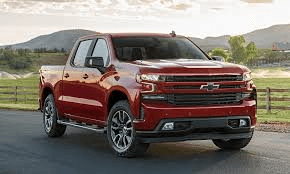
The Silverado delivers steady resale value year after year.
Late-model used trucks usually sell for $33,000–$43,000, with four-wheel drive versions moving quickly in truck-heavy states. Fleet turnover and loyal owners help support consistent pricing.
- Avg. used price: ~$39,000
- Strong fleet penetration
Ram 1500
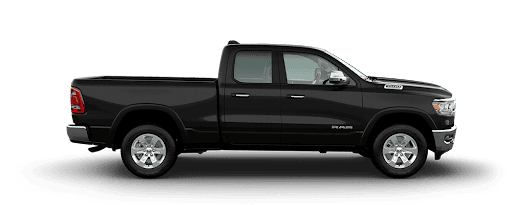
The Ram 1500 has boosted its resale strength thanks to improved interiors and comfort-focused trims.
Two-to-five-year-old models commonly sell for $34,000–$44,000, with premium trims going higher. Its resale value now competes closely with Ford and Chevrolet.
- Avg. used price: ~$38,000–$40,000
- High interior comfort appeal
Sales Channels: Dealerships vs Private Sellers
Where people buy a used car can change the experience. It affects price, trust, and even financing options.
Franchise Dealers vs Independent Dealers
Franchise dealers work with car manufacturers. They usually have a steady supply from trade-ins and lease returns. They also follow clear inspection rules.
Independent dealers are different. They often sell older cars and work with buyers who may not qualify for traditional loans.
Trade-Ins as Primary Supply
Trade-ins are a big source of used cars. When someone buys a new vehicle, they often give their old car to the dealer. The dealer then sells that car as used.
This keeps inventory moving.
Off-Lease Returns
Leased cars usually come back after three or four years. These vehicles often have lower mileage and service records.
Many of them qualify for certified programs. That helps buyers feel more confident. Independent dealers help buyers who need flexible options. They play an important role in the market.
They provide access where franchise dealers may not.
Growth of Online Used Car Platforms
Digital retail has reshaped how people shop. Consumers now expect to browse listings, compare prices, and access vehicle reports online before stepping onto a lot.
Peer-to-peer platforms and large online retailers have expanded rapidly .
This shift increases reliance on accurate vehicle documentation and reliable used car data.
Transparency is no longer optional. It is expected.
Regional Differences in the U.S. Used Vehicle Market
The used vehicle ecosystem in the USA is not uniform.
State-Level Variations
Truck-heavy states such as Texas and parts of the Midwest exhibit stronger pickup demand. Coastal urban states show higher penetration of compact SUVs and electric vehicles.
Climate plays a role. Snow-heavy states see stronger demand for all-wheel-drive vehicles. Warm-weather states may see stronger convertible or compact car activity.
Urban vs Rural Used Vehicle Demand
Urban buyers often have access to larger inventory pools but face tighter price competition.
Rural buyers may experience inventory limitations in specific categories but can sometimes benefit from lower local dealer overhead.
These regional dynamics affect pricing dispersion and demand elasticity.
Serious used car market research must account for geographic variability.
What the Data Suggests About the Future of the Used Vehicle Market
It is tempting to frame 2021 as an anomaly and move on. That would be incomplete.
Structural vs Temporary Shifts
Yes, semiconductor shortages were temporary.
However, several shifts appear structural:
- Used-to-new sales ratio remains firmly above 2 to 1
- Digital retail penetration continues rising
- Consumers are more price sensitive than a decade ago
- EV inventory will gradually expand into the used pool
These patterns are not short-lived reactions.
Continued Importance of Data and Transparency
One of the most underappreciated changes is the heightened focus on vehicle history transparency.
A 2023 study revealed that 1 in 8 used vehicles listed on major platforms had undisclosed flood histories .
That statistic alone reinforces the importance of reliable documentation.
In a market moving nearly 40 million vehicles annually, trust matters.
Price volatility exposed weaknesses in opaque transactions. The next phase appears more disciplined, more documented, and more data-driven.
Why Vehicle History Still Matters in Today’s Market
Prices are more stable now. Inventory is improving. But one thing has not changed.
Risk still exists in the used market. When prices were rising quickly in 2021 and 2022, many buyers rushed decisions. Some vehicles moved across states after floods or accidents. Others were resold multiple times during supply shortages.
That kind of movement leaves gaps.
A vehicle may look clean on the surface. Low mileage. Fresh paint. Clean interior. But history is not always visible.
A proper vehicle history report helps answer simple but important questions:
- Has the car been in an accident?
- Was it ever reported stolen?
- Does it have title issues?
- Has it been used as a rental or fleet vehicle?
- Are there open recalls?
With a vehicle history report, you can verify accident data, title history, mileage records, ownership history, and, in many cases, auction photos.
The American used vehicle ecosystem is not a backup plan. It is a core economic engine.
Sales volume consistently exceeds new vehicle transactions. Supply shocks exposed structural dependence on used inventory. Light trucks dominate demand. Used EVs introduce new dynamics. Transparency and digital infrastructure continue to shape the buying process.
The market is no longer defined by panic. It is defined by adjustment. And an adjustment, in a sector moving nearly 40 million vehicles a year, is powerful.
Frequently Asked Questions on Used Car Market Analysis
Used car prices have gone down a little from their highest point in 2022. During the pandemic, prices went up very fast because there were not enough cars available.
In 2024, prices became more stable. They are lower than the peak, but they are still higher than they were before 2020. So prices are not crashing. They are slowly settling.
The $3,000 rule is a simple idea. If you buy an older used car for around 3,000 dollars, you should expect some repair costs.
At that price, the car may have high mileage or wear and tear. It can still be a good deal, but buyers should plan for maintenance. It is not about the exact number. It is about understanding risk at very low price levels.
There is no perfect month, but late fall and early winter can offer better deals. October, November, and December often have slower sales.
Dealers may lower prices to clear inventory before the new year. However, the difference is usually small. Market supply matters more than the calendar.
The 8% rule means your total car expenses should not be more than 8% of your monthly income.
This includes your loan payment, insurance, fuel, and maintenance. It is a budgeting guide. It helps buyers avoid spending too much on a vehicle.
Used car prices in 2025 are expected to stay close to 2024 levels. In 2024, the average used vehicle price ranged between about 26,000 and 27,500 dollars.
Prices may move slightly up or down depending on supply and interest rates. But large price spikes like we saw in 2021 and 2022 are not expected right now.