
Decode Ford VIN and Get Vehicle Details
Planning to buy a used modern or classic Ford? Make sure to run a Ford VIN decoder and review the vehicle history report. Get model year, trim, engine specifications, transmission setup, body style production details and many more.
|No VIN?Use License Plate
Table of Contents:
What Will You Get From the Ford VIN Decoder?
Accurate vehicle data starts with the VIN. Use the Ford VIN decoder verifies specifications, eliminates guesswork in listings, and helps establish pricing based on the original MSRP.
- Manufacturer and origin
- Model, trim, and package details
- Engine specifications
- Transmission setup
- Body style
- Model year
- Production plant
- Manufacturer Suggested Retail Price (MSRP)
- Market Value
How to Use the Ford VIN Decoder
The Ford VIN decoder works for both modern and classic vehicles, giving access to detailed vehicle history in seconds. Follow these simple steps to complete the process quickly and accurately.
Decode Classic Ford VIN
Buying a classic Ford requires closer inspection. Use the 5 to 14-digit VIN to access available records and confirm key details. A classic VIN report helps evaluate the vehicle more carefully before completing the purchase.
Where to Find the VIN on a Ford
Before decoding, you need to locate the VIN on your Ford. While placement is generally standardized across most models, slight variations can occur depending on the model, body style, and production year.
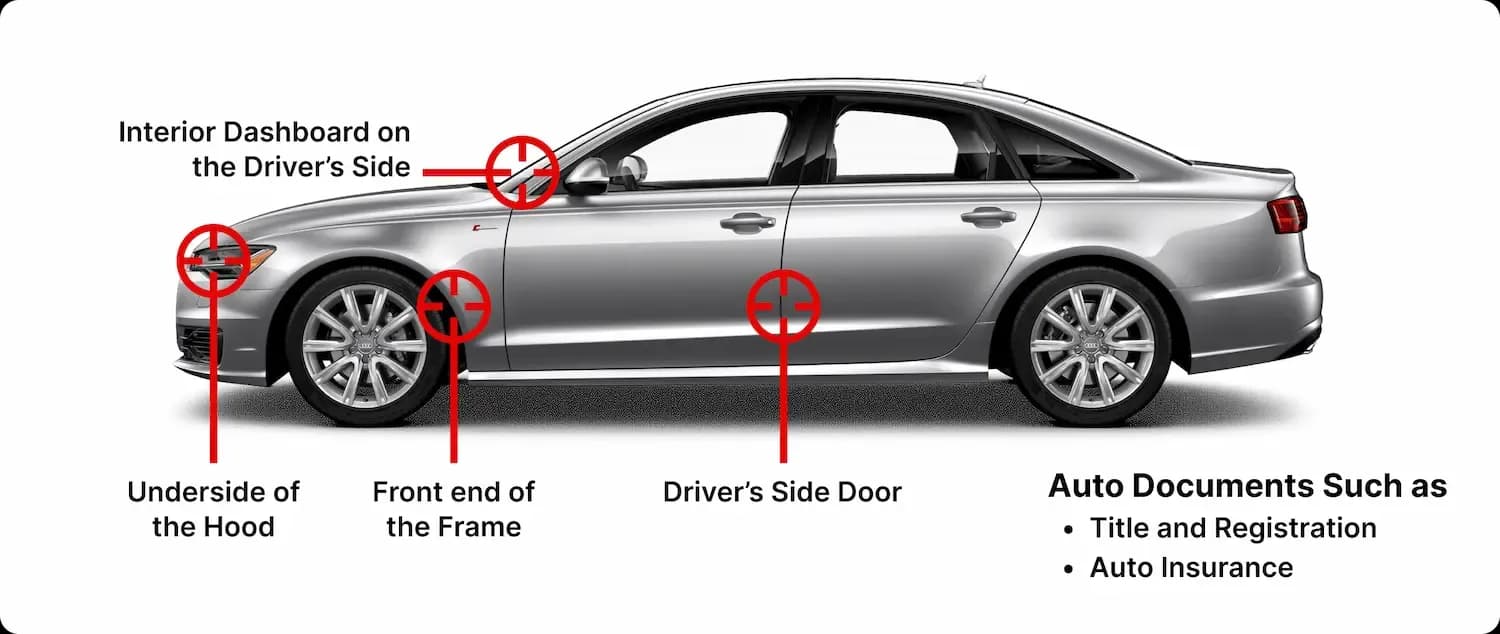
Ford VIN Location
The VIN is placed in several common areas on the vehicle and within official documents. Check the following locations to find it accurately.
Driver’s Side Dashboard
Look through the windshield at the lower corner of the dashboard on the driver’s side to find the VIN plate.
Driver’s Side Door Jamb
Open the door and inspect the frame or pillar near the latch area for a sticker or metal plate displaying the VIN.
Engine Bay
Check the engine compartment for a stamped VIN, often located on the firewall, radiator support, or chassis frame.
Documents
The VIN is also listed on official paperwork such as the registration, insurance documents, or vehicle title.
Classic Ford VIN Location
Classic Ford models may follow similar VIN placement, but older vehicles can include additional or less standardized locations depending on the production year and assembly plant.
Under the Floor Mat
On some older Ford vehicles, the VIN may be stamped into the floor pan beneath the carpet, often on the driver or passenger side.
Body Panels
Certain classic Ford models may have VIN tags attached to panels such as the hood, trunk area, or inner fenders, usually shown on small plates or factory labels.
Who Should Use a Ford VIN Decoder
A Ford VIN decoder is valuable for anyone involved with used, fleet, or classic vehicles. With a wide range of models, trims, and engine options across different markets, verifying details through the VIN helps ensure accuracy and better decision-making.
Buyers
Ford buyers need more than a quick visual check. Our Ford VIN decoder helps you to confirm factory specs, engine options, ownership records, and vehicle history, helping ensure the vehicle matches its listing, especially important for trucks, performance models, or imported units.
Dealers
Dealers managing Ford inventory rely on accurate data to avoid costly listing mistakes. Our service can help with identifying engine variants and trim levels, ensuring listings are correct and transparent in a competitive market.
Fleet Owners
Businesses and fleet operators can use a VIN decoder to track vehicle specifications and history across multiple units. This helps with maintenance planning, compliance, and resale preparation while keeping records consistent.
What is the Difference Between Modern and Classic VIN
The difference between modern and classic VINs comes down to structure, consistency, and how much information they can provide. Newer Ford vehicles follow a standardized 17-digit format, while older models use shorter, less uniform VINs, which can affect decoding accuracy.
VIN Length and Format
Modern Ford vehicles use a 17-digit VIN with a fixed global structure. Older Ford models may have VINs ranging from 5 to 14 characters, as there was no universal system before the 1981 standardization.
Data Availability
Modern VINs provide detailed data, including engine specifications, trim levels, and production details. Classic Ford VINs may return limited information depending on available records, especially for older trucks or early production models.
Decoding Accuracy
Decoding modern Ford VINs is generally accurate due to standardized formatting and complete databases. Classic VINs can be harder to interpret because of inconsistent formats and missing records, but reliable tools can still provide useful insights.
Breaking Down a Ford VIN
A 17-digit Ford VIN follows a structured format that reveals details about the vehicle. The VIN is divided into three different categories: WMI, VDS, and VIS. Each section represents specific information, helping identify the manufacturer, vehicle attributes, and unique production data.
Sample VIN: 1FMEE5DP7NLB29110
WMI (World Manufacturer Identifier)
Digit 1 to 3: 1FM
- 1 = Country of origin (United States)
- FM = Ford
VDS (Vehicle Descriptor Section)
Digit 4 to 9: EE5DP7
- E = Engine type (2.7L EcoBoost twin-turbo V6)
- 5 = Body style (4-door SUV)
- D = Trim level (mid-range configuration, e.g., Big Bend / Outer Banks)
- P = Series or equipment package within the model range
- 7 = Check Digit
VIS (Vehicle Identifier Section)
Digit 10 to 17: NLB29110
- N = Model year (2022)
- L = Michigan Assembly Plant, Wayne, Michigan, United States
- B29110 = Production sequence number
Why Decoding a Ford VIN is Non-Negotiable
Decoding a Ford VIN does more than identify the vehicle. It verifies specifications, history, and build details, helping ensure the car or truck matches what is being presented, especially important given Ford’s wide range of models, trims, and engine options.
Before Buying a Ford
Ford vehicles come in many configurations, from EcoBoost engines to heavy-duty truck packages. A VIN check confirms the exact specs, ownership history, and condition, reducing the risk of relying only on listings or seller claims.
Before Selling a Ford
Accurate information helps listings stand out. Decoding the VIN allows sellers to present verified specifications and history, making the vehicle more credible and helping justify the asking price.
Verify Ford Vehicle Identity
Many Ford vehicles, especially trucks and performance models, may be modified over time. A VIN check ensures key details like engine type, trim level, and production data align with original factory records.
Check History and Records
Review ownership timelines, accident history, and title data to understand the vehicle’s background. These records help identify issues that may affect value, safety, or resale potential.
Decode Ford Models by VIN Now
Need a hand to decode any classic or newer Ford VIN? Use our tool and get it done within seconds!
Supported Modern Ford
Check the list below to see the models of modern Ford we supported. Can’t see yours? It's totally fine as we are able to decode all models and trims.
ContourCrown VictoriaEscortExpeditionExplorerE 150E 250E 350 Super DutyF 150F 250F 350MustangRangerTaurusWindstarExcursionFocusEscapeExplorer SportExplorer Sport TracF 150 SupercrewThunderbirdZX2FreestarF 150 HeritageFive HundredFreestyleGTEscape HybridFusionEdgeExpedition ELF 450Taurus XFlexFusion HybridTransit ConnectFiestaFocus ElectricC MAX EnergiC MAX HybridFocus STFusion EnergiSedan Police InterceptorUtility Police InterceptorTransit 150Transit 250Transit 350Focus RSShelby Gt350EcosportExpedition MAXFusion TaxiEscape PhevShelby Gt500Transit 150 CargoTransit 150 CrewTransit 150 PassengerTransit 250 CargoTransit 250 CrewTransit 350 CargoTransit 350 CrewTransit 350 PassengerBroncoBronco SportF 150 Police ResponderMustang Mach EF 150 LightningMaverick
Supported Classic Ford Models
Not only can we decode modern Ford models, but we can also decode classic Ford models.
Ford 500Ford 124 SpiderFord X1/9Ford 600Ford 850 SpiderFord 1500Ford 2300Ford 128Ford DinoFord 1300/1500
Want More Info About Your Ford? Get a Vehicle History Report
Once the VIN is decoded and the report is generated, it provides detailed information about the vehicle’s background and specifications. This is useful for both buyers and sellers to verify condition, confirm legality, and avoid costly mistakes.
Vehicle Specification
View key factory details for both classic and modern Ford models in one report. This includes engine type, transmission, assembly plant, fuel data, MSRP, and trim-level information to ensure the vehicle matches expectations.
Title Records
Check for any title issues that may affect the vehicle’s value or legality. This includes records such as salvage, rebuilt, lemon, theft, or potential discrepancies that could impact registration or resale.
Odometer Reading
Review the recorded mileage history along with timestamps of each entry. This helps confirm whether the odometer readings are consistent and reliable before making a purchase.
Accident and Damage History
Identify any reported accidents, including dates, locations, and types of damage. This section may also include records of structural damage, flood exposure, or other incidents that could affect safety and performance.
Auction History
Find out if the Ford has been listed or sold at auction. The report may include auction dates, locations, final sale prices, and in some cases, vehicle photos showing its past condition.
Ownership Information
Access ownership history, including the number of owners, regions, and duration of ownership. Personal details are not included, but this timeline helps assess how the vehicle has been used over time.
Recalls Check
Check for any safety recalls issued for the Ford. Modern models typically include detailed recall data, while older vehicles may have limited records. Addressing recalls helps maintain safety and performance.
Engine Information
Confirm engine specifications, configuration, and key features. Ford vehicles may include a wide range of engines, from EcoBoost turbocharged units to larger V8 options, making this section important for verification and maintenance planning.
Get More Ford Information With Our Tool
Before buying a used Ford, check for recalls, past damage, and inconsistencies. Reviewing all available data helps avoid unexpected problems and ensures the vehicle meets your expectations.
Ford Recall Check by VIN
Need to check whether the Ford was recalled and fixed thoroughly? Use the Ford recall by VIN!
Ford Window Sticker
Use our Ford window sticker by VIN and get the complete information on features, options, MSRP, and more!
Check All Vehicles’ VINs in Seconds
Need to check another vehicle, but not a Ford? Don’t worry, our service can be used to decode all vehicle makes. See the list below.
Acura
Alfa Romeo
AM General
Aston Martin
Audi
Bentley
BMW
Buick
Cadillac
Chevrolet
Chrysler
Daewoo
Dodge
Ferrari
Fiat
Fisker
Ford
Genesis
GMC
Honda
Hummer
Hyundai
Infiniti
Isuzu
Jaguar
Jeep
KIA
Lamborghini
Land Rover
Lexus
Lincoln
Lotus
Maserati
Maybach
Mazda
Mclaren
Mercedes Benz
Mercury
Mini
Mitsubishi
Nissan
Oldsmobile
Panoz
Plymouth
Polestar
Pontiac
Porsche
RAM
Rolls Royce
Saab
Saturn
Scion
Smart
Subaru
Suzuki
Tesla
Toyota
Volkswagen
Volvo
Ford EVs Update
Ford’s strategy is to focus on EVs, expanding across mobility, passenger, truck, and commercial vehicle segments. Under the Ford Motor Company, the brand has continued developing its electrified models while balancing hybrid, combustion, and battery-electric vehicles.
Ford EV Expansion
The Ford EV lineup is led by the iconic Mustang Mach-E, F-150 Lightning, and E-Transit. These models represent the main EV strategy across performance-oriented passenger vehicles, electric pickup trucks, and commercial fleet transportation.
EV Product Development
Instead of expanding EVs rapidly, Ford chose to focus on refining its existing EV lines through plenty of improvements. Here’s what Ford plans to develop in the future for its EV family.
- Enhanced software integration and connectivity.
- Improved charging capability and charging experience.
- Better range efficiency and energy management.
- Increased focus on everyday usability and practicality.
- Ongoing refinement of the overall EV ownership experience.
Global EV Strategy
In the North American market, Ford continues to strengthen its electric truck and SUV lineup. Meanwhile, in the European market, the company focuses more on compact, urban-oriented EVs. Ford is also expanding its hybrid offerings alongside its electric vehicle lineup.
FAQs About Ford VIN Decoder
Yes, a classic Ford VIN decoder can help verify original components by identifying details like engine code, assembly plant, and production year. By comparing VIN data with body tags, it becomes easier to check if key parts align with factory specifications, though confirming true “numbers-matching” may require inspecting stamped codes on the engine or transmission.
Older Ford VINs appear shorter or different because there was no universal format before 1981. Modern VINs are standardized at 17 characters, while earlier Ford VINs typically ranged from 8 to 13 characters and focused on basic details like plant, model year, and production sequence.
It is sometimes possible to get limited vehicle information without a VIN, but options are restricted. Searches using a license plate, past online listings, or DMV records may provide partial data. However, the VIN remains the most accurate identifier, so reports without it usually contain less detail.
Yes, a Ford VIN can indicate the vehicle’s model year. For vehicles built from 1981 onward, the 10th character of the 17-digit VIN represents the year. For example, “A” can indicate 1980 or 2010, “L” corresponds to 1990 or 2020, and “G” represents 1986 or 2016.
Yes, decoding a Ford VIN is often free for basic details. Many tools allow users to check specifications such as engine type, drivetrain, and manufacturing information without any cost.
Ford date codes, often found on engine components and parts, usually follow a Year-Month-Day or Week format. A typical code like “4E15” represents 1974, May, 15th, where the number indicates the year within a decade, the letter represents the month, and the final digits show the day or production week.
Quick VIN Decoder
Get comprehensive vehicle history reports
Quick VIN Decoder
Get comprehensive vehicle history reports