
Ghana Chassis Number Check for Used Cars
Buying a used car in Ghana is exciting, but it also raises questions. Where did the car come from, and can you trust what the seller says? That’s where a Ghana chassis number check helps. Easily verify a vehicle’s background, spot red flags early, and avoid costly surprises.
|No VIN?Use License Plate
What is a Ghana Chassis Number or VIN?
A Ghana chassis number, also known as a VIN, is the unique number used to identify a vehicle. It is assigned by the manufacturer and stays with the car for its entire lifetime.
In Ghana, this number is used for registration, ownership records, insurance, and vehicle checks. It links the physical car to its official details and history, including information from outside the country if the vehicle was imported.
You can usually find the chassis number on the dashboard near the windshield, inside the driver's door area, or on the Vehicle Registration Certificate issued by the DVLA. This is the same number used when running a chassis number check or VIN lookup.
Why Running a Chassis Number Check in Ghana Matters
$ 218.14M
worth of vehicles exported to Ghana from the US in 2024
5Y
of vehicle imports in Ghana are used vehicles, often with hidden issues
22%
of imported vehicles in Ghana are salvaged due to sustained damage
Benefits of a Chassis Number Check in Ghana
Stay Safe on the Road
A safe car leads to a safer journey. If a vehicle was involved in accidents, suffered flood damage, or went through major repairs, a VIN check in Ghana helps you find out before you put yourself and others at risk.
Avoid Buying a Problematic Car
A chassis number check helps uncover serious damage or red flags before you buy. This keeps you from spending money on vehicles with hidden mechanical, structural, or legal issues.
Know the True Car History
You can learn where the car was first used, how often it changed owners, and whether it was properly serviced. This gives you a clearer picture beyond what the seller tells you.
Protect Your Investment
Cars are getting more expensive every year, especially imported vehicles in Ghana. A chassis number check helps you make a smarter buying decision by confirming the car’s real condition and background before you pay.
Avoid Legal Problems
If a vehicle was reported stolen or had unpaid loans before it was imported, you could face serious legal trouble after purchase. In some cases, cars can be seized by authorities, leaving you with no car and no refund. A VIN check helps you avoid such risks.
Negotiate Better Prices
When you have a detailed history report, you are no longer negotiating blindly. If the car shows past accidents, mileage inconsistencies, or other concerns, you can use those findings to justify a lower price.
How to Check a Chassis Number Online in Ghana
To check a chassis number using our online tool, first, you need to locate the chassis number on the vehicle or its documents. Then, enter it into our instant chassis number lookup tool that supports imported vehicle data and Ghana-related checks.
The report will be generated immediately, showing all theft records, accident records, mileage history, auction data, and other useful insights.
How to Find the Chassis Number on a Car
Before running any check, you need the correct number. Always verify it directly on the car and not just from the seller's message. Common places to find the chassis number are:
Dashboard
Look through the windshield on the driver’s side. Many vehicles display the chassis number on a metal plate near the dashboard.
Driver-side door frame
Open the driver’s door and inspect the door jamb or pillar. Manufacturers often place a sticker with the chassis number here.
Engine Bay or Frame
Some vehicles have the number stamped directly onto the engine block or frame.
Vehicle Documents
The chassis number appears on the Vehicle Registration Certificate issued by the DVLA, insurance papers, and import documents.
How to Use the Chassis Number for a Check
Once you've confirmed the number is accurate, the steps are simple.
1
Find the Chassis Number
2
Run the Check Online
3
View your report
What’s in a Ghana Chassis Number Check Report?
The VIN or chassis number is a unique 17-character code assigned to every vehicle by the manufacturer. It acts as the car's identity number and is used for registration and history checks.
You can find it on the dashboard near the windshield, inside the driver-side door area, on the engine bay, and on the Vehicle Registration Certificate issued by the DVLA.
A report shows whether the car was ever involved in an accident or suffered noticeable damage. Many imported vehicles are repaired before being sold in Ghana, so earlier damage is not always obvious. Looking here helps you spot cars that may have taken hard hits in the past.
Accident and damage data you will see:
Accident dates and reported severity
Areas of impact such as front, rear, or sides
Structural or frame damage indicators
Airbag deployment records
Insurance damage claims
Some cars were once written off by insurance companies and later fixed up for resale. This section shows if the vehicle was ever labeled as salvage or rebuilt. These labels matter because they can affect value, insurance, and future resale.
Title brand details shown
Salvage or rebuilt status
Reason for write off (collision, flood, theft recovery)
Location and date the brand was applied
Insurance total loss history
This section checks whether the vehicle was ever reported stolen in its country of origin or elsewhere. Stolen vehicles sometimes enter the export market and can later be seized, even after being registered. Verifying theft status protects you from serious legal and financial consequences.
Theft-related records shown:
Theft reports from international databases
Recovery information, if the vehicle was found
Current stolen or cleared status
Mileage is one of the easiest things to manipulate on used cars. When vehicles move between countries or owners, the numbers do not always tell the full truth. This section helps you see if the mileage makes sense.
Odometer and mileage data shown:
Recorded mileage readings by date
Sudden drops or inconsistencies
Odometer rollback alerts
Flood damage does not always show right away. Cars can look fine and still develop electrical or corrosion problems later. This section helps flag vehicles that may have been exposed to water in the past.
Flood-related information shown:
Flood damage indicators
Hurricane- or storm-related insurance claims
Corrosion and rust risk warnings
Many vehicles imported into Ghana were previously sold through auctions before shipment. This section helps you understand how the car was categorized and described at the time of sale.
Auction records often provide honest condition notes and, in some cases, actual images of the vehicle.
Auction and sales data shown:
Auction dates and locations
Final sale prices
Vehicle condition notes
Up to 10 auction images, when available
This section outlines how often the vehicle changed hands and the type of ownership it had over time. Frequent ownership changes or commercial use can signal heavier wear. Understanding past usage gives context to the car’s current condition.
Ownership history details shown:
Number of previous owners
Ownership type such as private, fleet, or lease
- Length of each ownership period
Manufacturers issue recalls when safety defects are discovered. This section shows whether the vehicle had open or completed recalls. Addressing recalls is important for safety, compliance, and insurance acceptance.
Recall information shown:
Open or resolved recall notices
Description of the safety issue
Repair guidance from the manufacturer
A vehicle that was regularly serviced is often more reliable over time. This section provides insight into whether routine maintenance and repairs were recorded. While not all servicing is reported, available data can still be helpful.
Maintenance related records shown:
Reported servicing and oil changes
Workshop or dealer visit entries
Maintenance timelines
This section checks whether the vehicle had outstanding financial obligations attached to it in the past. Unresolved liens or repossession records can complicate ownership transfers and registration. Reviewing this information helps avoid legal and financial disputes.
Financial and lien data shown:
Active or past loan records
Repossession or lien events
Event dates and recorded locations
Real Example: How a Ghana VIN Check Stopped a Costly Mistake
The car was originally listed on an auto auction in Winnipeg, Canada, before being exported to Ghana. This case study shows how a VIN check saved a buyer from purchasing a 2016 Honda CR-V reported stolen in Canada.
Sample Report: 1N4AA6AP2GC422916
Critical Findings
Initial Impression
Critical Findings
Outcome
Key Lessons Learnt
Who Needs a Ghana Chassis Number Check?
A Ghana chassis number check is useful for anyone who wants to confirm a vehicle's background before buying, selling, importing, or registering it. Since many cars in Ghana are used imports, checking the chassis number helps uncover issues that are not obvious at first glance.
Private Buyers Purchasing Used Cars
If you're buying a used car, a vehicle chassis number check helps verify accident history, mileage accuracy, and theft records before you commit.
Buyers Interested in Imported Vehicles
Imported cars often have history records outside Ghana. A chassis number check for imported cars shows past damage, salvage status, or theft reports from abroad.
Car Dealers and Resellers
Dealers rely on DVLA chassis number checks to verify stock before listing. This reduces risk and helps maintain credibility with customers.
Vehicle Importers and Clearing Agents
Importers and agents use the chassis number to confirm vehicle details during customs clearance and duty calculation processes.
The Role of the DVLA in Ghana Vehicle Identification
Many buyers ask about the DVLA chassis number check and what the DVLA actually does.
The Driver and Vehicle Licensing Authority registers vehicles in Ghana and issues the Vehicle Registration Certificate. This document ties the chassis number to the legal owner and confirms that the vehicle is recognized by the state.
While the DVLA does not offer a full public online car history database, its records play a key role in ownership verification, transfers, and legal compliance. That's why matching the physical chassis number to DVLA documents is essential.
Why Choose Our Ghana Chassis Number Check Service?
Not all lookup tools are equal. The right service makes information easy to understand and fast to access.
Here's why users rely on our platform:
Fast and simple searches
Get results in seconds without complicated steps or technical knowledge.
Trusted and Update Data Source
Get up-to-date vehicle data from DMV, auctions, police, insurance, and proprietary online sales sources.
Support for imported vehicle data
Covers vehicles brought in from the U.S., Europe, and other common import sources.
Helpful insights for Ghana buyers
The report focuses on details that matter when buying or registering a car in Ghana.
Printable and downloadable reports
Save the report as a PDF or print it for records, sellers, or registration use.
24/7 Customer Support & Live Chat
Get 24/7 customer support with live chat, so you can ask questions and get help fast.
VIN Check Ghana by Make
Looking to check a VIN number by make in Ghana and access a vehicle history report? Browse a wide range of makes and models below.
Protect yourself—run a VIN check before buying any used vehicle.
AcuraAlfa RomeoAM GeneralAston MartinAudiBentleyBMWBuickCadillacChevroletChryslerDaewooDodgeFerrariFiatFiskerFordGenesisGMCHondaHummerHyundaiInfinitiIsuzuJaguarJeepKIALamborghiniLand RoverLexusLincolnLotusMaseratiMaybachMazdaMclarenMercedes BenzMercuryMiniMitsubishiNissanOldsmobilePanozPlymouthPolestarPontiacPorscheRAMRolls RoyceSaabSaturnScionSmartSubaruSuzukiTeslaToyotaVolkswagenVolvo
More Vehicle Check Tools
In addition to our VIN check service, we offer useful tools like license plate lookups, motorcycle VIN checks, and more, making it simple to access detailed information for any type of vehicle.
Check VINs From Other Countries
Need to check a VIN from other countries? Our VIN check service can be used from around the world, helping you access accurate specs, market value, and history.
Albania VIN Check
Argentina VIN Check
Armenia VIN Check
Austria VIN Check
Azerbaijan VIN Check
Bahamas VIN Check
Bahrain VIN Check
Belarus VIN Check
Belgium VIN Check
Bolivia VIN Check
Bulgaria VIN Check
Brazil VIN Check
Cambodia VIN Check
Canada VIN Check
Chile VIN Check
Colombia VIN Check
Costa Rica VIN Check
Croatia VIN Check
Dominican Republic VIN Check
El Salvador VIN Check
Estonia VIN Check
France VIN Check
Finland VIN Check
Georgia VIN Check
Germany VIN Check
Greece VIN Check
Honduras VIN Check
Iraq VIN Check
Ireland VIN Check
Israel VIN Check
Italy VIN Check
Jamaica VIN Check
Jordan VIN Check
Kazakhstan VIN Check
Kenya VIN Check
Lebanon VIN Check
Lithuania VIN Check
Luxembourg VIN Check
Mauritius VIN Check
Mexico VIN Check
Moldova VIN Check
NZ VIN Check
Nicaragua VIN Check
Nigeria VIN Check
Oman VIN Check
Poland VIN Check
Portugal VIN Check
Puerto Rico VIN Check
Qatar VIN Check
Romania VIN Check
Russia VIN Check
Saudi Arabia VIN Check
Senegal VIN Check
South Africa VIN Check
Spain VIN Check
Sudan VIN Check
Sweden VIN Check
Switzerland VIN Check
Taiwan VIN Check
Uganda VIN Check
Ukraine VIN Check
UAE VIN Check
UK VIN Check
Yemen VIN Check
Trusted by Used Car Buyers in Ghana
Hear from real buyers who checked a vehicle's chassis number and gained clarity before making a buying decision.
I used them to look up a car I was about to buy gave me a full report on everything, really helpful if you want to know more of the passed of the car, I hope this information helps someone in need, if you need to know something about a car DVH is the place to go …I would recommend them to friends and family every time
reno Manickum
ZA•Apr 17, 2025
I was stressed with getting a detailed history about my Car, as someone from Africa and living here, there are not too many options for me to choose from, but when I ran into detailedvehicle website online, the solution to my problem was just a click away. What an amazing experience.
Victor
NG•Aug 23, 2023
After a struggle to find a website that I can check car's information via a VIN number, I came across this website and it help me to pull out the car's information of the car I wanted to buy via VIN number, they are very helpful, I do recommend this website to everyone
Given Vusi Sibiya
US•Mar 29, 2025
FAQ About Ghana Chassis Number Check
The VIN or chassis number is a unique 17-character code assigned to every vehicle by the manufacturer. It acts as the car's identity number and is used for registration and history checks.
You can find it on the dashboard near the windshield, inside the driver-side door area, on the engine bay, and on the Vehicle Registration Certificate issued by the DVLA.
Chassis number verification helps confirm that the vehicle you are buying is genuine and properly registered. It can reveal stolen vehicle records, past accidents, damage history, or mismatched details. This step is especially important in Ghana, where many vehicles are imported and past records may not be obvious.
If you suspect the chassis number has been altered, compare the physical VIN on the car with the details on official documents and any digital records. Any mismatch is a serious warning sign. Do not proceed with the purchase, and report the issue to the DVLA or the police for further investigation.
Physically inspect the VIN on the dashboard or engine and compare it character by character with the Vehicle Registration Certificate. The numbers and letters must match exactly. Even a small difference can indicate an error, tampering, or incorrect registration.
The Driver and Vehicle Licensing Authority is responsible for registering vehicles in Ghana and issuing the Vehicle Registration Certificate. This document legally links the chassis number to the vehicle and its owner, confirming that the car is recognized and registered with the state.
Save Thousands with a VIN Check Ghana
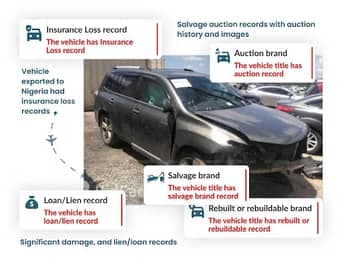
- The vehicle had an insurance loss record
- Accident record with significant damage
- Junk title record with auction records and images
Run a Chassis Number Check Before You Buy in Ghana
Before you commit to any used car, take a few minutes to verify its history. A chassis number check in Ghana can get you started, and a full report can help you avoid costly mistakes. Check the facts first. Then decide with confidence.