
Key Takeaways
- A window sticker is a federally required sales document for new vehicles sold in the United States.
- A build sheet provides factory specifications and production information for classic vehicles.
- Window stickers are commonly used for modern vehicles, and build sheets are primarily used for classic and vintage vehicles.
If you’re buying a used car, doing some research on your next buy, or restoring a classic vehicle, you would have heard about two terms that may look similar but serve different purposes: the window sticker vs. build sheet.
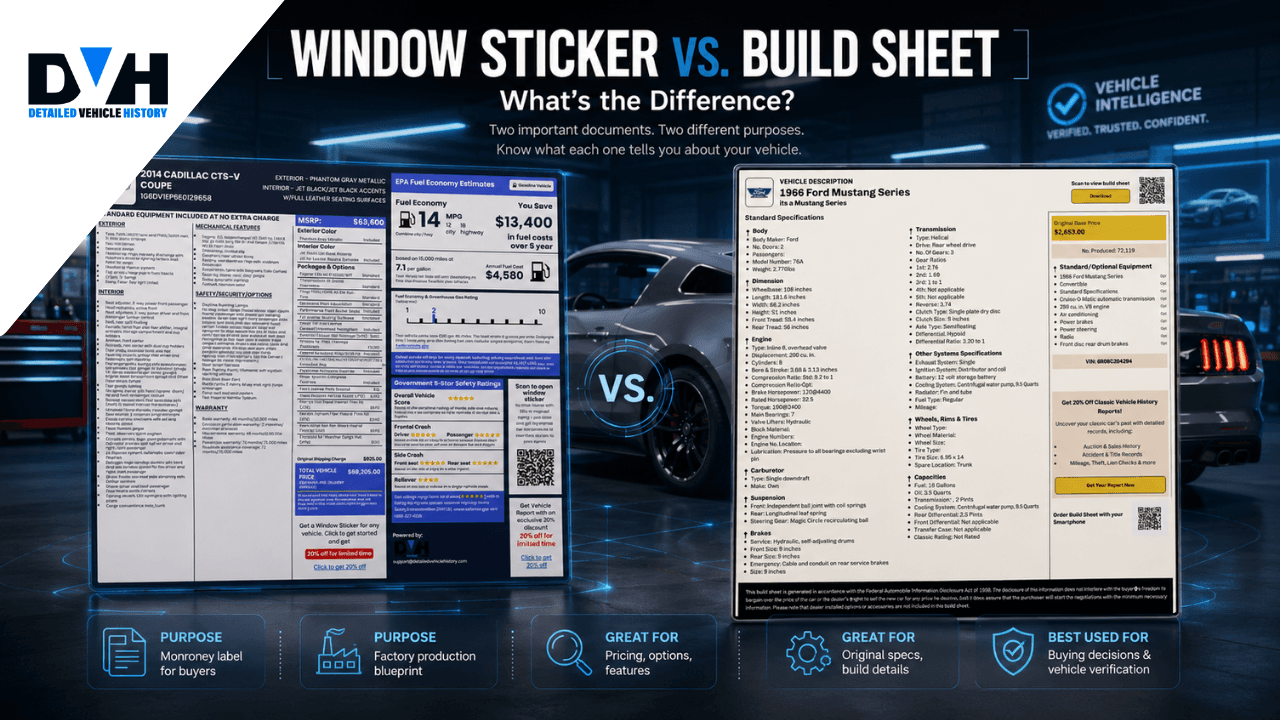
A window sticker is made for car buyers and shows pricing, features, factory options, and other specifications. A build sheet, on the other hand, focuses on how a classic vehicle was originally configured, providing information such as production details, factory specifications, dimensions, engine data, etc.
Most vehicle owners will get everything they need from a window sticker. However, those interested in factory specifications and production details will find a build sheet more helpful.
So, What Is a Window Sticker?
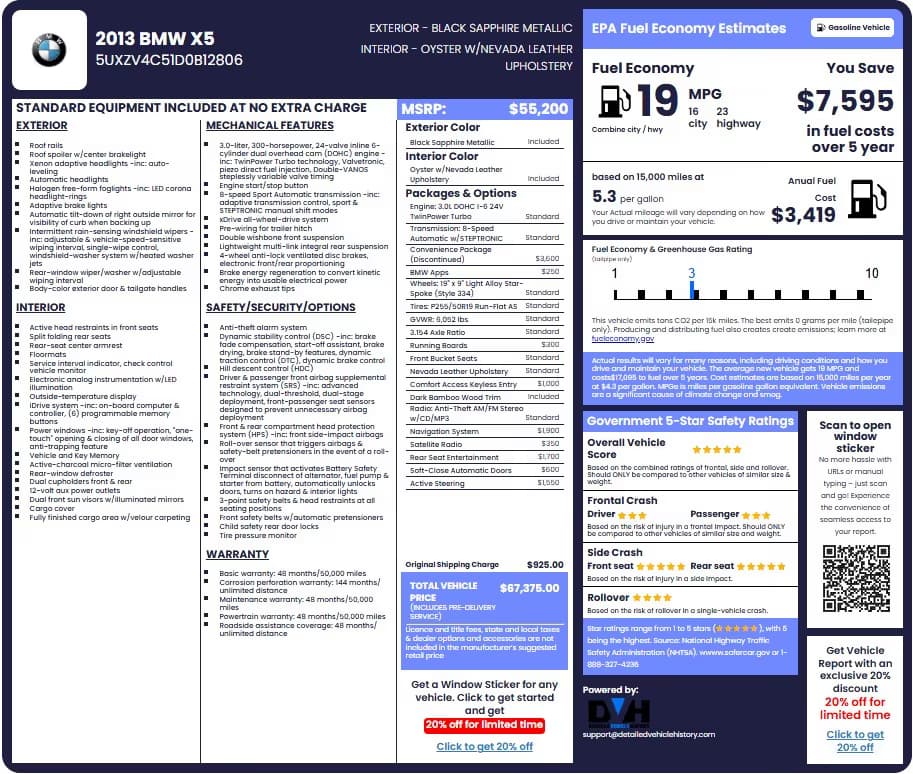
A window sticker, also known as a Monroney label, is the information sheet attached to every new vehicle sold in the United States. It was introduced through the Automobile Information Disclosure Act of 1958 and became mandatory in 1959 to help buyers understand exactly what they were paying for.
Before window stickers became required, comparing vehicles wasn't always easy. Buyers often had limited information about pricing, equipment, and available options. Today, every new vehicle sold in the U.S. must display a window sticker before it can be offered for sale.
What Information Does a Window Sticker Show?
A factory window sticker typically includes:
- MSRP (Manufacturer's Suggested Retail Price)
- Standard features and equipment
- Optional packages and upgrades
- Engine and transmission information
- Fuel economy ratings
- Fuel cost estimates
- Safety features
- Safety ratings
- Warranty coverage
- Destination charges
- Vehicle Identification Number (VIN)
- Final assembly location
For used vehicles, the original sticker is often missing. An estimated 60–70% of used vehicles do not retain their original window sticker, especially after multiple ownership changes.
The good news is that with the right tools, buyers and sellers can recreate the original window sticker by VIN.
One of the biggest benefits of a window sticker is that it shows exactly how the vehicle was equipped when it left the factory. It gives buyers, sellers, and owners a clear picture of the vehicle's original pricing, options, and specifications.
What Is a Build Sheet?
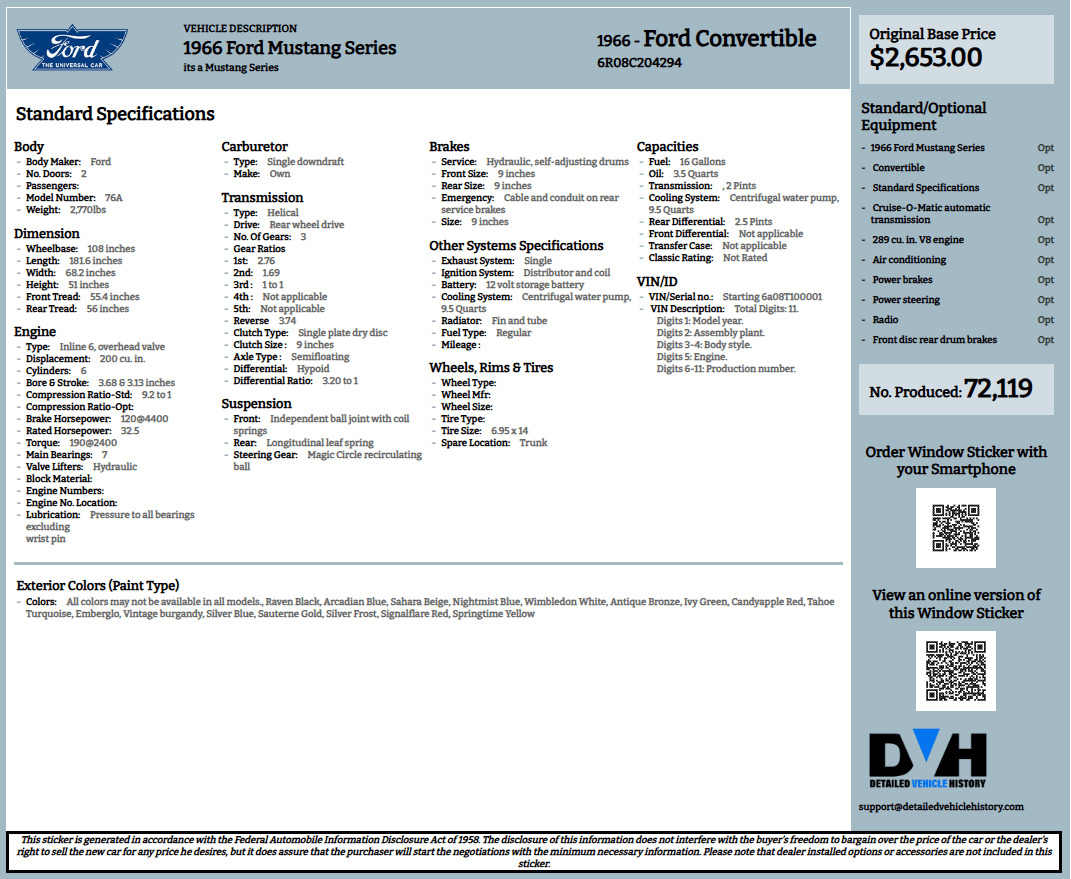
A build sheet is an internal production document created during the manufacturing process. Unlike a window sticker, it was never intended for consumers and is usually collected by classic car owners/restorers.
Depending on the manufacturer, a build sheet may also be called:
- Broadcast sheet
- Production sheet
- Vehicle order sheet
- Data card
- Factory build record
Build sheets are most commonly associated with classic and vintage vehicles. They are popular among collectors, restorers, enthusiasts, museums, and anyone interested in preserving a vehicle's history.
Industry insight:
- Among unrestored classic cars (pre-1980), build sheets are successfully recovered in roughly 20–40% of cases, depending on brand and condition.
- Chrysler vehicles from the 1960s–70s are especially known for hidden broadcast sheets, making them highly valuable in collector markets.
What’s on a Build Sheet?
On a build sheet, you can find:
- Vehicle series and model information
- Original base price
- Production numbers
- Engine specifications
- Transmission details
- Dimensions
- Suspension information
- Brake specifications
- Capacities and measurements
- Exterior paint colors
- Factory equipment
- VIN information
- Manufacturing details
Window Sticker vs. Build Sheet: Side-by-Side Comparison
Although both documents describe the same vehicle, they serve different practical purposes, and the data backs that up.
- In used car transactions, pricing transparency is a top concern for over 80% of buyers, making the window sticker more immediately useful.
- In collector car auctions, documented originality (often supported by build sheets) can increase vehicle value by 10–30% or more, depending on rarity and condition.
- Vehicles with full documentation (window sticker + build sheet + records) consistently outperform undocumented vehicles in resale confidence and speed.
Here’s a simple comparison to guide you:
Feature | Window Sticker | Build Sheet |
|---|---|---|
Primary Purpose | Vehicle sales document | Factory specification document |
Best For | Used car buyers and sellers | Classic car owners and restorers |
Shows MSRP | ✓ | ✓ (when available) |
Shows Factory Options | ✓ | ✓ |
Shows Fuel Economy | ✓ | ✘ |
Shows Safety Ratings | ✓ | ✘ |
Shows Production Information | Limited | ✓ |
Shows Engine & Mechanical Specs | Basic | Detailed |
Shows Dimensions & Capacities | Limited | ✓ |
Commonly Available For | Modern vehicles | Classic and vintage vehicles |
Helps With Restoration Projects | Limited | ✓ |
Which One of these Documents Do You Need?
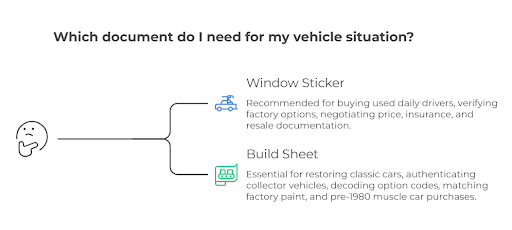
The answer depends on your goals.
Choose a Window Sticker If You Want To:
- Verify factory options
- Check original MSRP
- Compare vehicle packages
- Research a used vehicle
- Confirm standard equipment
- Prepare to sell a vehicle
Choose a Build Sheet If You Want To:
- Restore a classic vehicle
- Research a vintage vehicle
- Verify original specifications
- Learn about production details
- Confirm factory equipment
- Document a collector vehicle
How to Access Your Vehicle's Window Sticker by VIN
Getting a window sticker is usually straightforward. The simple steps to follow are:
1
Step 1: Locate Your VIN
You can find the VIN on:
- The dashboard
- Driver's side door jamb
- Vehicle registration
- Insurance documents
- Vehicle title
2
Step 2: Use a Window Sticker Lookup Service
Many manufacturers only provide window stickers for certain model years. When factory access isn't available, you can use our window sticker lookup service to get any vehicle's window sticker.
3
Step 3: Review the Vehicle Information
Once generated, the window sticker can help verify options, packages, MSRP, and factory-installed equipment.
How to Look Up a Classic Vehicle Build Sheet
Build sheet availability depends heavily on the vehicle's age and manufacturer. But we make things easier. To get a build sheet, the steps to follow are:
1
Step 1: Gather Your Vehicle Information
For older vehicles, inspect common build sheet hiding locations such as:
- Rear seats
- Carpeting
- Door panels
- Headliners
- Fuel tank areas
- You may be surprised by what you find.
2
Step 2: Search Available Factory Records
Detailed Vehicle History offers build data for supported manufacturers. All you need to do is enter the VIN into the classic build sheet lookup tool, and we’ll take it from there. Your build sheet will be generated in just a few seconds.
You could also check for your classic car’s build sheet by:
Contacting a Dealership
Many dealership service departments can access manufacturer databases containing build information. Some dealers provide this information for free, while others may require proof of ownership.
Checking Manufacturer Heritage Programs
Several automakers maintain historical archives.
Examples include:
- GM Heritage programs
- Ford archives
- Chrysler historical records
- National Corvette Museum documentation programs
These services may charge a fee but often provide highly detailed records.
In Conclusion, Which One Should You Choose?
A window sticker vs. a build sheet both provide factory vehicle information, but they're designed for different purposes.
If you're buying a used car, checking original options, verifying MSRP, or researching a vehicle's features, a window sticker is usually the better choice. It gives you a clear picture of how the vehicle was equipped and sold when it was new.
If you're restoring a classic car, researching a vintage vehicle, or trying to learn more about its factory specifications, a build sheet can provide valuable information about how the vehicle was originally configured.
In many cases, the best option is to have both.
FAQ on Window Sticker vs Build Sheet
A window sticker is a sales document that shows MSRP, factory options, packages, fuel economy, and other information intended for buyers. A build sheet focuses on factory specifications, production details, and original equipment, making it especially useful for classic vehicle owners and restorers.
A window sticker is also known as a Monroney sticker or Monroney label. The name comes from the Automobile Information Disclosure Act, which requires new vehicles sold in the United States to display pricing and vehicle information.
A build sheet is a document that shows how a vehicle was originally configured at the factory. It may include information such as engine specifications, transmission details, production data, paint colors, dimensions, and factory equipment.
Yes, you can get build sheet information using a VIN. Availability depends on the manufacturer, model year, and available factory records. Build sheets are most commonly available for classic and vintage vehicles.
Yes. Our window sticker lookup tool allows you to retrieve a window sticker using a VIN. A VIN-based window sticker can show the original MSRP, factory options, packages, and vehicle specifications.
Build sheets are most commonly associated with classic and vintage vehicles. While some modern vehicles have factory build records, classic car enthusiasts and restorers are the primary users of build sheets because of the historical and restoration value they provide.
For most modern vehicles, a window sticker is usually the best tool for verifying factory-installed options and packages. For classic vehicles, a build sheet can provide additional information about the vehicle's original equipment and specifications.