How to Check a Vehicle's Original Transmission by VIN

Key Takeaways
A free VIN decoder transmission lookup can identify whether a vehicle originally came with an automatic, manual, or CVT transmission.
- A window sticker by VIN provides deeper factory information, including transmission specifications and speed count.
- The same make, model, and year of a vehicle may have multiple transmission options available.
- Factory VIN data does not show later transmission swaps or replacements.
- The best approach is to decode the VIN first, then verify with factory records or the physical transmission tag.
The fastest way to check a vehicle's original transmission by VIN is to enter the 17-character VIN into a VIN decoder, and you can get it for free. In just a few seconds, you can usually see whether the vehicle left the factory with an automatic, manual, or CVT transmission.
If you need deeper information, though, like the exact transmission model, number of speeds, or how it was paired with the original engine, a window sticker by VIN is usually the better option. It shows the factory powertrain configuration exactly as the vehicle was built and sold.
Why does this even matter? Well, the same vehicle can sometimes come with completely different transmissions depending on the trim level, engine option, production date, or package selected by the original buyer.
That difference affects maintenance, repair costs, towing capability, fuel economy, and even resale value. That’s why this article is here to help buyers and sellers easily check any vehicle’s transmission.
What a free VIN Decoder Tells You About the Original Transmission
A free VIN decoder is excellent for getting a quick overview of what the vehicle originally was when it left the factory. It can identify the engine, trim level, body style, drivetrain, and in many cases, the transmission category.
For example, a VIN decode result might look something like this:
Example: 2014 Chevrolet Sonic
Trim: LS
Engine: 1.8L LUW
Fuel Type: Gasoline
Transmission: Automatic
Drive Type: FWD
Body Style: Sedan
MSRP: $15,420
That information alone can be pretty useful.
Let's say you're looking at a used car listing and the seller claims the vehicle has a manual transmission. You run the VIN and discover the vehicle originally left the factory with an automatic.
Now you can ask questions and see if the seller made a mistake, if the transmission was changed at some point, or if you’re falling victim to a scam.
How to Check a Vehicle's Original Transmission by VIN
Finding the original transmission isn't difficult. The process only takes a few minutes.
Step 1: Locate the VIN
First, find the VIN. You can usually find it in several places, including:
- Driver-side dashboard near the windshield
- Driver-side door jamb sticker
- Vehicle registration
- Insurance card
- Vehicle title
Most modern vehicles use a 17-character VIN format that became standardized in 1981.
Step 2: Double-Check the VIN
Before you run any search, make sure the VIN is copied correctly. This trips people up more often than you'd think.
VINs never contain the letters I, O, or Q because they can be confused with the numbers 1 and 0. One wrong character can pull up a completely different vehicle.
Step 3: Run the VIN Through a Decoder
Next, use a transmission type by VIN lookup tool. Within seconds, you should see:
- Engine details
- Trim information
- Drivetrain
- Transmission category
- Vehicle specifications
This gives you a solid baseline for what the vehicle originally had.
Step 4: Get a Window Sticker Lookup
If you need more than just "automatic" or "manual," pull the factory window sticker by VIN.
This is where you'll often see details such as:
- 6-Speed Automatic Transmission
- 8-Speed Automatic Transmission
- Continuously Variable Transmission (CVT)
- Dual-Clutch Automatic Transmission
- SelectShift Transmission
- Hydra-Matic Transmission
Those details can make a big difference.
For example, repair costs for a CVT can be significantly different from those of a traditional automatic transmission. According to industry repair estimates, replacing certain CVTs can cost several thousand dollars depending on the vehicle and manufacturer.
Step 5: Physically Verify the Transmission
If you want to be sure that your vehicle is original, you need to inspect the transmission itself. The transmission identification tag or case code can often confirm exactly what unit is installed.
And honestly, this is sometimes where surprises show up.
A VIN may say one thing. The vehicle may contain something completely different. And this is because the VIN can only tell you what was installed from the factory. However, with this information, you can verify if the transmission had been changed or altered in the past.
The important thing is knowing about it before you spend your money.
How to Read Transmission Information on a Window Sticker
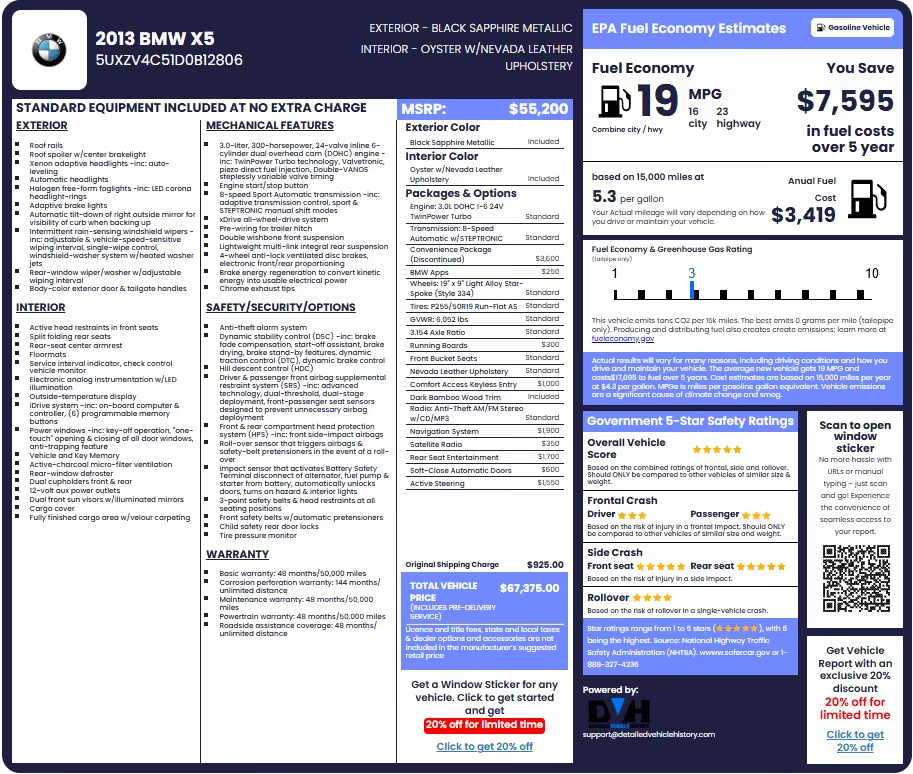
If you've never looked at a factory window sticker before, finding the transmission details can feel a little confusing at first, but it’s actually very straightforward. You just need to check under the "Mechanical Features," "Powertrain," or "Standard Equipment" section of the sticker.
You'll see something like:
- Transmission: 8-Speed Automatic with sport and manual shift modes
Here's what each part tells you:
8-Speed tells you the transmission has eight forward gears.
Automatic confirms the vehicle shifts gears automatically.
Sport Mode typically changes shift timing for quicker acceleration and higher engine RPM.
Manual Shift Mode allows the driver to select gears manually without using a clutch pedal
The window sticker will tell you the exact transmission configuration the vehicle received at the factory, including features that can affect performance, towing capability, fuel economy, and driving feel.
What to Look For on the Window Sticker
When reviewing a window sticker, pay attention to:
- The transmission type
- The number of speeds
- Any manufacturer-specific transmission name
- Sport or manual shift functions
- The engine paired with the transmission
- The drivetrain configuration (FWD, RWD, AWD, or 4WD)
The engine pairing is particularly important.
The same vehicle model may offer multiple engine choices, and each engine can be paired with a different transmission. That's one reason why two vehicles that look identical can end up with completely different powertrain setups.
Don't Ignore the Mechanical Features Section
A lot of buyers focus on options, packages, and MSRP while skipping the mechanical section entirely. That's usually where the transmission information lives.
And honestly, it's often one of the most important sections on the entire sticker.
If you're buying a used vehicle, trying to verify a seller's claims, or checking whether a vehicle originally came with a specific transmission, this section gives you one of the clearest answers available.
Types of Transmissions a VIN Check Returns
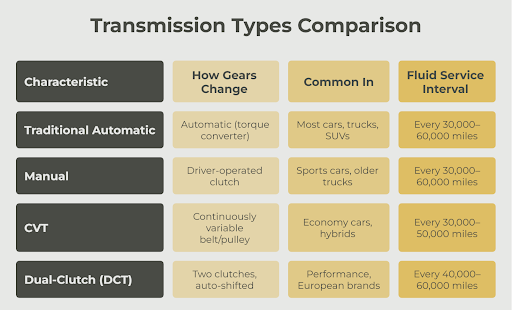
Different transmissions drive differently, require different fluids, and have different maintenance needs. Here's a quick breakdown of the most common types.
Automatic
An automatic transmission does the gear shifting by itself, automatically, so it’s the most common setup you’ll see in newer cars, trucks, and SUVs. You might notice 6-speed, 8-speed, or even 10-speed automatics quite a bit on newer models.
In general terms, having more gears can help with fuel use, and it usually gives you that more relaxed acceleration too.
Manual
A manual transmission makes the driver handle the gear changes, using the clutch pedal and the shifter.
They’re not as common as they once were, but plenty of folks still like them for that extra control and also because it feels more involved. The quickest way to spot one is to look for a third pedal next to the brake and accelerator, it’s usually right there.
CVT (Continuously Variable Transmission)
A CVT, or continuously variable transmission, uses a belt-and-pulley arrangement, not a set number of fixed gears. That way it can adjust the gear ratio again and again while you’re driving, without stepping through the usual gear “jumps”.
These are common in economy cars and hybrids because they’re built to boost efficiency. You’ll see CVTs used a lot by Honda, Nissan, Subaru, and Toyota across many models.
Dual-Clutch Transmission (DCT)
A dual-clutch transmission uses two clutches to deliver extremely fast gear changes.
They're commonly found in performance vehicles and some European models. In basic VIN lookup results, they're often listed simply as "Automatic," which is why additional factory records can be useful.
How to Confirm the Transmission Is Still Original
This section matters a lot if you're buying a used vehicle, or if you've bought one recently and want to verify what's actually under it.
A VIN transmission lookup tells you what the factory put in the car. It does not tell you what's in the car right now, after years of ownership. So you need to carry out some extra steps to verify if a vehicle still has its original transmission.
These steps include:
Check the transmission ID tag.
This is a metal plate or stamped code directly on the transmission housing. It's the most direct physical confirmation of what transmission is actually in the vehicle, completely independent of any VIN records or paperwork.
The tag usually includes a model number, plant code, and production date.
For GM vehicles: Check the RPO sticker.
Every GM vehicle has a Regular Production Option sticker, usually in the glove box. Transmission codes start with "M". M30 is a 4L60E, M32 is a 4L80E, MYC is a 6L80, and MYD is a 6L90.
Cross-referencing these codes against what the VIN returns gives you a very solid picture of whether anything has changed.
Ford and Ram: Check the door jamb.
Some Ford and Ram trucks include a transmission code right on the door jamb sticker alongside the tire pressure info.
When it's there, it's pretty definitive.
Compare the VIN data to what's physically in the vehicle.
If the VIN shows an automatic but there's a clutch pedal in the car, something's off.
If the speed count on the window sticker doesn't match what the transmission tag shows, that's worth investigating before buying or spending money on a service.
Get professional confirmation when in doubt.
If the codes on the vehicle are missing, damaged, or don't match the documentation, a dealer service department can run the VIN through factory systems and get a clear answer.
Why Knowing the Original Transmission Matters
Besides identification, there are real, practical reasons why knowing the exact transmission matters.
Fluid Compatibility
Different transmissions require specific fluid formulations, and the wrong fluid causes real damage. For example, Honda CVT fluid isn't compatible with Nissan CVT fluid.
GM Dexron and Ford Mercon specs have evolved through multiple incompatible generations. Many European transmissions from suppliers like ZF and Aisin require specific OEM-approved fluids.
Using generic "ATF" without confirming the exact specification for your unit is a mistake that can cost thousands.
Service Intervals
As shown earlier with the Ram 3500 example, the difference between transmission types can mean fluid changes at 30,000 miles versus 120,000 miles. That's a big difference in maintenance planning and long-term cost.
Parts and Repair Costs
Knowing the exact transmission model is necessary for ordering correct replacement parts and getting accurate repair estimates.
Two automatics that look similar from the outside can have very different rebuild costs. A 68RFE rebuild at a local shop might come in under $5,000. A full AS69RC rebuild with the right components can run $8,000 to $10,000 or more.
Buying a Used Car
Confirming the transmission matches what's advertised protects the buyer. A vehicle listed with a specific transmission spec should match what the window sticker and VIN records show.
If it doesn't, that's worth addressing before any money changes hands.
Insurance and Resale Value.
A post-factory transmission swap, especially one that wasn't disclosed, can affect insurance coverage and resale value.
A non-original transmission in a vehicle can be flagged during appraisals and can complicate claims.
A Final Word on Transmission Identification
Checking a vehicle's original transmission by VIN is one of the easiest ways to verify how it was built from the factory.
A VIN decoder can quickly identify whether the vehicle originally came with an automatic, manual, or CVT transmission, while a window sticker lookup can provide additional details such as the transmission designation, speed count, and drivetrain pairing.
If you’re buying a used vehicle, ordering parts, planning maintenance, or verifying a seller's claims, taking a few minutes to confirm the transmission can help you avoid costly mistakes and better understand exactly what you're dealing with.
Transmission Lookup by VIN: Common Questions
What's the fastest way to check a vehicle's original transmission by VIN?
The quickest option is to run the VIN through a free VIN decoder. It can usually tell you whether the vehicle originally came with an automatic, manual, or CVT transmission. If you need the exact transmission model, pull the window sticker too.
Why doesn't my VIN decoder show the full transmission details?
Most free VIN decoders focus on core vehicle information. They'll often show "Automatic" or "Manual" but stop there. The exact transmission designation, speed count, and factory pairing are usually found on the window sticker or build sheet.
Can a VIN decoder tell me if the transmission has been replaced?
Not really. A VIN decoder only shows what the vehicle left the factory with. If the transmission was replaced ten years later, the VIN itself won't magically update. That's why physical inspections and transmission tags still matter.
Why do two vehicles with the same year and model have different transmissions?
This happens more often than people think. Manufacturers frequently offer multiple engines and trim levels within the same model year. One trim may come with a 6-speed automatic while another gets an 8-speed automatic or CVT.
The VIN removes the guesswork.
What if my VIN result doesn't match what's physically in the vehicle?
If the VIN result doesn’t match what’s physically in the vehicle, there are a few possibilities:
- The transmission could have been replaced.
- The vehicle may have received a performance upgrade.
- The seller could have listed the wrong information.
- Or the decoder may not have complete factory records available.
When that happens, compare the VIN results with the transmission ID tag and factory documentation.
Can I identify a transmission by VIN for free?
Yes, in many cases. A free VIN decoder can usually identify the transmission category, along with the engine, trim level, and drivetrain. If you need deeper information, a window sticker lookup is usually the next step.

About Joses Peter
131 articles published
Joses Peter is a seasoned writer with a portfolio of 100+ blog posts and two published papers. Currently, she contributes as a professional writer in the automotive industry, with a great passion for technology and automobiles. This passion keeps her constantly learning and translating complex tech concepts into accessible content.