
How to Check if a Car Has Been Sold at Auction

You can check if a car has been sold at auction by searching its VIN through an auction history lookup. A search can show available auction records, including the auction date, reported damage, sale information, title brand, mileage, and historical photos.
A vehicle can be cleaned, repaired, repainted, and advertised in excellent condition even though it has a very different story in its past. An auction record gives you a look at the vehicle at an earlier point in its history, including its condition when it was listed or sold.
This is especially useful when you're considering a used or imported vehicle and want to compare its current condition with its previous condition before making a purchase.
Key Takeaways
- The VIN is the easiest way to search auction history because it identifies the specific vehicle.
- An auction record does not automatically mean a car was damaged, as vehicles are sold through many types of auctions for different reasons.
- Check the auction date, mileage, damage, documents, sale information, and photos to understand a vehicle's auction history.
- Auction history is only one part of a vehicle's history, so compare it with the car's current condition and other available records before buying.
How Can I Find Out if a Car Was Sold at Auction?
The simplest way to check whether a car was previously sold or listed at an auction is to search for its auction history using the VIN.
An auction history lookup by VIN can match the vehicle to available historical auction records. Depending on the available record, you may find information such as the auction date, mileage, damage, sale status, price, title information, and photos.
Here's how to check.
1. Find the Vehicle's VIN or License Plate
Start by finding the vehicle identification number, or VIN.
Most modern vehicles have a 17-character VIN made up of letters and numbers. It acts as a unique identifier for the vehicle.
You can usually find the VIN:
- On the dashboard near the windshield on the driver's side
- On the driver's-side door jamb or door frame
- On the vehicle title
- On registration documents
- On insurance documents
- In some dealer listings or online vehicle advertisements
If you're looking at a vehicle in person, check the VIN on the vehicle against the VIN shown on its paperwork. This helps make sure you're researching the correct vehicle.
You can also use the VIN to confirm basic vehicle information through the National Highway Traffic Safety Administration's VIN decoder.
Tip: Copy the VIN carefully. One incorrect character can prevent a lookup from finding the correct vehicle. If the VIN is unavailable, you can also get an auction lookup with the license plate.
2. Enter the VIN into an Auction History Lookup
Once you have the VIN, enter it into a vehicle auction history lookup.
The lookup searches available historical auction records associated with that VIN. You can check the vehicle's auction history by VIN to see whether an auction record is available.
3. Check for Previous Auction Records
If records are found, don't stop at the message that says the vehicle was auctioned. Open the available records and look at the details.
Depending on the record, you should see:
- Auction date
- Auction location
- Auction or lot number
- Sale status
- Sale price or final bid
- Odometer reading
- Primary and secondary damage
- Title or sale documents
- Run & Drive information
- Vehicle value information
- Seller information
- Auction photographs
Auction-history databases commonly organize these details around individual auction events, allowing you to compare what was recorded at the auction with what you're being told about the vehicle today.
If the same VIN appears in more than one auction record, review each event rather than looking only at the most recent one. Multiple appearances can give you a better picture of how the vehicle moved through the market.
READ ALSO: Rebuilt Title Meaning: Rebuilt vs Salvage
Common Reasons Why Vehicles Are Sold at Auction
Finding an auction record doesn't automatically mean the vehicle was wrecked.
There are many types of automotive auctions, and vehicles can enter them for completely different reasons. Understanding why a vehicle may have been auctioned helps you interpret the record correctly.
Dealer Wholesale Auction
Dealers frequently use wholesale auctions to buy and sell vehicles. A dealer may send a vehicle to auction because:
- It doesn't fit the dealership's current inventory.
- The dealer received it as a trade-in.
- The vehicle has been sitting in inventory too long.
- The dealer wants to move it to another buyer or dealership.
- The vehicle is being sold through a wholesale channel.
A vehicle appearing at a dealer or wholesale auction therefore does not automatically indicate serious damage.
Insurance or Salvage Auction
Insurance and salvage auctions are a different situation.
A vehicle may be sent to an insurance auction after an insurance claim or when the insurer determines that the vehicle is a total loss. Salvage-auction records can contain information about reported damage, loss type, mileage, sale price, and photographs.
These records deserve particular attention if you're considering buying a vehicle that has since been repaired.
Look closely at:
- Primary damage
- Secondary damage
- Flood or water damage
- Fire damage
- Structural damage
- Airbag deployment
- Historical photos
- Title or loss information
Repossessed Vehicle
A vehicle can also enter an auction after being repossessed by a lender.
If a borrower stops making payments, the lender may recover the vehicle and sell it to recover some of the outstanding debt.
A repossession-related auction does not necessarily mean the vehicle was damaged. The reason for the auction and the vehicle's physical condition are separate issues.
Fleet or Rental Vehicle
Companies with large vehicle fleets eventually need to sell older vehicles.
Rental companies, businesses, and other fleet operators can dispose of vehicles through auctions.
These vehicles may have relatively high mileage because they were driven frequently, so mileage and usage history are particularly useful when reviewing their records.
Some auction databases identify vehicles associated with rental or fleet sales.
Government or Seized Vehicle Auction
Government agencies can also sell vehicles through auctions.
These may include:
- Former government fleet vehicles
- Unclaimed vehicles
- Seized vehicles
- Surplus vehicles
- Other vehicles being disposed of by government agencies
The circumstances vary, so the auction record should be examined together with the vehicle's other available records.
Key takeaway: A vehicle's auction history needs context. Being sold at auction does not, by itself, tell you that the vehicle was damaged or has a salvage title. Look at the auction type, damage information, title or sale documents, mileage, photographs, and other available records before drawing conclusions.
What Can You Learn From a Car's Auction History?
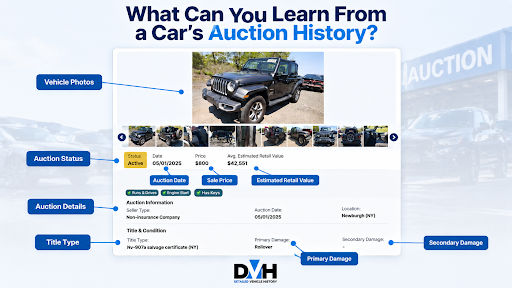
An auction record can provide useful information about what happened to a vehicle at a particular point in its past.
The exact information varies by record, but common details include auction dates, mileage, damage, sale status, prices, documents, vehicle condition, and photographs.
Auction Date
The auction date tells you when the vehicle appeared in the auction record. This becomes more useful when you compare it with other events.
For example:
Auction date → recorded mileage → later mileage → current mileage
This can help you understand the vehicle's timeline.
Odometer Reading
The auction record may show the mileage recorded when the vehicle was listed or sold. Compare that number with later mileage records and the mileage shown in the current listing.
For example:
| Event | First auction |
|---|---|
| First auction | 42,100 miles |
| Later record | 51,600 miles |
| Current listing | 67,200 miles |
The numbers should make sense chronologically. A mileage discrepancy deserves further investigation.
Damage Information
Auction records can contain primary and secondary damage information. Depending on the record, you may see descriptions such as:
- Front end
- Rear end
- Side
- Hail
- Flood
- Undercarriage
- Vandalism
- Fire
- Rollover
Damage descriptions should be read together with the auction photos and other vehicle records. A damage label alone doesn't tell you the full extent of the damage or the quality of any repairs that happened later.
Auction Photos
Historical auction photos can be particularly useful because they show the vehicle as it appeared when it was at the auction.
You may be able to compare those images with current photographs to identify changes in:
- Body panels
- Bumpers
- Headlights
- Wheels
- Windows
- Interior
- Dashboard
- Engine compartment
- Other visible components
Sale Status and Price
The record may show whether the vehicle sold and, when available, the final sale price or bid.
This can provide useful historical context, but don't treat the old auction price as the vehicle's current market value.
The vehicle may have been repaired, transported, modified, or sold again after the auction. Auction fees, transportation, repairs, taxes, and other costs can also affect the eventual price paid by a later buyer.
Title or Sale Documents
Available documents can provide additional context about the vehicle's status at the time of the auction.
Pay attention to information indicating a salvage, rebuilt, junk, flood, or other branded title when such information appears in the record.
Run & Drive Information
Some auction records indicate whether the vehicle was described as running and driving at the time of the auction.
Treat this as a historical condition indicator, not a guarantee of the vehicle's current mechanical condition. A vehicle that was listed as "Run & Drive" years ago could have developed mechanical problems since then.
Repair Cost or Vehicle Value
Some auction records include an estimated repair cost or vehicle value.
These numbers can help you understand why the vehicle was handled a certain way at the time, but they should not automatically be treated as a current repair estimate or current market value.
READ ALSO: Eliminate Uncertainty Surrounding Auction Export Cars
Is a Car That Was Sold at Auction Bad?
Not necessarily.
A previous auction sale is not enough information to determine whether a vehicle is good or bad. A dealer's trade-in and a heavily damaged insurance vehicle can both appear in auction records, but they have very different histories.
Instead of asking only:
"Was this car sold at auction?"
Ask:
"Why was it sold, what condition was it in, and what happened afterward?"
Pay particular attention to:
- The type of auction
- Damage information
- Historical auction photos
- Odometer readings
- Title or sale documents
- Sale status and price
- Subsequent vehicle history
- Current physical condition
If the auction photos show significant damage, for example, the next question is whether the vehicle was properly repaired.
Likewise, if the auction record shows no damage and the vehicle was simply part of a dealer or fleet sale, the auction event may be less concerning.
The important thing is to investigate the record itself rather than treating the word "auction" as a conclusion.
Red Flags to Look for in a Car's Auction History
An auction record becomes more useful when you know what details deserve extra attention.
Major Damage in Historical Photos
Photos showing substantial damage deserve careful review, particularly when the current vehicle looks completely different.
Compare the old photographs with the current vehicle from the same angles where possible.
Mileage That Doesn't Follow a Logical Timeline
Compare the mileage recorded at every available auction event with later records. A reading that decreases unexpectedly or changes in a way that doesn't fit the vehicle's timeline should be investigated further.
Multiple Auction Appearances
A VIN appearing in multiple auction records isn't automatically a problem. However, repeated appearances can give you more information to investigate.
Compare:
- Dates
- Mileage
- Damage
- Photos
- Sale status
- Prices
- Locations
You may discover that the vehicle was relisted, sold more than once, or moved through different stages of the wholesale or salvage market.
Serious or Repeated Damage
Pay close attention when auction records show significant damage or different types of damage across multiple events.
For example, a vehicle with an earlier front-end damage record and a later record showing additional damage deserves closer investigation.
Title or Document Issues
Look at the available title or sale documents and compare them with what the seller currently tells you. A branded title, salvage designation, flood designation, or other significant document information should not be ignored.
Historical Information That Conflicts With the Current Listing
This is one of the most important things to look for.
Suppose a seller describes a vehicle as:
"Never damaged."
But the historical auction record contains photographs showing substantial front-end damage. That's a reason to ask the seller for an explanation and investigate the vehicle further.
Likewise, if the current listing shows 62,000 miles but an older record shows 70,000 miles, don't ignore the discrepancy.
An auction history doesn't tell you automatically what happened. It gives you information that you can investigate.
Conclusion on Car Auction History
Checking a car's auction history can give you a clearer picture of what happened before it reached the current seller. Search the VIN, review any available auction records and photos, and compare them with the car's current condition before making your decision.
If you want to check a vehicle, you can look up its auction history by VIN with Detailed Vehicle History.
How do I know if my car was previously sold at an auction?
You can tell if a vehicle was previously sold at auction by searching the vehicle's VIN through an auction-history lookup. If a matching record is available, you can review the auction date and other available information such as mileage, damage, sale status, price, documents, and historical photos.
Can I check auction history using a VIN?
Yes. The VIN is one of the most useful identifiers for finding a vehicle's auction history because it identifies the specific vehicle. Many auction-history services, including Detailed Vehicle History, allow users to enter a 17-character VIN to search historical auction records.
Can I check auction history without a VIN?
Sometimes. Some auction archives also support searches using an auction lot number, while others allow browsing by license plate, make, model, or other vehicle information.
However, a VIN is generally the most reliable starting point when you're investigating one specific vehicle. With Detailed Vehicle History, you can check auction history using the VIN or license plate.
Does being sold at auction mean a car has a salvage title?
No. Vehicles are sold through many types of auctions. A car can be sold through a dealer or wholesale auction without having a salvage title. Insurance and salvage auctions are more closely associated with damaged or total-loss vehicles, so the type of auction and available title information matter.
Why would a clean-title car be sold at an auction?
A clean-title vehicle can be sold at auction for many ordinary reasons. For example, a dealer may sell a trade-in through a wholesale auction, or a fleet or rental company may dispose of an older vehicle.
Can I see how much a vehicle sold for at auction?
Yes, you can see how much a vehicle sold for at auction if the records contain a final sale price or bid. Some auction archives specifically provide final bids and sale prices for completed lots.
However, a final auction bid is not the same as the vehicle's total cost to the buyer or its current market value.
Can I find old Copart auction photos by VIN?
Yes, you can find old Copart auction photos for a VIN through an auction-history lookup.
Enter the VIN and look for a matching Copart record and its available historical images. Auction archives commonly organize photos alongside the VIN, lot number, damage, mileage, and sale information.
Can I find IAA auction history by VIN?
Yes, where IAA auction records for the VIN are available in the database being searched. Some auction-history services specifically index IAA records and allow users to search by VIN or lot number.
How far back does vehicle auction history go?
There is no single time period that applies to every vehicle. The available history depends on the records collected by the database, the auction, the vehicle, and the age of the available records.
A lookup showing no historical auction record should therefore be understood as no matching record found in the available data, rather than proof that the vehicle was never auctioned.
Why does my car have multiple auction records?
A vehicle can appear at an auction more than once for different reasons.
For example, it may have been:
- Listed but not sold
- Relisted
- Sold and later resold
- Moved between dealers
- Sent through different auction events
- Re-entered the market after repairs
Compare the date, mileage, damage, photos, and sale status for each record to understand what changed.
What does "sold at auction" mean on a vehicle history report?
It means the vehicle has a recorded auction event associated with its VIN. The phrase alone does not tell you why the vehicle was auctioned or whether it was damaged.
Look at the details surrounding the event, including the auction type, damage, mileage, title or sale documents, photographs, and sale information.
Frequently Asked Questions About Car Auction History

About Adewale Peter
39 articles published
Peter, a versatile writer specializing in automotive content, has thrived as Detailed Vehicle History's brand journalist. With over 8 years of writing experience, he has excelled in the creation of engaging, reader-centric content, including book formatting for Amazon Kindle and making sleek PowerPoint slides. He is very passionate about researching and penning inspiring and informative blogs and articles as he strives to keep improving and giving his best.