Free vs. Paid VIN Auction Photo Checks: What Do You Really Get?
 Adewale PeterOct 9, 2026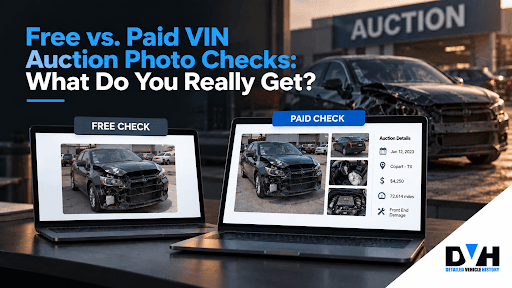
If you've started researching a used car's past, you've probably typed some version of "free auction photo lookup by VIN" into Google and found a handful of free tools that will show you photos of a vehicle from its time at a salvage or insurance auction. These tools are real, they work, and for a quick gut check, they can be genuinely useful.
But "free" and "complete" are not the same thing. Before you decide a car is safe to buy based on a free photo lookup, it's worth understanding exactly what these tools show you and, just as importantly, what they leave out.
Key Takeaways
- Free auction photo lookups can be useful for a quick check, but they may only cover certain auction sources and records.
- No auction photos does not mean a car has no auction history, since records can be missing, unavailable, or outside a tool's coverage.
- A paid vehicle history check gives you more context, including auction records, title information, damage, mileage, ownership, and other available history.
What Free Auction Photo Lookup Tools Actually Do
Free VIN-to-auction-photo tools generally work the same way: you enter a 17-character VIN, and the tool checks it against a database of vehicles that have passed through one or more salvage auction networks, most commonly Copart and IAAI, the two largest insurance and salvage auction operators in the U.S.
If a match is found, you'll typically see:
- Photos taken at the auction (exterior, interior, sometimes engine bay)
- The primary and secondary damage type listed at auction
- The odometer reading recorded at the time of sale
- The final sale price or bid amount
- The auction location and sale date
For a car that's clearly been through a total-loss event, this can be genuinely eye-opening, especially if a seller has described the car as "clean" or "no accidents."
A set of auction photos showing crumpled body panels or water lines on the upholstery tells a very different story than a polished listing photo.
Quick tip: You can get a free auction photo lookup with Detailed Vehicle History.
Where Free Lookups Fall Short
Here's the catch: a free auction photo tool is answering one narrow question: "was this VIN ever listed at a salvage auction, and if so, what did it look like?" That's useful, but it's not the same as knowing whether a car is safe to buy. A handful of real limitations show up consistently across free tools:
1. They usually cover one or two auction sources, not the whole picture.
Most free lookups pull exclusively from Copart and IAAI. That covers a huge share of salvage and total-loss vehicles, but not all of it. Dealer auctions, manufacturer buyback auctions, and public/government auctions often aren't included.
A car with zero results on a free Copart/IAAI lookup hasn't necessarily avoided every auction. It may just have sold somewhere the tool doesn't cover.
2. A "no results" match doesn't mean "no history."
This is the biggest trap. Because free tools only search one or two databases, a clean-looking result can create false confidence.
Buyers sometimes treat "nothing found" as proof the car is clean, when it may simply mean the auction record exists elsewhere, was recorded under a slightly different VIN entry, or predates the tool's coverage window.
3. Auction photos alone don't confirm title status.
Seeing damage photos from an auction is not the same as knowing how that damage was ultimately titled. Some vehicles are repaired and re-titled as "rebuilt," others stay branded "salvage," and title rules vary significantly by state.
A photo lookup shows you the moment in time. It doesn't tell you what happened to the title afterward or whether that brand carried over correctly when the car crossed state lines (a common way title-washing happens).
4. There's no cross-referencing with accident, ownership, or mileage records.
This is where free tools are most limited. A full vehicle history draws on multiple record types, accident and insurance claim data, prior ownership changes, mileage readings from services and inspections over time, open recalls, and lien records, and checks them against each other.
A free auction photo tool checks none of that. So even if the auction photos look "fine," the same VIN could have an accident on record that never went through a salvage auction at all, or a mileage inconsistency that only shows up when auction mileage is compared against other recorded readings.
5. Coverage windows and update frequency vary.
Some free databases update daily; others lag. If a vehicle was sold at auction recently, there's a real chance it hasn't been indexed yet by every free tool, especially smaller or newer ones.
A Simple Way to Think About It
A free auction photo lookup answers: "Do I have a photo of this car from an auction?"
A full vehicle history report answers: "What do I actually know about this car's past, accidents, title brands, mileage consistency, ownership changes, recalls, liens, and auction activity, all checked against each other?"
If a seller's story and a free auction photo already don't match, that's a red flag worth taking seriously on its own. But if the free lookup comes back with nothing, that's exactly the moment to dig further rather than relax. A clean result from a single-source, photo-only tool isn't the same as a clean bill of health.
What a Paid Auction Check Gives You That Free Lookups Don't
A paid auction check is useful when you need more than a quick photo search. Instead of simply asking whether an auction record exists, you can examine the details surrounding the event and see how it fits into the vehicle's history.
For example, the Detailed Vehicle History auction section can include:
- Auction date and location
- Auction status
- Sale price
- Odometer reading
- Seller type
- Title type and sale documents
- Primary and secondary damage
- Runs & Drives status
- Engine Start information
- Keys information
- Estimated retail value
- Auction photos when available
That extra information can change how you interpret the same VIN.
See More Than the Auction Photos
Photos can show you what happened to the vehicle, but the information around those photos helps explain what you're looking at.
A damaged bumper in an auction photo means something different when the report also shows the auction date, primary damage, title type, seller, and sale details.
You can compare those details with the vehicle's current condition instead of judging the old photos on their own.
Check the Vehicle's Title Information
A paid report can also show title information associated with the auction record.
This matters because an auction photo can show that a vehicle was damaged, but the title information can tell you more about how that vehicle was documented at the time.
For example, a report may show a salvage title or another title brand alongside the auction record. That gives you something concrete to investigate before buying.
See the Reported Damage
The auction section can separate primary and secondary damage, giving you more detail than a photo alone.
You can then compare the damage description with the actual auction photos.
If the report lists front-end damage, for example, you can go through the photos and see whether the hood, bumper, headlights, fenders, or other visible areas were affected.
Check What the Auction Recorded About the Vehicle's Condition
Some auction records contain condition indicators such as Runs & Drives, Engine Start, and Has Keys.
These details give you more context about the vehicle when it was at the auction. They are historical indicators, though, and shouldn't be treated as a guarantee of the vehicle's current mechanical condition.
See How the Auction Fits Into the Bigger History
This is where a paid vehicle history report becomes more useful than a standalone photo archive.
You can compare the auction event with other available records, including accidents, mileage records, title events, and ownership information.
For example, if an auction record shows 48,000 miles, you can compare that number with other mileage records before and after the auction. If the auction occurred shortly after a reported accident, you can also see how those events fit together chronologically.
The goal isn't simply to find an old photo. It's to understand what happened to the vehicle.
What Does a Detailed Vehicle History Auction Report Show?
When you run a VIN through Detailed Vehicle History, the auction section is designed to give you more context around the vehicle's recorded auction activity.
You can see the available auction events and review details such as the date, price, location, seller, title information, damage, mileage, condition indicators, and auction photos.
That means you can move from:
"This VIN has an auction record."
to:
"This is when it happened, where it happened, what damage was reported, what the vehicle looked like, what title information was recorded, and what was documented about its condition."
That distinction matters when you're about to spend thousands of dollars on a used car.
Free vs. Paid Auction Checks: What Should You Use?
It doesn't have to be one or the other.
A free lookup can be a useful first step when you're casually researching a vehicle and want to see whether auction photos or a basic record exist.
A paid check makes more sense when you're seriously considering the vehicle and want more information before committing your money.
The Bottom Line on Free vs. Paid Auction Photo Lookups
A free auction photo lookup can tell you something about a car's past. A paid check can give you more of the context needed to understand what that information actually means.
If you're just curious about a VIN, start with a free search. If you're seriously considering buying the vehicle, look beyond the photos and review the full auction record with a vehicle history report before you make an offer.
FAQs About Free and Paid Auction Photo Lookups
Can I check auction photos for free using a VIN?
Yes, there are free tools out there where you can view free auction photos. Some tools let you enter a VIN and view available auction photos and basic auction details for free. Coverage varies by tool and auction source.
Does a free VIN lookup show all auction history?
No. A free lookup may only search certain auction databases or provide limited records. A vehicle can have auction history that does not appear in a particular free search.
Does no auction history mean the car was never sold at auction?
No. A "no results" search only means the tool did not find a matching record in the sources it checked. It does not prove the vehicle has never been through an auction.
Why do I need a paid auction history check?
A paid check can provide more auction records and supporting details in one report. Depending on the available data, this can include title information, damage details, auction status, mileage, seller type, condition details, and historical photos.
Can auction photos tell me if a car is safe to buy?
No. Auction photos can show how the vehicle looked at a specific point in its history, but they do not confirm its current mechanical condition or the quality of repairs. A physical inspection is still important.
Can auction photos show previous damage?
Yes. Auction photos can show visible damage that may no longer be obvious on the vehicle today. Comparing those photos with the car's current condition can help you spot major repairs or changes.
Is a paid vehicle history report better than a free auction photo lookup?
They serve different purposes. A free lookup can be useful for a quick check for auction photos, while a paid vehicle history report can provide a broader set of records and more auction details.
About Adewale Peter
40 articles published
Peter, a versatile writer specializing in automotive content, has thrived as Detailed Vehicle History's brand journalist. With over 8 years of writing experience, he has excelled in the creation of engaging, reader-centric content, including book formatting for Amazon Kindle and making sleek PowerPoint slides. He is very passionate about researching and penning inspiring and informative blogs and articles as he strives to keep improving and giving his best.