Where Is the VIN on an RV? Complete RV VIN Location Guide
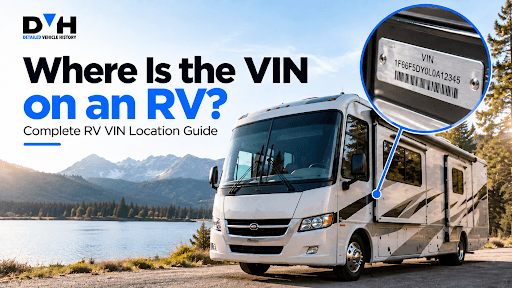
Summary: Finding an RV's VIN depends on what kind of RV you have. A Class A, B, or C motorhome usually follows automotive VIN placement, while travel trailers and fifth wheels put the VIN on the frame, hitch area, or exterior certification label.
If you're standing in front of an RV and can't see the VIN right away, don't worry. There are several places to check, and the best location changes between motorhomes and towable RVs.
This guide walks you through the most common VIN locations for each type. Once you have it, you can compare it against the paperwork and use it to check the RV's available history.
Where Is the VIN on a Motorhome?
Motorhomes have a chassis and a coach body, so you may find identification in more than one location.
The easiest places to check are the driver's-side dashboard, driver's door jamb, chassis or frame, and engine compartment.
1. Check the Driver's-Side Dashboard
Look through the windshield at the lower driver's-side corner of the dashboard.
This is one of the first places to check because the VIN is commonly displayed where it can be read from outside the vehicle.
If you're standing outside the motorhome, look through the windshield near the driver's-side pillar.
Why Start Here?
You don't need to open anything or crawl under the vehicle. If the VIN is in the standard dashboard location, you should be able to see the plate or label from outside.
2. Check the Driver's Door Jamb
Open the driver's door and inspect the door jamb and surrounding frame. Look for a certification label, VIN plate, or other identification label.
Forest River, for example, documents door-jamb VIN locations on certain Class B and Class C motorhomes.
3. Check the Firewall and Engine Compartment
If you don't find the VIN inside the cab, check under the hood. Some motorhomes have a VIN tag attached to the firewall or framing in the engine compartment. Coachmen specifically lists firewall and under-hood framing locations for motorized RVs.
4. Check the Cockpit and Interior Living Area
Some motorhomes place the VIN or vehicle identification tag inside the living area, such as on a cockpit sidewall, behind the driver's seat, inside a cabinet, or near the entry area. The exact location varies by manufacturer and model.
READ ALSO: What is VIN Cloning: What is it and How to Protect Yourself?
Where Is the VIN on a Travel Trailer?
Travel trailers don't have a dashboard, so you'll need to look toward the front of the trailer.
Start with the A-frame, tongue, front frame, and Federal Certification Label.
1. Check the A-Frame or Trailer Tongue
Look around the front of the trailer where the tongue connects to the main frame.
Some manufacturers stamp the VIN directly into the A-frame or attach a metal tag there. Forest River specifically lists the top of the A-frame as a possible VIN location on travel trailers.
2. Check the Front Frame Near the Hitch
Inspect the frame around the hitch and tongue-to-frame connection. The VIN can be stamped into the metal or displayed on a plate or tag.
3. Check the Federal Certification Label
This is one of the most useful places to check on a towable RV.
NHTSA requires trailer certification labels to be placed on the forward half of the left side of the trailer, where they can be easily read from outside.
So, stand on the driver's side of the trailer and inspect the forward section.
What Does the Certification Label Show?
The certification label contains important vehicle information, including the VIN and manufacturer information.
If you're having trouble finding a separate VIN plate, look carefully for this label.
4. Check the Front-Left Exterior Wall
Inspect the lower front section of the trailer's roadside wall. On many towable RVs, this is where the certification label can be found.
Where Is the VIN on a Fifth Wheel?
A fifth wheel uses a pin box rather than a conventional trailer tongue, so its VIN locations are slightly different.
Start with the pin box, front frame, front-left certification label, and entry area.
1. Check the Pin Box
Look around the pin box and its frame.
Forest River lists the pin box frame as one location where the VIN can be stamped on fifth wheels.
Make sure you're looking at the actual frame and not just the adjustable components.
2. Check the Front Frame
Inspect the metal frame around the front of the fifth wheel.
Look for:
- Stamped VIN characters
- Metal identification tags
- VIN plates
- Manufacturer labels
3. Check the Federal Certification Label
Look on the front-left side of the fifth wheel.
The trailer certification label is required on the forward half of the left side, making this an important place to check.
4. Check the Entry Door Area
Some manufacturers place identification near the entrance.
Forest River, for example, lists the entrance door frame as another possible fifth-wheel VIN location.
5. Check Interior Cabinets
If you still haven't found it, inspect cabinet doors and other interior areas. Some fifth wheels have identification information inside cabinets or near the entry area.
READ ALSO: Complete List of VIN Country Codes
Where Is the VIN on Other Towable RVs?
Here’s where to check for other towable RVs:
Pop-Up Campers
For a pop-up or folding camper, check the tongue, A-frame, and side frame rails. The VIN may also appear on an exterior identification plate or label.
Toy Haulers
Toy haulers generally follow the same VIN placement patterns as other towable RVs. Check the front-left exterior certification label, tongue or A-frame, frame rails, and entry area.
Check Secondary Locations
If you don't find the VIN in the obvious exterior locations, inspect:
- Entry door frame
- Cabinet doors
- Storage compartments
- Frame near the propane tanks
- Support bars near the front or rear
What If You Can't Find the VIN on Your RV?
Don't assume the RV doesn't have a VIN simply because the first location you checked was empty.
Check the Title and Registration
Your title and registration should contain the VIN associated with the RV. Use them to verify any VIN you find on the vehicle.
Check Your Insurance Documents
Your insurance documents can also contain the VIN. This gives you another number to compare against the vehicle itself.
Check the Owner's Manual
The owner's manual may identify the VIN location for your specific make and model. Just ensure you take some time to read through the owner’s manual properly to find the VIN location.
Contact the RV Manufacturer
If you still can't find the VIN, contact the manufacturer or an authorized dealer.
Give them the RV's:
- Make
- Model
- Year
- Type
They can help identify the appropriate location.
Why Should You Check an RV VIN Before Buying?
Finding the VIN gives you a way to compare the physical RV with its paperwork and available history.
Verify the RV's Identity
Compare the VIN on the RV with the title, registration, and insurance documents. If they don't match, investigate before moving forward.
Check the RV's History
You can use the VIN to search available vehicle history records, which can include accident and damage records, title brands, theft records, and mileage information.
Check for Mileage Inconsistencies
Compare mileage readings recorded at different points in the vehicle's history. A difference between the current odometer and previous records deserves further investigation.
Check for Title Problems
A history search can show available title information, including brands such as "salvage" or "rebuilt."
Check for Recalls
The VIN can also be used to check recall history and identify vehicle recalls.
Found the RV VIN? Check Its History
Once you've found and verified the VIN, you can use an RV VIN lookup to check the RV's available specifications and history before buying.
The important part is to use the full VIN, not a partial number or another serial number.
Frequently Asked Questions About RV VINs
Where is the VIN on an RV?
On a motorhome, the VIN is commonly found on the driver's-side dashboard or door jamb. On travel trailers and fifth wheels, check the front-left certification label, frame, A-frame, or pin box area. The exact location depends on the manufacturer and RV type.
Where is the VIN on a Class A motorhome?
Start by checking the driver's-side dashboard through the windshield. You can also check the driver's door area, chassis, frame, and engine compartment.
Where is the VIN on a Class B or Class C RV?
Check the driver's-side dashboard and door jamb first. Some manufacturers also place additional identification under the hood or on the chassis. Forest River, for example, lists specific locations for Class B and Class C models.
Where is the VIN on a travel trailer?
Check the front-left exterior area, A-frame, tongue, and certification label. Forest River documents several possible locations, including the top of the A-frame and entrance door frame.
Where is the VIN on a fifth wheel?
Start with the front-left certification label and pin box frame. You can also check the entrance door frame and lower front compartment frame.
Can an RV have more than one identification number?
Yes. An RV can have identification associated with its chassis and coach portion. This is particularly important with motorhomes because the chassis can come from one manufacturer while the completed RV is built by another.
What if I can't find the VIN on my RV?
Check the title, registration, insurance documents, owner's manual, and other VIN locations on the RV. If you still can't locate it, contact the manufacturer or an authorized dealer for the correct location.
Is an RV serial number the same as a VIN?
Not necessarily. Some RV manufacturers use serial numbers alongside the VIN. If you're checking the RV's history, use the complete VIN associated with the vehicle.

About Adewale Peter
42 articles published
Peter, a versatile writer specializing in automotive content, has thrived as Detailed Vehicle History's brand journalist. With over 8 years of writing experience, he has excelled in the creation of engaging, reader-centric content, including book formatting for Amazon Kindle and making sleek PowerPoint slides. He is very passionate about researching and penning inspiring and informative blogs and articles as he strives to keep improving and giving his best.