
Ferrari VIN Decoder for Modern & Classic Car
In the market to purchase a used Ferrari? You cannot just buy without checking the background and history. Use the Ferrari VIN decoder to get model year, trim, engine, transmission, body style production details and more!
Table of Contents:
What Will You Get From the Ferrari VIN Decoder?
Decoding the VIN helps you to make sure the vehicle matches your needs and budget. Thus, it helps with avoiding mismatched listings and helps with setting the right price in accordance with its MSRP.
- Manufacturer and origin
- Model, trim, and package details
- Engine specifications
- Transmission setup
- Body style
- Model year
- Production plant
- Manufacturer Suggested Retail Price (MSRP)
- Market Value
How to Decode the Ferrari VIN
Decoding a Ferrari VIN is easy, as you just need to use our Ferrari VIN decoder service and get it done in less than a minute.
Step 1: Find the VIN
Check the engine bay, driver’s side doorjamb, or the vehicle’s paperwork to find the VIN.
Step 2: Fill out the Form
Click on the form and write any classic or modern Ferrari’s VIN. Then, click on the button to submit the form.
Step 3: Check the Vehicle Specs
Check the preview page to see the full vehicle’s specifications like engine, transmission, trims, MSRP, and the market value.
Where to Find the VIN on a Ferrari
Before decoding, you need to locate the VIN on your Ferrari. While placement is generally consistent, Ferrari models, especially hand-built or limited-production units, may have slight variations depending on the model and production year.
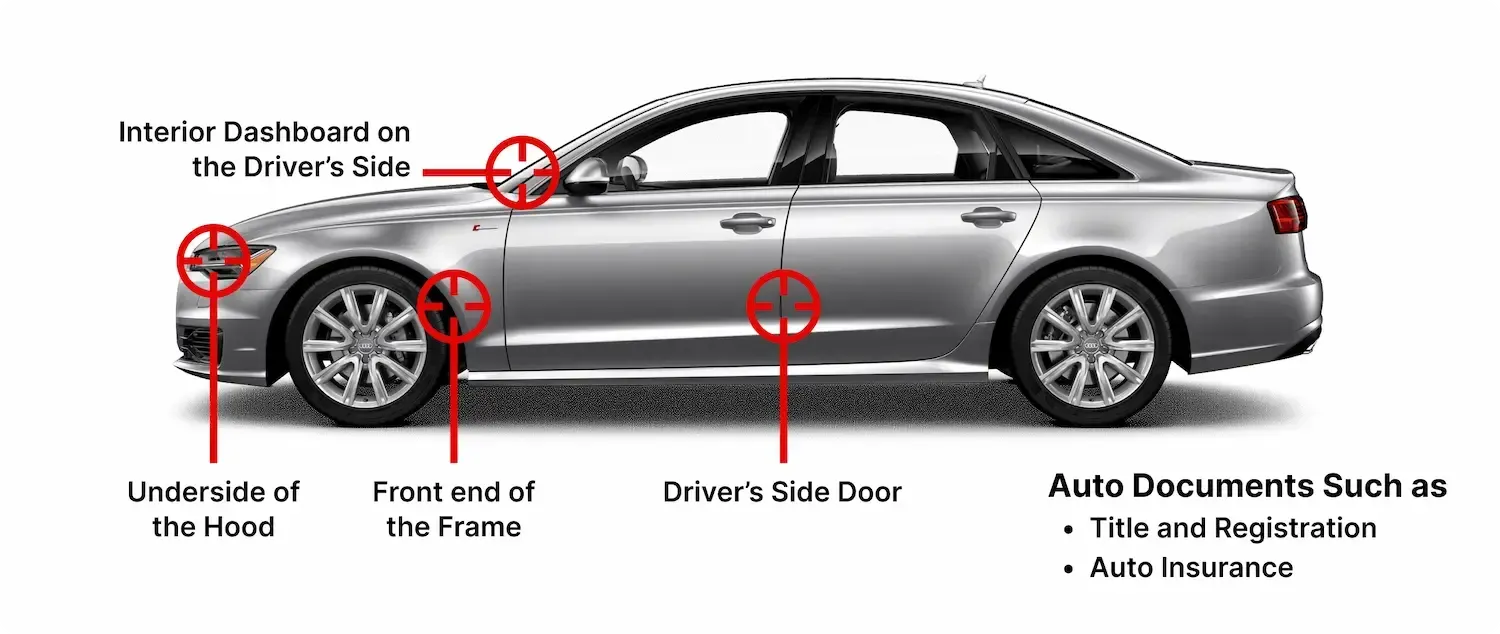
Ferrari VIN Location
The VIN is positioned in several key areas on the vehicle and within its official paperwork. Check the following locations to find it accurately.
Driver’s Side Dashboard
Look through the windshield at the lower corner of the dashboard on the driver’s side to locate the VIN plate.
Driver’s Side Door Jamb
Open the door and inspect the door frame or pillar for a label or metal plate near the latch area.
Engine Bay
Check the engine compartment for a stamped VIN, often found along the chassis frame, firewall, or near structural components, particularly important for mid-engine Ferrari models.
Documents
You can also find the VIN on official paperwork such as the registration, insurance documents, or vehicle title.
Classic Ferrari VIN Location
Classic Ferrari models may follow similar VIN placements, but due to their handcrafted nature, some vehicles include less common or model-specific locations.
Under the Floor Mat
On certain older Ferraris, the VIN may be stamped into the floor pan beneath the carpet, often on the passenger side.
Body Panels
Some classic Ferrari vehicles may carry VIN tags on panels like the hood, trunk area, or inner fenders, usually displayed on small plates or factory-applied labels.
Who Should Use a Ferrari VIN Decoder
A Ferrari VIN decoder is essential for anyone involved with a high-value or collectible vehicle. With bespoke configurations, limited production runs, and strong emphasis on provenance, verifying details through the VIN helps protect both investment and authenticity.
Buyers
Ferrari buyers need more than surface-level checks. A VIN lookup helps confirm factory specifications, ownership history, and records, ensuring the car matches its claimed configuration—especially important for rare trims, special editions, or heavily optioned builds.
Sellers
For Ferrari sellers, documentation directly impacts value. Using a VIN check allows you to present verified specs and history, support your asking price, and give buyers confidence that the car is properly represented and well-documented.
Dealers
Dealers handling Ferrari inventory rely on accuracy and speed. VIN decoding helps verify build details, avoid listing errors, and present transparent information to well-informed buyers in a highly competitive, detail-driven market.
Collectors
Collectors depend on precise data when evaluating a Ferrari. A VIN report helps confirm originality, production details, and whether the car retains its factory-correct configuration, factors that influence rarity, desirability, and long-term value.
VIN Length and Format
Today’s vehicles use a standardized 17-character VIN with a fixed structure applied worldwide. In contrast, older models often carry shorter VINs, typically between 5 and 14 characters, since there was no universal system before 1981.
VIN Length and Format
Today’s vehicles use a standardized 17-character VIN with a fixed structure applied worldwide. In contrast, older models often carry shorter VINs, typically between 5 and 14 characters, since there was no universal system before 1981.
Data Availability
Modern VINs are backed by extensive digital records, covering specifications, engine details, and production data. Classic VINs, however, depend on archived or manufacturer-specific records, which means the level of detail can vary significantly by model and year.
Decoding Accuracy
With standardized formatting and complete databases, modern VIN decoding is generally consistent and reliable. Classic VINs can be more complex to interpret due to inconsistent formats and gaps in historical records, but with our tool, you can decode any classic VIN.
Ferrari VIN Structure Breakdown
A VIN or Vehicle Identification Number is a 17-digit alphanumeric code used to identify a vehicle; hence, every model and trim has a different VIN number. Generally, a VIN is divided into three different categories: WMI, VDS, and VIS. Check the section below to check the VIN.
World Manufacturer Identifier (WMI)
Digit 1 to 3 = ZFF
- Z = Country of origin (Italy)
- FF = Ferrari
Vehicle Descriptor Section (VDS)
Digit 4 to 9 = 89FPA0
- 8 = Model line (V8 mid-engine platform)
- 89 = Model code (likely Ferrari F8 Spider)
- F = Body type/engine indicator
- P = Restraint/safety system type
- 0 = Check digit
Vehicle Identifier Section (VIS)
Digit 10 to 17: M0259265
- M = Model year (2021)
- 0 = Assembly plant in Maranello
- 259265 = Production sequence number
Why Decoding a Ferrari VIN is Non-Negotiable
Decoding a Ferrari VIN goes far beyond basic identification. In a market where provenance, originality, and specification drive value, the VIN is your gateway to verifying exactly what the car is and what it is not.
Before Buying a Ferrari
Ferrari models often feature bespoke options, limited production runs, and subtle spec differences that can significantly impact value. A VIN check helps confirm the exact configuration, ownership history, and condition, so you are not relying solely on what is being advertised.
Before Selling a Ferrari
When selling a Ferrari, documentation is everything. Decoding the VIN allows you to present verified specifications and history, making your listing more credible and helping justify your asking price to well-informed buyers.
Verify Ferrari Vehicle Identity
Ferraris are frequently subject to restorations, modifications, or even replica builds. A VIN check ensures the vehicle aligns with its original factory configuration, like engine, model, and production details.
Check History and Records
Review ownership timelines, accident history, and title data to understand the car’s past. For Ferrari, even minor incidents or gaps in records can influence desirability and long-term value.
Decode Ferrari Models by VIN Easily
Use our Ferrari VIN decoder tool to be able to decode its classic and modern VINs easily.
Modern Ferrari Models
We cover all the Ferrari models and trims.
Supported Classic Ferrari Models
We also support the VIN decoding process for all models and trims of classic Ferrari.
Want More Info About Your Ferrari? Get a Vehicle History Report
After decoding a Ferrari VIN, the report compiles detailed insights into the car’s build, history, and authenticity. In the Ferrari market, factors like provenance, originality, and specification play a major role in determining value and desirability.
Vehicle Specification
Access factory-issued details such as engine configuration, transmission type, production facility, and original MSRP. For Ferrari, this is essential to confirm the exact build spec, including optional extras and bespoke configurations that can significantly impact value.
Title Records
Review the title status for any issues such as salvage, rebuilt status, theft records, or inconsistencies. These factors can influence the vehicle’s market position and whether it can be resold or registered without complications.
Odometer Reading
Track mileage records over time to ensure accuracy and consistency. With Ferrari vehicles, mileage plays a critical role, and even small discrepancies can raise concerns about authenticity and usage history.
Accident and Damage History
Check for any reported accidents, structural repairs, or environmental damage. This helps determine whether the Ferrari maintains the performance standards and structural integrity expected from the brand.
Auction History
See if the vehicle has been listed or sold at auction, including sale dates, locations, and final prices. Some records may include images, offering a clearer view of the car’s previous condition and presentation.
Ownership Information
Review past ownership records, including the number of owners, regions, and duration. A well-documented ownership history strengthens provenance, which is a key factor in Ferrari valuation.
Recall Check
Identify any safety or performance recalls issued for the Ferrari. TIn this section, you’ll get the complete information like the date of recall, causes, how the issues were handled by the manufacturer, and the recall status (open/close).
Engine Information
Confirm engine type, configuration, and performance-related details. This helps ensure the vehicle still matches its original build and supports accurate comparisons when reviewing listings or checking for possible modifications.
Get More Ferrari Information Using Our Tool
If you want a complete picture before making a move, running a VIN check gives you access to specifications and historical data in one place—so you can move forward with confidence, not assumptions.
Ferrari Recall Check by VIN
Need to know if the car was recalled? Use the Ferrari recall by VIN to see its complete recall history in seconds.
Ferrari Window Sticker by VIN
Get the original Ferrari window sticker copy by using the VIN!
Electrified Ferrari Update
The electrified Ferrari began to take place shortly. The company has gradually expanded its hybrid technology before moving forward to its EV production, while maintaining its internal combustion engine.
First Full Electric Model (Elettrica)
Ferrari’s first fully electric production model, widely referred to as the “Elettrica,” is scheduled for its global debut in 2026. The vehicle is expected to feature advanced in-house-developed technology, including a high-performance multi-motor setup and a focus on maintaining Ferrari’s signature driving dynamics.
Platform and Technology Direction
The upcoming EV is built around Ferrari’s philosophy of in-house engineering, integrating key components such as motors, inverters, and battery systems developed specifically for high-performance applications.
Brand Strategy and Market Positioning
Ferrari has confirmed that its electric model will not replace combustion or hybrid vehicles but will instead sit alongside them. The brand will continue offering ICE and hybrid models well into the next decade to maintain a well-balanced portfolio.
FAQs About Ferrari VIN Decoder
Do Ferraris have VIN Numbers?
Yes, all Ferrari models built from 1980 onward use a standardized 17-digit VIN. You can find it on the dashboard (through the windshield), the steering column, or official documents. Earlier or rare models may use different formats.
Is there any other way to get a vehicle history report?
Yes, there are several ways to get a vehicle history report, from free basic lookups to detailed paid reports. For a complete record, use our VIN check service and access the full vehicle history for just $19.99.
How to look up classic car VIN numbers?
To check a classic car VIN, locate the stamped number on the dashboard, driver’s door jamb, or engine block. Vehicles built before 1981 often use shorter, non-standard VINs. To review specs, use our free VIN decoder tool.
Can you get the Ferrari build sheet through VIN decoding?
Yes, you can access a Ferrari build sheet and factory-installed options using a VIN decoder, especially through services focused on luxury vehicles. These reports include production dates, original colours, and installed features.
How to look up classic car VIN numbers?
For pre-1981 classic cars, find the 1 to 16-digit serial number on the driver’s door jamb, firewall, or engine block. Then use a specialised tool, such as Detailed Vehicle History’s classic VIN lookup, to decode the information.